Private Equity
Market Trends
North America
The PE Playbook: Death Services
Understand the key private market trends shaping the death services industry - growth segments, M&A, and top roll-up strategies.




This is piece three of a six-part series on AI, data, and private market intelligence. Read piece one here and piece two here.
Most deal teams have done some version of market mapping. They've used an LLM to generate a company list, organized it by segment, and run with it. While that might be a solid starting point, it’s far from a complete picture of the market.
Full market visibility means seeing every relevant company in a space, including the founder-owned businesses that have never raised capital and never appeared in a deal database. To get there, you need a foundation of verified, proprietary, data built specifically for M&A.
In this article, we break down where most market maps fall short, what complete market maps actually look like, and how to build them.
Incomplete market maps inevitably cause problems in each stage of the dealmaking process that follows. They lead to incorrect fragmentation analysis, missed opportunities, and passing the competitive advantage to competitors.
Deal teams that rely on generic LLMs for market mapping are in for trouble. Tools like Claude and ChatGPT can provide well-known names that show up in prominent industry articles. But nearly half of companies that get acquired are bootstrapped at the time of acquisition. They have no VC backing, no PE sponsor, and little — if any — press coverage before the deal. They exist in the private market generating revenue, building value, and approaching readiness to transact, and they are invisible to every model trained on public data.
This is because a significant portion of the most valuable private market intelligence exists in the world, not on the internet. Think: financial filings locked in scanned PDFs at European national registries, valuations that private companies never publicly report, and conference attendee lists that require registration or physical presence to obtain.
Accessing this kind of intelligence requires the infrastructure, relationships, and operational investment that takes years to build.
A complete market map has six components:
A complete map includes every relevant company — private, public, sponsor-backed, founder-owned, regional, and niche. Don’t worry too much about filtering at this stage. The best platform in a fragmented market is often not the largest company; it may be a regional operator with defensible density and a founder preparing to retire. Filtering too early means you might never see it.
An actionable map organizes companies by the criteria that drive decisions, such as customer type, service line, business model, geography, and revenue model. Relying purely on NAICS codes is insufficient. For example, a cybersecurity map that lumps managed detection & response together with identity access management & compliance automation produces noise rather than a thesis.
Each company in the map should carry an ownership classification. That field determines what action to take. A sponsor-backed platform may be a buyer for add-ons. A founder-owned business in the same segment may be a direct outreach candidate. Without ownership context, a prioritization decision is a guess.
Revenue estimates, employee counts, growth indicators, and transaction history belong in every priority record. Without using a private market intelligence platform like Grata, private company financials are hard to source with any degree of precision, but even directional estimates change where a company sits in the market map. The difference between a 40-person operator and a 250-person operator with multiple facilities is the difference between an add-on and a platform conversation.
Hiring patterns, executive changes, geographic expansion, trade show presence, new product lines, and M&A activity are indicators that a company is approaching an inflection point. That could be scaling, preparing for a transition, or entering a new phase of growth.
Acting on timing signals before they become visible to the broader market drives proprietary deal flow. Grata’s Seller Intent proprietary data is designed to help teams identify companies preparing to sell, 6–12 months before a transaction reaches the market. It monitors aggregated, anonymized research at scale to flag companies that are actively in the early stages of exploring a sale. Learn more here.
A complete map captures executives, owners, board members, advisors, intermediaries, and existing CRM connections for priority targets. A company without a clear relationship path requires a different outreach strategy than one where a known advisor worked on a prior transaction in the sector. Knowing the path before you start allows you to act faster.
Knowing what a complete market map requires is one thing — building one is another. Here's how successful deal teams approach the process:
Start with the investment or acquisition thesis rather than an industry category. Define boundaries by customer type, use case, geography, business model, and size range.
Good segmentation turns discovery into strategy. It tells you which subsegments are fragmented, which are consolidating, which are overpriced, and which are overlooked.
The narrower the definition, the more useful the map — and the more likely it is to surface companies that broader searches miss. Poor market definition at this stage creates a false sense of coverage that persists through the entire sourcing workflow.
Start with what you know: companies from prior deals, public comps, banker knowledge, portfolio company references, and search results. Add companies from precedent transactions and keyword searches. Don't filter aggressively at this stage. The goal is to establish a base layer, and it helps to track the source of each company. You'll want to know later whether your methodology had systematic gaps. This is a first pass, not a final list.
This is where the most interesting opportunities live, and where most market maps stop short. Search by use case, customer language, product descriptions, geographic markers, and adjacent categories. Look beyond companies with polished websites or known funding.
A founder-owned compliance services firm may not use the exact industry keyword investors use to describe the space, but it may surface through customer language, certifications, or service-line descriptions.
Add ownership type, revenue estimates, employee count, growth signals, funding history, transaction history, contact data, and relationship paths. This step refines where a company sits in the map. Two companies with nearly identical descriptions can belong in entirely different categories once you determine that one is sponsor-backed and acquisitive while the other is founder-owned and succession-ready.
Review your map’s segments and identify which ones are the most likely to produce investible opportunities. Here is a common framework that dealmakers use:
Assign a status to every company in your priority markets: pursue now, monitor, add-on candidate, buyer candidate, or exclude. Prioritize by thesis fit, ownership, scale, growth, relationship access, and timing signals. Then connect the map to a CRM or pipeline management system to convert your research to action. This way, when a signal changes on a company you've been monitoring, you’re prepared to reach out.
A complete market map allows a PE team to determine if a space is large and fragmented enough to support a platform strategy, and if there are enough add-ons to create value.
A PE firm evaluating veterinary services, for example, needs to map independent clinics, regional groups, PE-backed platforms, specialty providers, and recent acquirers. Then, it should assess whether the remaining independent universe supports a new platform thesis or whether the market is already too consolidated. Without a complete map, the answer to that question is guess work.
For bankers, a complete market map is a credibility asset. When a banker presents a buyer list, the quality of that list signals to the founder or management team how well the banker understands the market.
Any banker can produce names of the obvious strategics and the most prominent PE sponsors is a generic response. A list that includes adjacent consolidators, emerging platforms, sponsors with relevant sector history, and acquirers who've done comparable transactions is a different story. That’s the list that wins mandates and justifies fees.
Corp dev teams use market maps to justify a strategy internally, not just identify a target. They need to explain why this market, why this target, why now, and whether there are alternatives if the preferred deal falls through.
For example, a public software company evaluating an entry into compliance automation might find through a complete market map that the mature platforms are prohibitively expensive, but that several vertical-specific compliance tools represent viable tuck-in acquisitions at a fraction of the cost.
For BD teams, a complete market map becomes the first outbound sequence.
Here’s an example. A BD analyst working a fragmented industrial services market filters for founder-owned companies with:
That filtered list becomes the basis for targeted, credible outreach to the companies that fit the thesis and show signs of readiness.
A skilled analyst might be able to manually identify and research 50 to 75 companies in a niche industry. That list not only takes significant time to produce, it also likely overlooks the most interesting opportunities in the space. AI changes the game — when it has a strong foundation of verified deal intelligence.
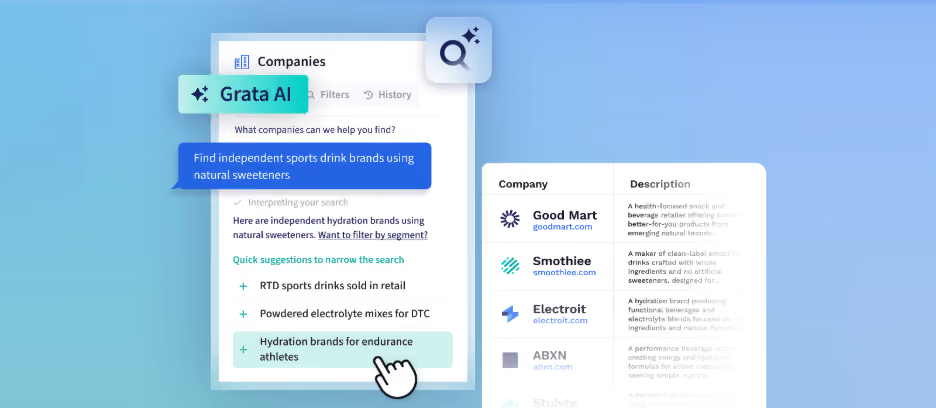
Purpose-built private market intelligence platforms like Grata enable deal teams to dig deeper and move faster. For example, Grata’s Agentic Search allows dealmakers to describe exactly what they’re looking for and surface structured, relevant lists in seconds. Agentic Search also provides guided suggestions and follow-up prompts to help users dig deeper into their search, develop their thesis, surface new opportunities, and think more strategically.
Most market mapping failures don't announce themselves. They're quiet. The team finishes the map, moves to outreach, and never realizes what they didn't see.
General LLMs only have access to public data. Claude or ChatGPT might give you a list that looks complete, but they will only capture companies that have some kind of public, online presence. That’s a snippet of the market. You need the whole thing.
Broad industry codes produce generic, noisy markets. The narrower the definition, the more useful the map — and paradoxically, the more likely it is to surface companies that wider searches miss.
A market map built in January for an IC in March is stale before it's used. Companies change. Ownership transfers. Executives leave. Expansion signals emerge. A map without a refresh cadence creates a false sense of confidence.
A market map that never connects to a CRM or pipeline workflow is just research. Research alone doesn't generate deals. The map has to drive outreach.
Grata is designed to provide private market dealmakers with full visibility into their industries. It does this with verified, investment-grade deal intelligence and proprietary, comprehensive AI workflows.
Grata’s AI reads and synthesizes public and proprietary sources just like a human analyst would to provide investment-grade data. The process is broken down into three layers:
The first layer is Foundational Intelligence, Grata’s proprietary synthesis. This is where we combine public data with purpose-built, verticalized AI and validation from our best-in-class research team.
Grata's suite of AI agents read millions of company websites in the same analytical way that an M&A professional would. Because our AI is backed by deep in-house human expertise and exclusive training data, it’s able to analyze frequency, patterns, navigation flows, word combinations, and conceptual signals.
All of this is synthesized with expert research and consistently verified by our data scientists to provide proprietary and opinionated perspectives on which data is accurate.
The next layer is Private Access. The data we capture here would be extremely difficult for dealmakers to find on their own, because it comes from non-public sources, such as web pages that are not indexed and materials hidden behind registrations.
Grata’s AI agents comb through proprietary and offline sources to aggregate data that dealmakers need to make decisions, including:
In cases where precise data doesn’t exist in any single source — like estimated revenue, industry classification, or business model — our AI agents generate it through inference, triangulation, and validation from our data scientists.
Because our AI engine is constantly running, it synthesizes the most current sources to ensure accuracy.
The final layer is Exclusive Data. This is data dealmakers can’t find anywhere else, including:
Seller Intent
This proprietary data is designed to help teams identify companies preparing to sell months before a transaction hits the market. Powered by a cutting-edge behavior‑based model, Seller Intent gives teams early visibility into opportunities others won’t see until it’s too late.
The real-time in-market intelligence is translated into a dynamic Intent score within Grata, updated weekly, and tracked over time, allowing teams to spot accelerating sale preparation long before a banker is hired or a process launches.
When back-tested against completed transactions, Seller Intent predicted 98% of U.S. and 89% of EMEA mid-market to large-cap deals in 2025. For each of these transactions, our model observed intent signals months before public announcements.
The Grata Deal Network
In our exclusive contributory network, vetted sell-side advisors share their active mandates with the Grata team. We then vet the deals to ensure the financials meet our investment-grade standards. Once they pass the test, we share deal teasers on the Grata platform so that our network of highly qualified buyers can find them.
Accessibility is just as important as depth. Private market dealmakers have to be able to seamlessly integrate the data into their processes. To work efficiently and build more precise market maps, they need the right AI-powered sourcing workflows.
Grata’s Agentic Search transforms the Grata platform into your own AI analyst. It interprets your intent and uses that understanding to collaborate with you and adapt as your needs evolve. The agent draws on Grata’s investment-grade data to quickly provide a complete picture of your market.
Agentic Search also suggests next steps to refine, expand, and test your hypotheses so you can get to differentiation faster.
Before presenting a market map to an IC, a client, or an acquisition committee, a deal team should be able to answer yes to each of these:
You can’t win deals that you can’t see. Grata provides the coverage, data depth, and comprehensive workflows that private market dealmakers need to access the complete, verified picture of their industries.
Ready to see your space clearly? Schedule a demo today to get started.
In private equity, a market map is a structured company universe built to support investment thesis development, target identification, and deal sourcing. It goes beyond a list of known competitors to include full coverage of private companies in a defined market — segmented by ownership type, scale, geography, and business model.
A complete market map is defined by how it was built, not how many companies it contains. It requires a business-description-based search methodology, coverage of long-tail private operators, verified ownership data, scale proxies, timing signals, and a connection to an active sourcing workflow.
Most market mapping processes rely on databases and search tools that index public information. The majority of middle-market private companies have limited public presence — no VC funding, no press coverage, minimal digital footprint. Accessing them requires proprietary data infrastructure built specifically for private market coverage.
A target list is a filtered output derived from a market map. The map is the full universe; the target list is what you decide to pursue first. A target list built without a complete underlying map inherits all of the map's gaps.
PE, IB, and corp dev teams use a combination of proprietary data platforms like Grata, CRM systems, and AI-powered search tools. For private markets specifically, the most useful platforms combine business-description-based discovery, verified ownership data, contact intelligence, and integration with deal workflow tools.

Monthly tactics from Grata’s team and operators.
From market trends to career advice, Grata’s content fuels smarter decisions.

.avif)

.avif)

.avif)