.avif)
AI & Automation
Datasite Brings AI to the Entire Deal Lifecycle – from Target to Transaction
Grata Intelligence and Datasite Connect allow deal teams to use AI from opportunity discovery through diligence while retaining document-level permissions.



Ten years ago, a junior analyst’s week was spent researching, building target lists, screening companies against a set of criteria, reading documents, and organizing data rooms. That work was hard and time-consuming, but valuable — the people who did it well laid the foundation of every deal.
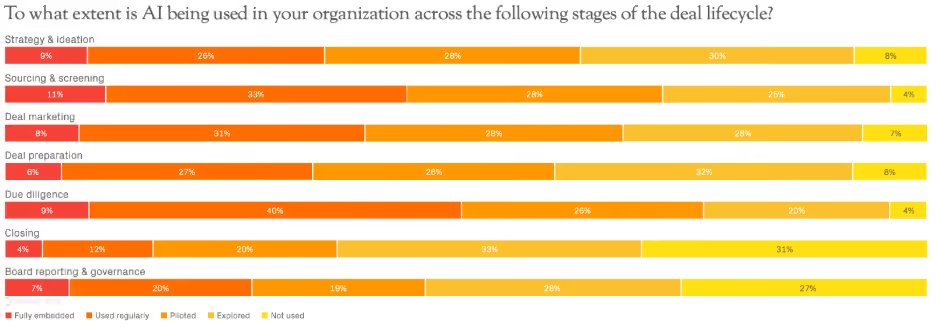
Now, those tasks belong to AI. Automated tools complete them faster and at much greater scale than any human analyst could match. It’s no wonder that 96% of dealmakers are already using or exploring AI for sourcing and screening. Ninety-two percent are using or exploring it for strategy and deal preparation. So where does that leave the humans?
AI is rewriting the job description — and raising the stakes — at every level of the deal team. The work that’s left to human dealmakers requires judgment, not just effort. Think: assessing whether a founder is truly ready to sell, reading the room in a negotiation, and determining whether a leadership team has the conviction to execute.
Below, we dive into what the modern deal team looks like and how they use AI most effectively.
As AI becomes more embedded in M&A workflows, a clear pattern is emerging: AI takes over where volume and pattern recognition create value, while humans maintain the work that requires trust.
Source: Datasite and FT Longitude
Chine Mmegwa, Head of Strategy, Corporate Development, and Operations at Match Group, described the reallocation precisely: AI compresses the first 50% of every deal — including the market mapping, target identification, and preliminary research — and frees dealmakers to dedicate their time to the last 50%, where the real impact happens.
The tech is also changing due diligence, which has historically been the most labor-intensive stage. Half of dealmakers use AI regularly or have it fully embedded in the diligence process, according to The New Deal Team report from Datasite and FT Longitude. Tasks like document review, gap analysis, and data extraction can now be completed in hours instead of eating up weeks of analyst time.
AI adoption is lowest in the stages that are fundamentally relationship-dependent: closing, where 31% of dealmakers don't use AI at all, and board reporting, where human accountability still dominates.
Datasite and FT Longitude’s interviews with 1,000 senior dealmakers around the world revealed five crucial human qualities that AI simply can't replicate:
The new division of labor is shifting the deal team hierarchy. AI is absorbing more of the junior-level roles, pushing each job function toward higher-order work.
Starting at the bottom, the analyst role is shifting from data gathering to validation and AI orchestration. The job is to interrogate what the AI surfaced, identify what's missing, and ensure the foundation of the deal is sound.
The associate role is moving its focus from compilation to synthesis. Building a deck was once a significant deliverable. Now, the deliverable is the narrative. What does the market actually look like? What does this target mean for the thesis? How does the team build conviction around that?
The VP role is shifting from process management to opportunity evaluation. With AI handling more of the workflow, the VP's time opens up for the judgment calls that determine which deals get done.
All the way at the top, partners are spending less time on output review and more time on conviction. The question shifts from whether the analysis is complete to whether the firm believes in the opportunity enough to act on it.
As AI takes on more analytical work, firms are grappling with how human oversight fits into the new flow.
Fifty-eight percent say applying human review to AI-generated output is the most important step their firm is taking to build trust in the technology. Deal teams are getting leaner, and so the responsibility each person carries for validating what AI produces is greater.
A VP evaluating an AI-generated market map needs to know it's complete. A partner acting on an AI-assisted diligence summary needs to trust that it didn't miss anything. The judgment that defines every role on the new deal team is only as good as the intelligence feeding it.
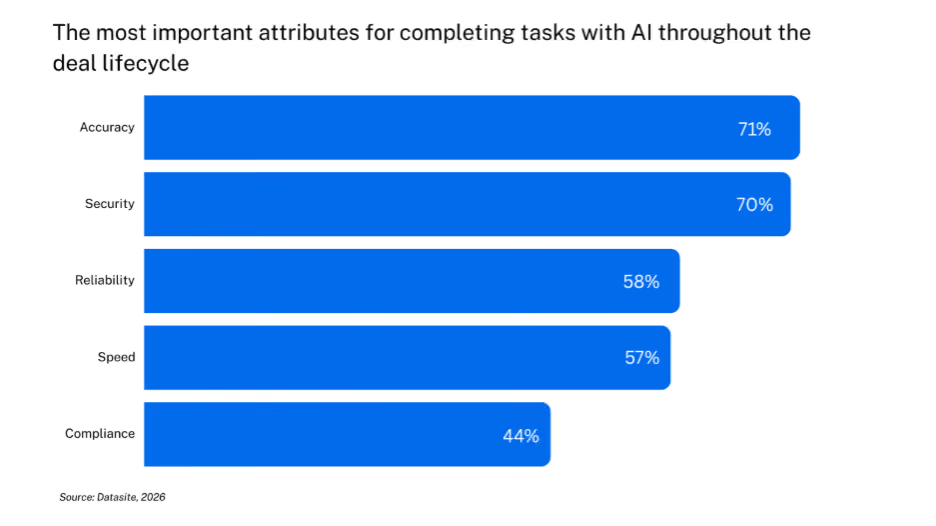
This is where the quality of the underlying data becomes a governance issue, not just a sourcing one. Dealmakers rank accuracy and security as the most important attributes for completing tasks with AI across the deal lifecycle — above speed, reliability, and compliance. The firms building durable AI workflows treat data reliability as a structural requirement.
Grata’s verified private market intelligence provides dealmakers with full, accurate visibility into their market so they can make decisions with confidence. Grata’s data covers the companies that general AI tools can’t surface, including current ownership information, verified financials, and much more.
Datasite CEO Rusty Wiley offered three practical recommendations for how deal teams should adapt to the shift caused by AI:
The best deal teams that emerge in the next five years will be the ones that build their tech stack — and their decisions — on verified private market intelligence.
The analyst role is shifting from data gathering toward validation and AI orchestration. Research, screening, and document review are increasingly handled by AI. Analysts are now responsible for interrogating AI output, identifying gaps, and ensuring the foundation of the deal is accurate.
No. The FT Longitude and Datasite research shows that 62% of dealmakers believe human-only decision-making is no longer defensible in complex deals — meaning AI-assisted judgment is becoming the standard. But judgment, negotiation, relationship-building, and accountability remain human responsibilities that AI cannot replicate.
Senior dealmakers in the FT research identified reading people, overriding data with instinct, understanding nuance in a negotiation, assessing leadership quality, and accepting accountability for risk as the qualities AI cannot replicate — and the ones that now define competitive advantage at every level of the deal team.
Each role is being pushed toward higher-order work. Analysts move from research to validation. Associates move from compilation to synthesis. VPs move from process management to opportunity evaluation. Partners move from reviewing outputs to allocating conviction.
Governance. As AI takes on more analytical work, the humans reviewing its output carry more responsibility for its accuracy. Firms need clear accountability structures, human validation processes, and investment-grade data underneath their AI workflows to ensure the judgment those workflows support is reliable.

Monthly tactics from Grata’s team and operators.
From market trends to career advice, Grata’s content fuels smarter decisions.

.avif)

.avif)
.avif)