.avif)
AI & Automation
Datasite Brings AI to the Entire Deal Lifecycle – from Target to Transaction
Grata Intelligence and Datasite Connect allow deal teams to use AI from opportunity discovery through diligence while retaining document-level permissions.


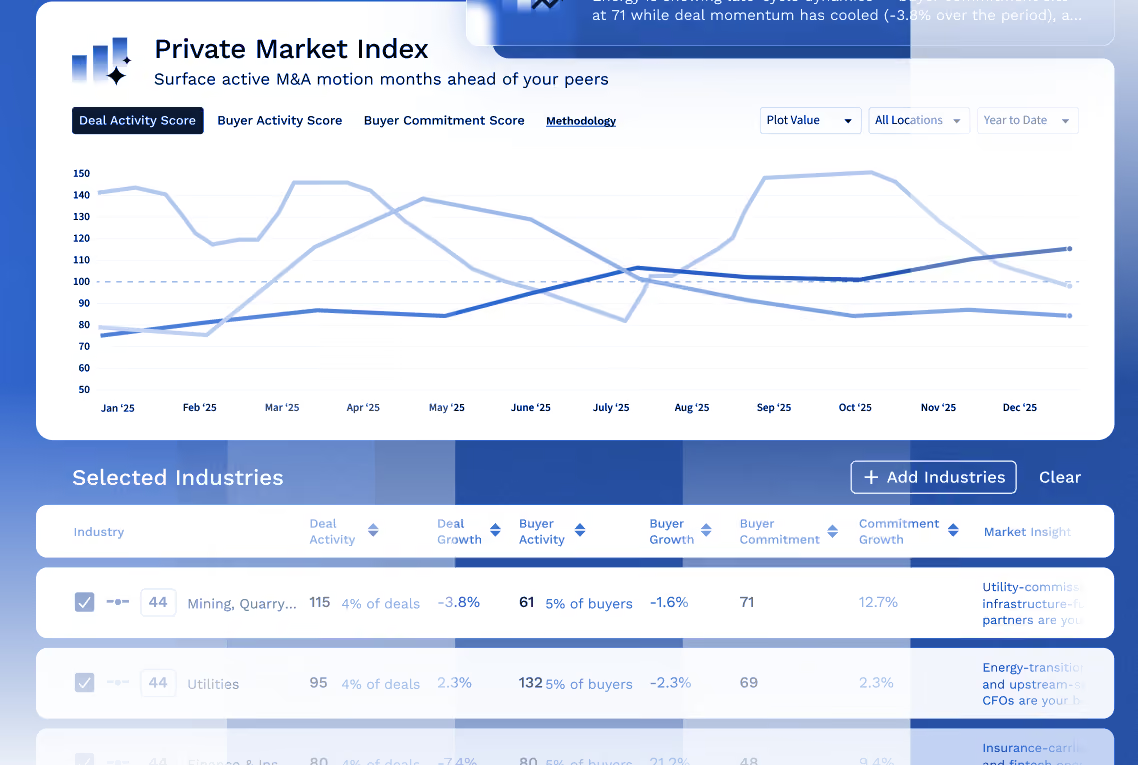
Every day in private markets, 250 deals close. 5,600 new investable companies emerge. 3,600 companies signal they're ready to transact.
Your team adopted LLMs to keep pace and it worked. Thesis generation that used to take days takes hours. Market maps that required a junior analyst now require a prompt. No one's going back.
But here's the thing: 43% of investable companies are never discovered. They don't show up in what your LLM can reach, which means they don't show up in your pipeline. And when only 6% of diligences lead to a closed deal, some of that is unavoidable. But some of it starts before the diligence: in the targeting, when the wrong companies make the list because the right ones were invisible.
LLMs didn't create this problem. They inherited it. And then they made it harder to see.
When a model returns a market map in 30 seconds, the output feels complete. There's no gap in the document, no asterisk, no note that says this reflects roughly half the market. The blind spots don't announce themselves. That's what makes them dangerous.
It's tempting to frame this as "LLMs hallucinate" and move on. But the issue for dealmakers is more precise than that.
Marin Tadić, an M&A Associate at Artemis Origination, spent time running the experiment — trialing ChatGPT and Claude for deal sourcing before concluding they weren't a fit. His critique wasn't that the models made things up. It was that they couldn't do the work: "LLMs are less effective, for instance, in differentiating between a private company, a PE-backed company, or a VC-backed company. Or in grasping a company's real purpose and state of maturity from the proposition set out through the buzzwords of its website." In isolation, he said, they're far less effective than purpose-built deal sourcing tools.
This is the actual problem. The most interesting targets - the ones without obvious digital footprints, the ones that don't describe themselves cleanly, the ones that are five years from an obvious exit but worth knowing now - are exactly the ones LLMs are worst at finding. They generate noise or silence where you need signal.
That's not a bug in the model. It's a ceiling on the data.
Here's what the teams navigating this well have figured out: the answer isn't a new tool. It's not a parallel workflow or a different platform. It's fixing what goes in.
Feed an LLM public data and you get public-data outputs - fast, fluent, and bounded by what's findable. Feed it verified private market intelligence and the same model, the same prompt, the same workflow produces something materially different. Not faster. Better.
That's the idea behind Grata's MCP.
Starting today, Grata's private market intelligence is available natively inside the AI tools your team already uses: Blueflame AI, Claude, ChatGPT, Grok, Copilot, Perplexity, and more.
No new platform. No parallel workflow. The data your LLM has been missing, connected where your team already works.
.gif)
Grata's data is built differently than what any LLM can reach on its own. We pull from foundational intelligence, private insights, and exclusive network data — active mandates, conference attendee lists, proprietary intent signals, banker and investor networks. All of it runs through a cleaning and reconciliation process before our 600 research analysts audit the output. The result is a dataset with coverage and depth that has no public equivalent.
Connect it to your LLM and you can run investment-grade workflows that weren't possible before: thesis generation, target identification, market mapping, deal screening, comps analysis, buyer list building. And because Grata surfaces data that LLMs simply can't reach on their own, it unlocks things that were previously off the table entirely — filings research, conference travel planning, live mandate browsing, intent monitoring.
One Corp Dev director we spoke with described what they were trying to build: a single workflow that combined Grata's proprietary niche company data with their LLM's ability to do third-party web research and their own enterprise knowledge, all in one query. That's not an edge case. That's what serious dealmaking with AI actually looks like.
With the MCP access model, your LLM can query across multiple providers, synthesize the results, and return a single answer to a complex request. Pull a target list and executive contacts from Grata. Enrich it with live news monitoring. Use the LLM to write personalized outreach for each target. The point isn't customization for its own sake. It's that your workflow should reflect how you actually work, not how any single vendor thinks you should.
The 43% of companies that never get discovered — they existed before your team started using LLMs, and they exist now.
The AI efficiency gains are real. The blind spots were always there too. But the difference now is you don't have to work around them.
Contact your Grata representative or get started to learn more.

Monthly tactics from Grata’s team and operators.
From market trends to career advice, Grata’s content fuels smarter decisions.

.avif)

.avif)
.avif)