.png)
AI & Automation
Sourcing
How Agentic AI Is Improving Outreach in M&A
Learn how agentic AI is making M&A outreach better by helping dealmakers prioritize targets, time it right, personalize messages, and build stronger relationships.

.webp)

The heating, ventilation, and air conditioning (HVAC) industry is evolving fast. For years, climate change has caused more extreme heat and more frequent weather events, driving demand for services.
Now there’s another factor at play: Data centers need constant, precise cooling to keep up with the AI boom. That's turning HVAC into critical infrastructure for one of the fastest-growing corners of the economy.
With well over 100,000 privately-owned companies ripe for acquisition, the HVAC industry has a deep well of opportunity for private market investors.
In this PE Playbook, the Grata team has put together the need-to-know trends for investors considering making moves in the HVAC market, including:

The market map above is not intended to be an exhaustive representation of companies in the space.
Companies that provide services that fall into multiple segments are categorized in this report by their primary offering.

Source: Grata
M&A deals in the HVAC industry have increased by almost 4x in the last 10 years, and 2026 is on pace to be another strong year. Strategic buyers have driven the majority of the activity, but financial sponsors are also active in the space.
A few forces key factors are driving the surge:
Tariffs, on the other hand, are working against the industry’s momentum. Costs of components sourced from China, Vietnam, and Mexico are rising, causing some strategic buyers to more cautious. Still, transaction multiples expanded through 2025, suggesting that buyers are still willing to pay up for the right target.

Source: Grata
Alpine Investors is the most active financial sponsor in the HVAC industry with 162 relevant acquisitions. Its activity in the space has focused on buy-and-build platforms in residential and light commercial services.
Source: Grata
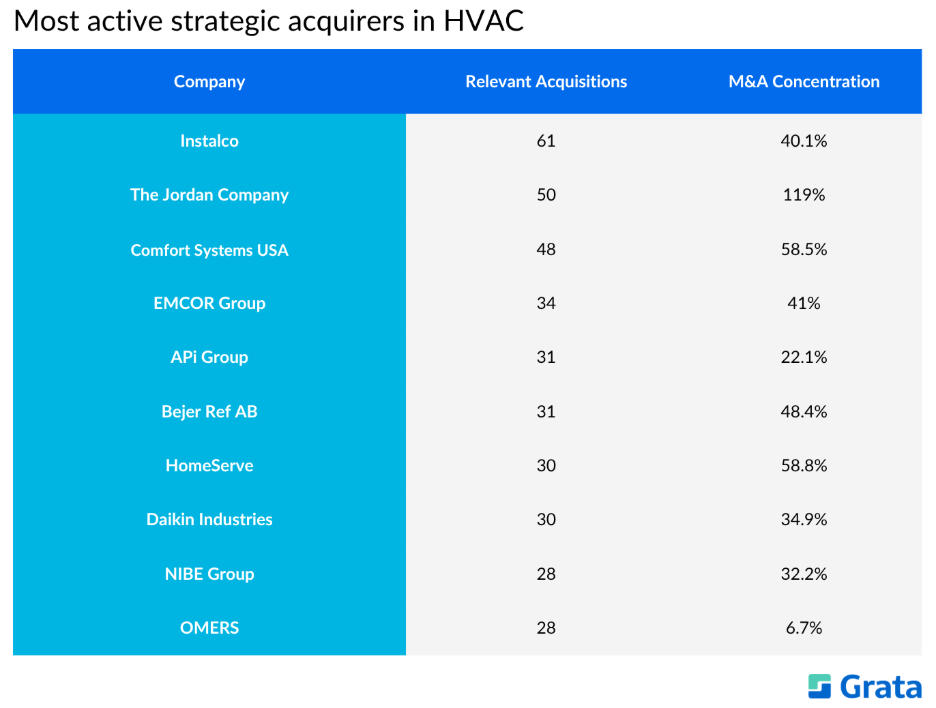
Instalco tops the list of strategic acquirers in the HVAC industry with 61 relevant acquisitions, reflecting the company's long-standing roll-up strategy across Northern Europe. Comfort Systems USA and EMCOR Group, both public mechanical contractors benefiting from the data center and advanced manufacturing construction boom, follow with 48 and 34 acquisitions, respectively.
Source: Grata
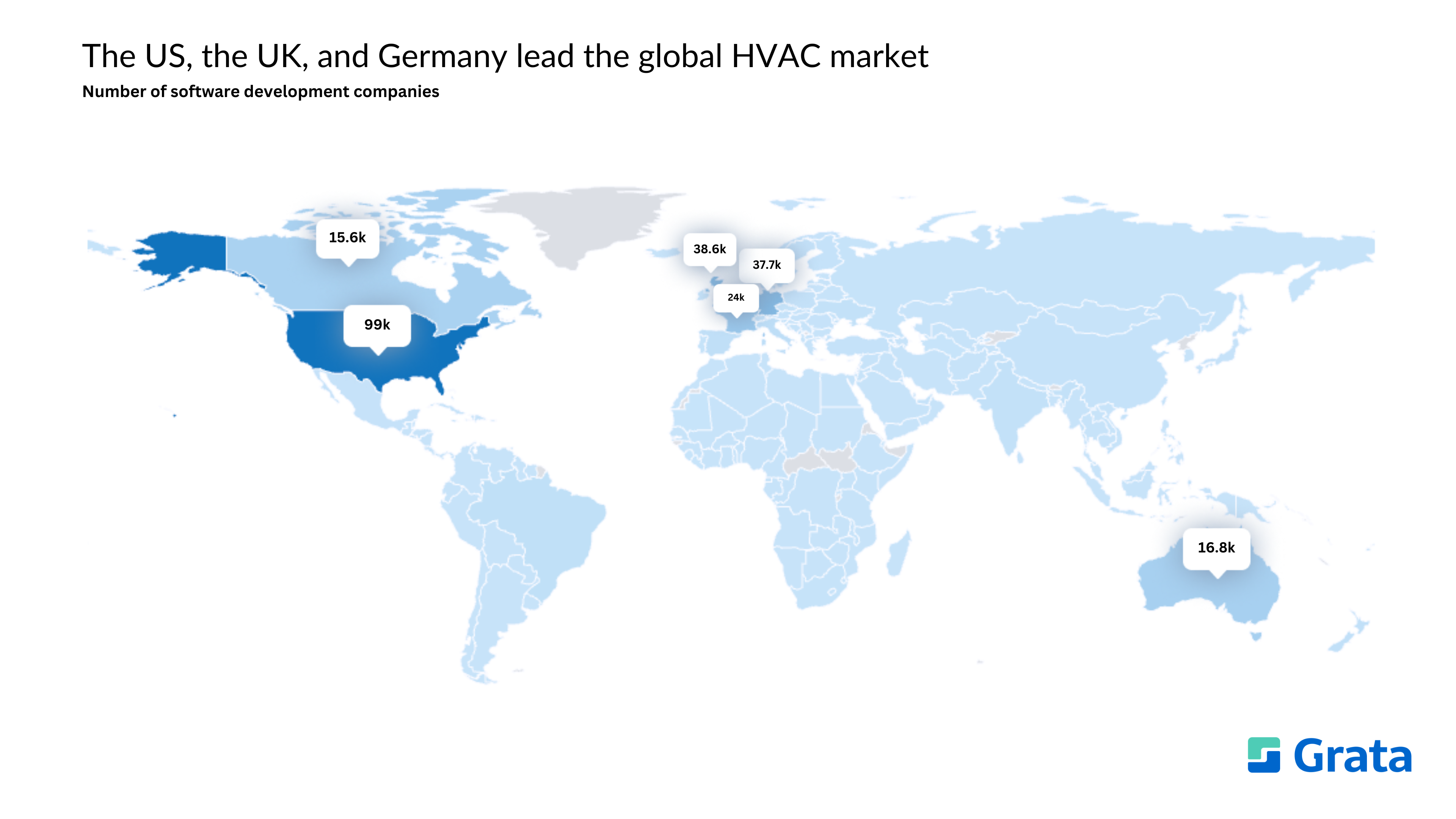
The US leads the global HVAC market by a wide margin, with roughly 99,000 companies. The UK and Germany are the next two largest markets at 38,600 and 37,700, respectively. France follows at 24,000, with Australia and Canada filling in the next tier.
For dealmakers scoping markets beyond the US, the UK and Germany are worth a look. Both countries have committed to phasing out fossil fuel boilers and transitioning to heat pumps over the next decade. That's pushing building owners to replace old systems faster, creating a large, fragmented pool of HVAC installers and engineers in both markets.
.png)
Source: Grata
For US-focused dealmakers, opportunity runs from coast to coast. Here are some key trends to consider:

Source: Grata
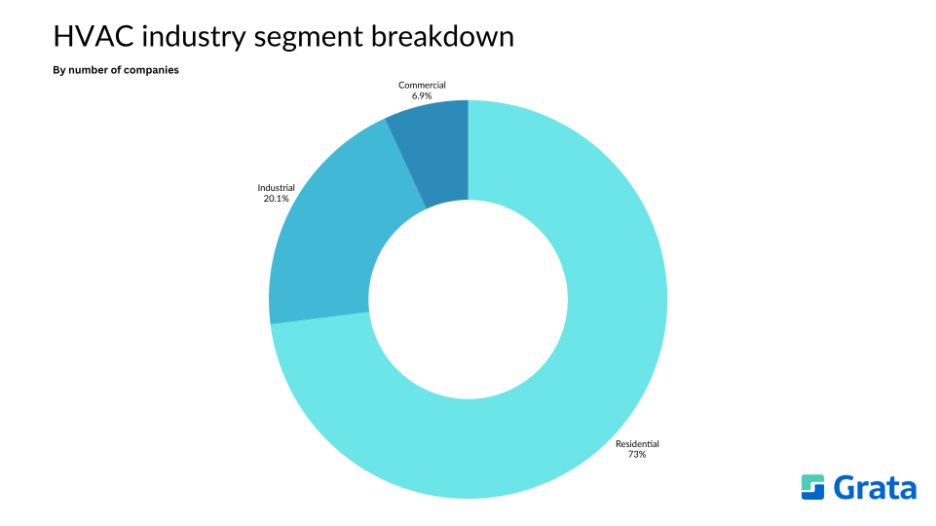
The HVAC industry is highly fragmented. Independent companies represent 48% of industry employment, while PE-backed and VC-backed companies account for just 8% combined. There are currently over 126,000 privately owned HVAC companies that are ripe for acquisition.
Source: Grata
This report focuses on the following segments of the HVAC industry. Grata users can see curated lists of some of the companies used to create each segment by clicking the links below.

Source: Grata
Industrial HVAC companies are seeing the fastest average growth rate in the public markets at 30.1% a year. They also pull in the most average revenue of the segments analyzed in this report. Demand for cooling equipment for data centers and chip factories is surging, bringing the need for industrial HVAC providers along with it. For example, data center revenue from global HVAC leader Carrier doubled to $1B in 2025, and its backlog now stretches into 2028. Note that average margins in the industrial sector are still relatively thin because much of the work involves large, custom-built equipment sold on competitive bid.
Backlog from the data center boom is also affecting the commercial HVAC sector. New work is coming in faster companies can finish it. Investors are pricing in that pipeline years before it turns into revenue, which explains the high EV/EBITDA and low margins. Investors are betting on where the contractors are heading versus where they are now.
Residential HVAC, on the other hand, posts the strongest average margin, but the slowest growth. The segment has experienced a bit of a rough patch. Contractors carried excess inventory through most of last year, and homeowners leaned toward repairing older units instead of replacing them. Even so, big residential manufacturers kept margins up by raising prices instead of chasing volume.

Source: Grata
In the private realm, commercial HVAC companies see the strongest average growth of the three segments and the highest average revenue by far. The underlying trends are the same ones hitting the public markets. Office buildings, warehouses, and retail facilities are replacing outdated systems ahead of stricter efficiency rules. New construction in logistics, healthcare, and manufacturing needs more complex, higher-value systems than a typical home installation. Commercial customers also tend to sign multi-year maintenance contracts, which gives these companies more insight into future revenue than their residential and industrial peers.
Meanwhile, growth in the residential sector is slowing at an average of –1.1%. Last year, existing home sales fell to their lowest level since 1995. More than 80% of homeowners are sitting on mortgage rates well below what's available today, so fewer people are selling and moving. Fewer moves means fewer new systems installed.
New home permits have also been trending down A residential HVAC contractor's revenue depends on how many homes change hands and how many new homes are built. Both numbers have fallen this year. Additionally, most HVAC companies are small, family-owned operations. Because they don't have the room to raise prices the way bigger players can, they tend to feel economic slowdowns more acutely.
Private industrial HVAC companies are growing at a modest 2.5% a year, on average — well below the rate that public players are seeing. This ultimately boils down to who's winning the data center projects. The companies building chillers and cooling systems for large data centers are usually big manufacturers with the scale and capital to bid on those contracts. Private industrial HVAC companies are almost always smaller, regional shops doing standard replacement work for factories and warehouses. That work is steady, but it doesn't move as quickly as the AI-driven data center boom.

Source: Grata
Residential and commercial HVAC provider Anchor Air joined Southeastern Heating and Air Conditioning to form the single brand Captain Cool\. The two companies have more than 70 years of combined experience in AC repair, installation, and maintenance. Captain Cool remains under local ownership and continues to expand its Coastal Alabama footprint.
If you’re an investor interested in companies similar to Anchor Air, try these:
Also in June, Exigent, a mechanical services platform backed by Huron Capital, acquired Superior Building Services. The company is based in Ohio, and it provides boiler, chiller, and HVAC service and retrofit work. Superior serves institutional and commercial customers across education, healthcare, government, and food and beverage facilities in the Columbus area. The deal is Exigent's eighth acquisition since Huron Capital launched the platform in 2022. It deepens Exigent's presence in one of the Midwest's fastest-growing commercial markets.
If you’re an investor interested in companies similar to Superior Building Services, try these:
In June, CECO Environmental acquired Thermon Group Holdings for an enterprise value of $2.2B. Thermon is a global leader in industrial process heating, temperature maintenance, and environmental monitoring. CECO pursued the deal specifically to gain exposure to data center thermal management, one of the fastest-growing end markets in industrial HVAC.
If you’re an investor interested in companies similar to Thermon Group Holdings, try these:
Nordic Climate Group acquired England-based K4 Services for an undisclosed amount last month. K4 designs, installs, and services custom and standard heating and cooling systems for industrial and commercial clients, including data centers, pharmacies, and medical facilities. This is Nordic Climate Group's second UK acquisition in quick succession, following its purchase of Lightfoot International. The deal extends Nordic's reach into a region where it previously had limited presence.
If you’re an investor interested in companies similar to K4 Service Limited, try these:
In May, Kansas City-based residential HVAC company Flint Group acquired Air Around the Clock, a nearly 40-year-old HVAC and plumbing provider based in South Florida. Air Around the Clock serves residential and commercial customers across Miami-Dade, Broward, and Palm Beach counties.
If you’re an investor interested in companies similar to Air Around the Clock, try these:
Also in May, Grizzly MEP acquired Stegall Mechanical, an Alabama-based contractor founded in 1957. Stegall operates an integrated plumbing, HVAC, and electrical business serving industrial, healthcare, education, and hospitality customers across Alabama and the broader Southeast.
If you’re an investor interested in companies similar to Stegall Mechanical, try these:
Mid-Town Plumbing acquired Bain Heat & Air in May for an undisclosed amount. Both companies are based in Benton, Arkansas. Bain Heat & Air is a family-owned HVAC contractor that offers repairs, replacements, and new construction installations. It serves residential and commercial customers across central Arkansas. Mid-Town Plumbing reportedly plans to keep Bain's staff and brand in place while combining scheduling and dispatch operations, giving customers a single point of contact for their plumbing and HVAC needs.
If you’re an investor interested in companies similar to Bain Heat & Air, try these:
Hundreds of live deals and active mandates are being showcased on the Grata Deal Network. Here are some examples of mandates related to the HVAC industry:
If you’re interested in these deals and you want to see more, register to learn more here.
Are you a sell-side advisor interested in generating inbound leads for your data center infrastructure deal? Get started here.
Grata makes it easy for dealmakers to find conferences, events, and trade shows in their industries. See attendee lists so you can set up meetings beforehand and make the most of your travel time. Check out which companies attended past events to find more potential targets.
Here are a few of the events related to the HVAC industry that dealmakers can find and track in Grata:

If you’re an investor interested in making moves in the HVAC space, Grata can help you put the insights in this article into action.
From in-depth market research to sourcing to pipeline management and relationship nurturing, Grata’s end-to-end dealmaking platform streamlines your workflows so that you can close more deals.
Schedule a demo today to get started.

Monthly tactics from Grata’s team and operators.
From market trends to career advice, Grata’s content fuels smarter decisions.
.png)

.png)
.webp)