.png)
AI & Automation
Sourcing
How Agentic AI Is Improving Outreach in M&A
Learn how agentic AI is making M&A outreach better by helping dealmakers prioritize targets, time it right, personalize messages, and build stronger relationships.



Using AI in M&A workflows is no longer cutting-edge. Ninety-six percent of dealmakers are already using or exploring the tech to source and screen deals, according to new research from Financial Times Longitude and Datasite. Forty-three percent have it fully embedded in their sourcing and screening workflows.
CRM systems went through the same arc two decades ago. Early adopters built a real process advantage. Then everyone caught up, and not having a CRM became the anomaly. AI is moving through the same cycle — but much faster.
Every major firm now has access to the same AI models. So how do dealmakers win when tools that were once game changers are now ubiquitous? It boils down to two irreplaceable elements: data and trust.
Most of the public conversation about AI has focused on efficiency. How fast can it summarize a document? How quickly can it build a target list? But the dealmakers actually using AI in consequential decisions have moved past that. Now the question is whether they can trust the output enough to act on it.
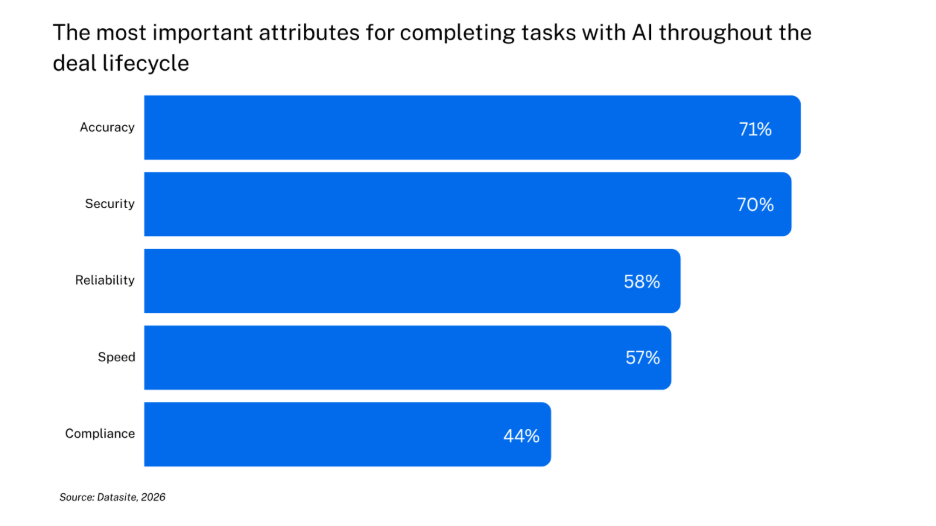
FT Longitude and Datasite’s report on the new deal team shows that dealmakers rank accuracy and security as the most important attributes for completing tasks with AI. With such high stakes, that shouldn’t be surprising.
A valuation going to an investment committee needs to be right. A market map used to identify a platform acquisition needs to be complete. A diligence summary that misses a material risk is a liability. Relying on AI grounded in untrustworthy data puts deal teams at risk of squandering valuable time and resources — and ultimately missing big opportunities.
Quality, holistic data changes what deals are possible. Twenty-four percent of dealmakers surveyed in the FT research say AI helped them complete a deal they would have otherwise missed. Those deals happened because their workflows were backed by complete, reliable data — not because they used generic AI.
Most of the targets that matter most to a middle-market thesis are invisible to a general LLM. These are founder-owned businesses that have raised little to no institutional capital, operate in fragmented industries. They have little to no press coverage, no public financials, and a minimal digital footprint.
No matter how sophisticated an AI model is, if it isn’t working from a foundation of verified private market intelligence, it will miss the vast majority of these companies. Firms running AI on incomplete market data are making resource allocation decisions based on a picture of the market that has gaping holes.
The cost compounds quickly. Analysts waste precious time screening bad-fit targets. Teams exert time and energy conducting diligence on deals that close at the wrong price or don't close at all. Relationship capital is squandered on unnecessary outreach.
Sixty-two percent of dealmakers say human-only decision-making is no longer defensible in complex deals, according to the latest report by FT Longitude and Datasite. But generic AI tools alone can’t provide the support they need.
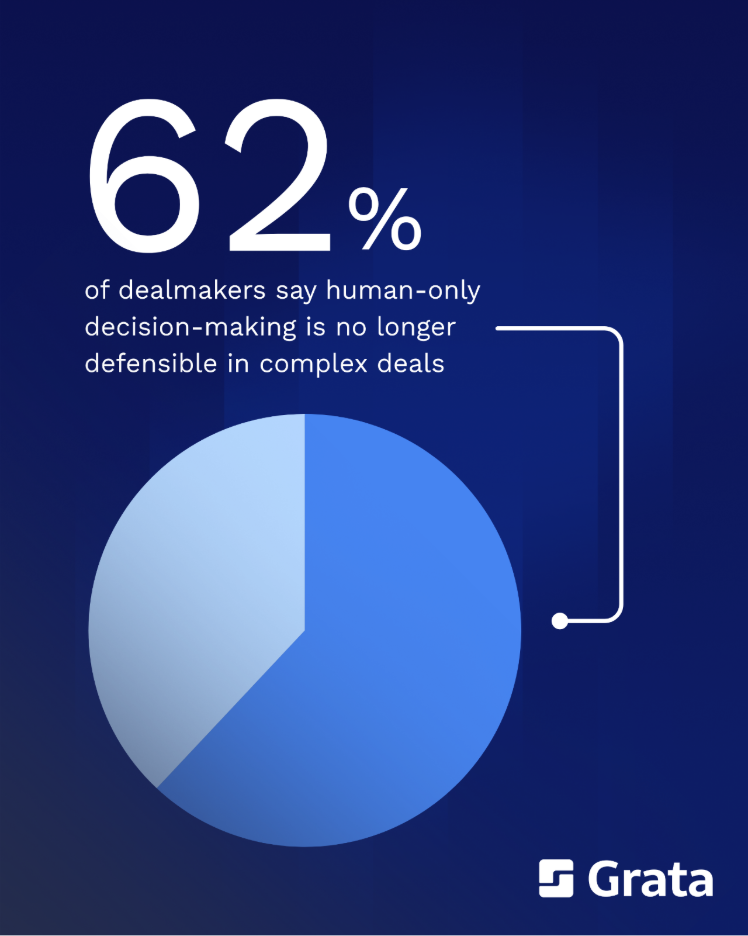
Source: Datasite and FT Longitude
That’s because complete private market data is genuinely difficult to come by. There are nearly 11M private companies across the US and Europe alone. The information that exists about them is scattered, inconsistently documented, and frequently out of date. Ownership changes without press releases. Revenue doesn't get reported. Industry classifications vary across sources. In Europe, reporting requirements vary by country and by company type and size. Regional ownership structures, local registration systems, language fragmentation, jurisdiction-specific disclosures, and cross-border holding entities also create blind spots.
Grata is built to solve this problem. The platform provides private market dealmakers with full visibility into their industries via verified, investment-grade deal intelligence and proprietary, comprehensive AI workflows.
The first layer of Grata’s AI and data science engine is Foundational Intelligence. This is Grata’s proprietary synthesis. Here, our AI agents read millions of company websites in the same way that a human M&A analyst would. Then, they cross-reference that against our deep in-house human expertise and exclusive training data. All of this is synthesized with expert research and consistently verified by our data scientists to provide proprietary and opinionated perspectives on which data is accurate.
The next layer is Private Access. Here, Grata combs through proprietary and offline sources to aggregate data that dealmakers need to make decisions, including:
In cases where precise data doesn’t exist in any single source, our AI agents generate it through inference, triangulation, and validation from our data scientists.
The third and final layer is Exclusive Data. This is data dealmakers can’t find anywhere else. For example, Grata’s proprietary Seller Intent data is designed to help teams identify companies preparing to sell months before a transaction hits the market. Signals synthesized by our cutting-edge behavior‑based model are translated into a dynamic Intent score within Grata that’s updated weekly and tracked over time.
The Exclusive Data layer also includes the Grata Deal Network, our exclusive contributory network in which vetted sell-side advisors share their active mandates with our team. We then vet the deals to ensure the financials meet our investment-grade standards. Once they pass the test, we share deal teasers on the Grata platform so that our network of highly qualified buyers can find them.
Accessibility is just as important as depth. Private market dealmakers have to be able to seamlessly integrate the data into their processes, which requires the right AI-powered sourcing workflows.
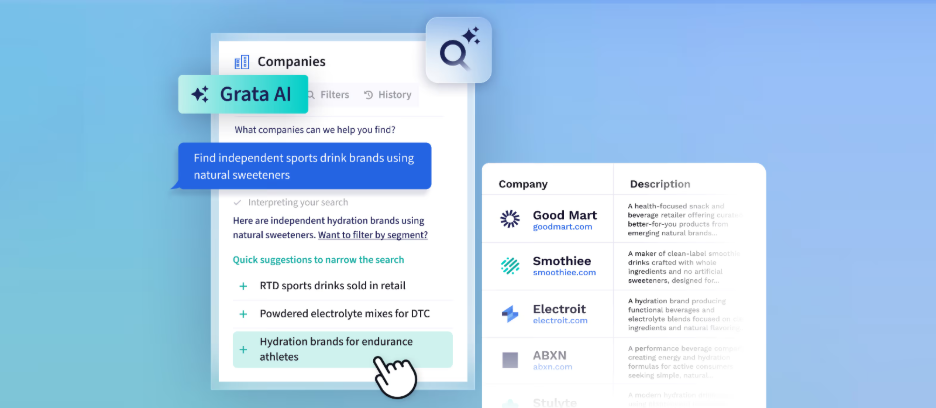
Grata’s Agentic Search transforms the Grata platform into your own AI analyst. It interprets your intent and uses that understanding to collaborate with you and adapt as your needs evolve. The agent draws on Grata’s investment-grade data to quickly provide a complete picture of your market.
Agentic Search also suggests next steps to refine, expand, and test your hypotheses so you can get to differentiation faster.
Seventy-one percent of dealmakers believe that firms who ignore AI today will struggle to compete over the next five years. But the research from FT Longitude and Datasite makes clear that AI adoption alone doesn’t create a competitive edge. For the new deal team, the advantage lies in a foundation of trustworthy data.
As AI continues to evolve and become more embedded in M&A processes, the firms that pull ahead will be the ones that unite the tech with complete, verified private-market intelligence. That combination will empower them to see their whole market, trust every signal their tools surface, and act on the right opportunities with confidence.
The firms that source the best deals are the ones who see the full market earlier, identify better-fit targets before processes emerge, and build relationships with founders long before anyone else is at the table.
Grata provides verified private market intelligence and powerful, proprietary AI to give dealmakers the complete picture of their industries. Schedule a demo today to see what your market actually looks like.
Yes. According to Financial Times Longitude and Datasite research, 96% of dealmakers are using or exploring AI for sourcing and screening. The technology has moved from early-adopter advantage to baseline expectation across the industry.
The quality of the intelligence behind the AI. Complete market coverage, verified information, and trusted private-market data become the differentiators when the AI tools themselves are commoditized.
AI produces better outcomes when it's working with accurate, complete, and verified information. In private markets specifically, where coverage is fragmented and many companies have limited public data, the quality of the underlying intelligence directly determines the quality of the sourcing output.
Relying on incomplete or inaccurate information. As AI becomes more widely adopted, the quality of the data powering it becomes the primary differentiator between firms that make better decisions and firms that simply move faster.
No. AI is increasingly supporting sourcing, screening, and diligence workflows, but judgment, negotiation, relationship-building, and strategic decision-making remain human responsibilities. Sixty-two percent of dealmakers say human-only decision-making is no longer defensible in complex deals — meaning AI-assisted judgment is becoming the standard, not AI replacing judgment.

Monthly tactics from Grata’s team and operators.
From market trends to career advice, Grata’s content fuels smarter decisions.
.png)

.png)
.webp)