
AI & Automation
Buy-Side
How AI Agents Are Changing Investment Committee Preparation
Discover how AI agents are transforming investment committee preparation by streamlining research, updating IC memos, and strengthening investment analysis.

.png)

The fire safety industry is more important than ever. Wildfires are becoming more frequent and severe as a result of climate change. Meanwhile, new AI data centers and grid-scale battery storage projects are posing fire risks that didn't exist a decade ago.
With insurers and regulators around the world tightening their compliance requirements, investment in the fire safety industry is trending up. Sectors like fire suppression and sprinkler maintenance have become some of the fastest-growing niches in a historically slow-moving industry.
The industry presents a hot opportunity for private market dealmakers: there are currently over 118,000 privately owned companies ripe for acquisition.
In this PE Playbook, the Grata team has put together the need-to-know trends for investors considering making moves in the fire safety market, including:
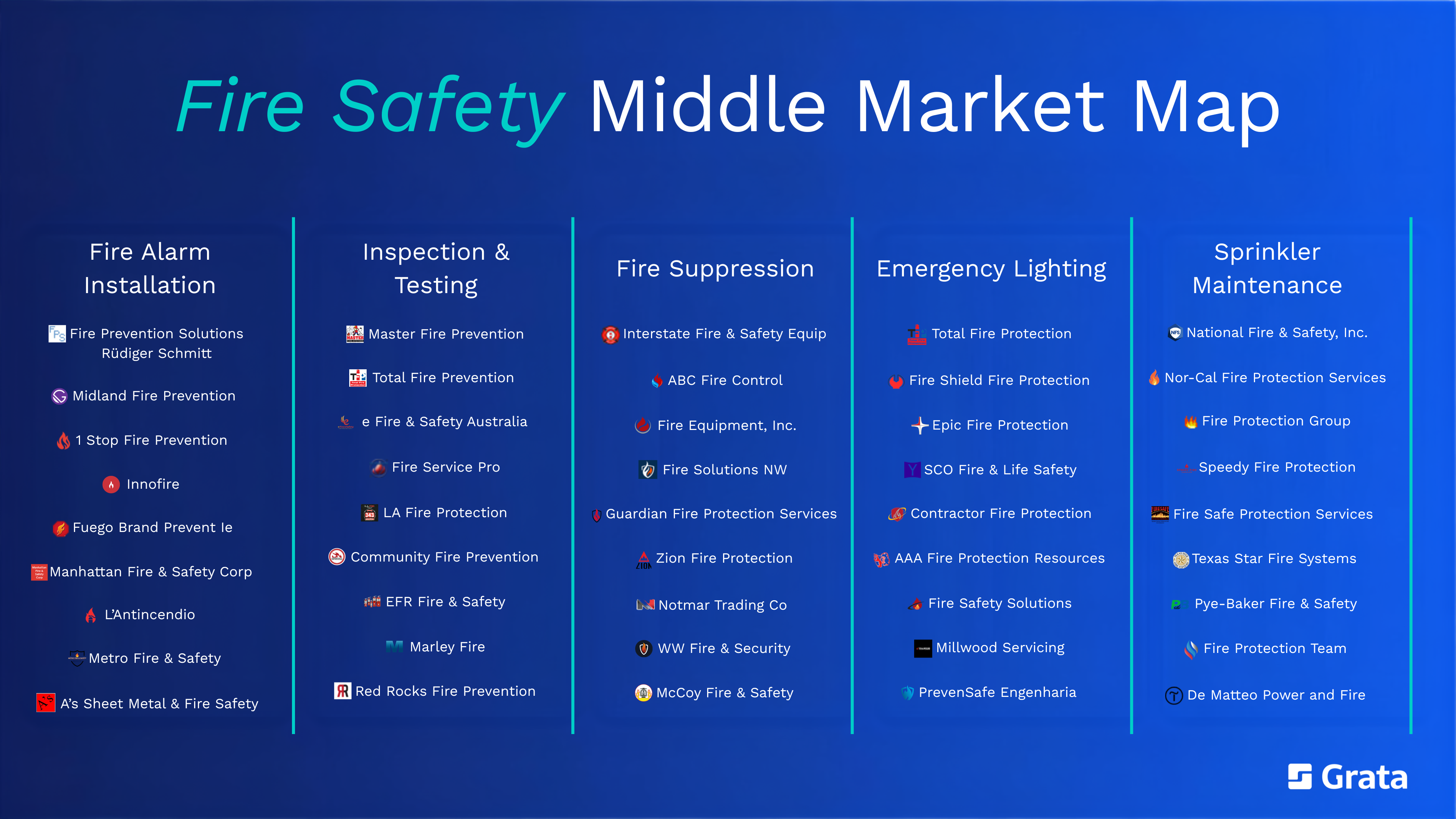
Source: Grata
The market map above is not intended to be an exhaustive representation of companies in the space.
Companies that provide services that fall into multiple segments are categorized in this report by their primary offering.
Source: Grata
M&A deals in the fire safety industry nearly quadrupled from 2017 to 2025, and 2026 is on pace to be another strong year. Strategic buyers have driven the majority of the activity over the last decade, but financial sponsors have grown their share steadily since 2021.
A few key factors are driving the surge:
Source: Grata
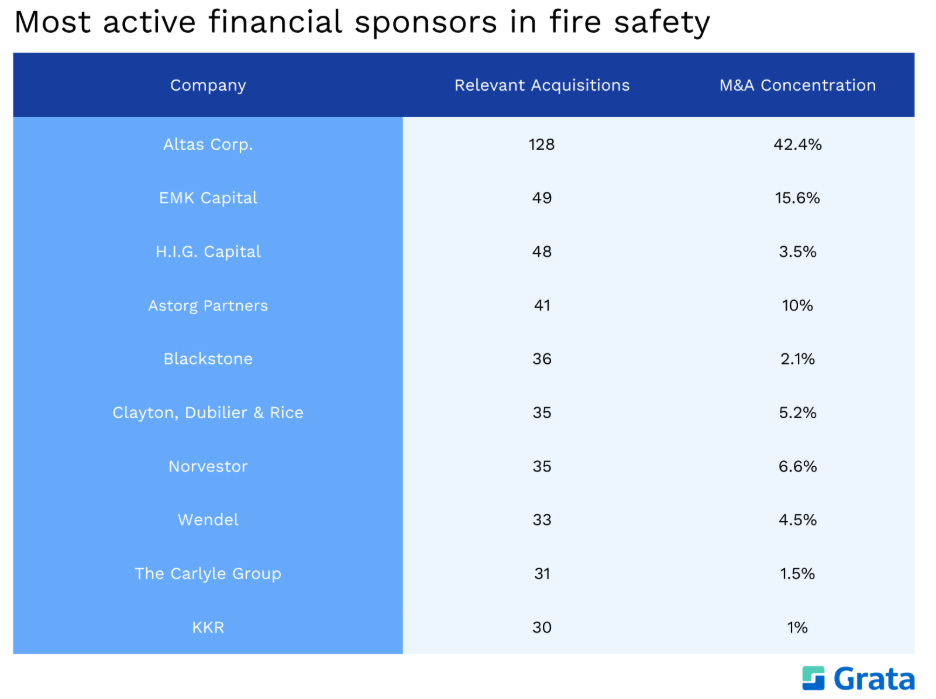
Altas Corp. is the most active financial sponsor in the fire safety industry with 128 relevant acquisitions. Its acquisitions are primarily small, regional fire and life safety service companies. Altas has acquired a mix of fire alarm/detection, sprinkler service, fire extinguisher service, and general fire protection contracting companies.
Source: Grata
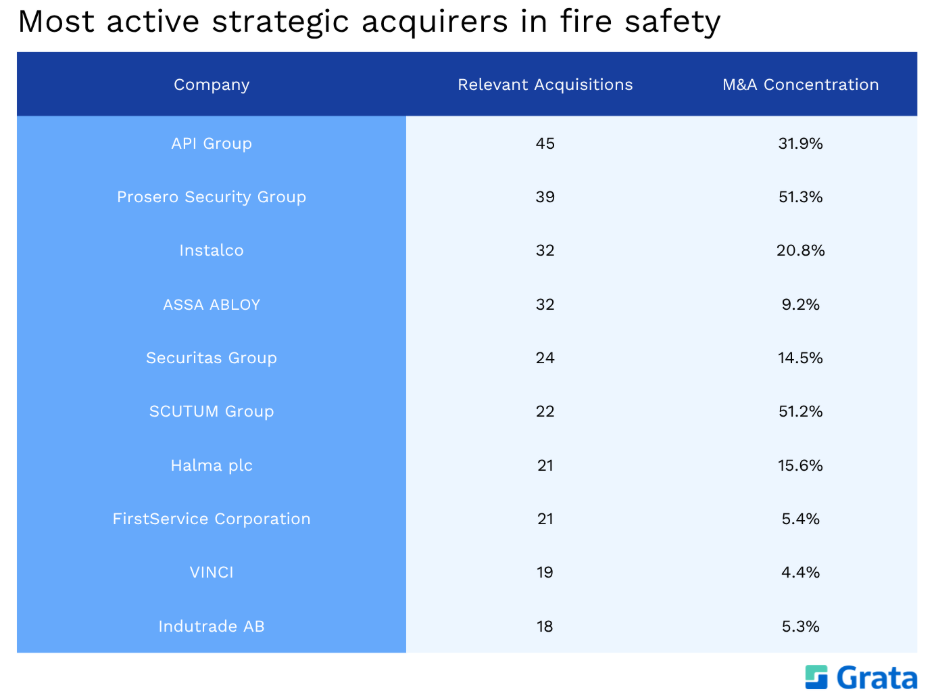
API Group tops the list of most active strategic buyers in the fire safety industry. Its acquisitions tend to fall into two main buckets: fire and life safety bolt-ons, and adjacent service line expansion.
Source: Grata
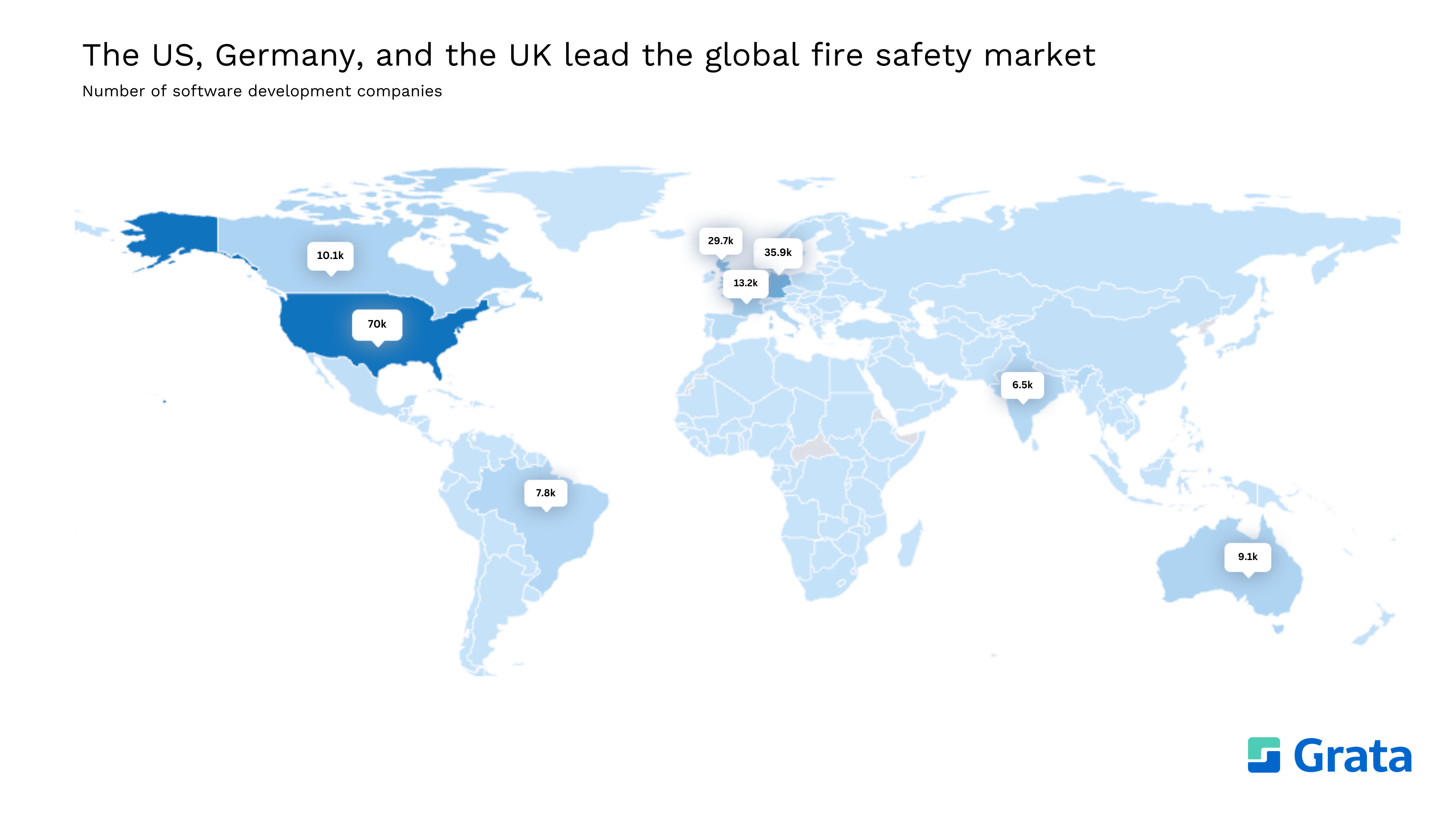
The US leads the global fire safety market by a wide margin, with roughly 70,000 companies. Germany and the UK follow with 35,900 and 29,700, respectively.
For dealmakers scoping markets beyond the US, the UK is worth a look. The Building Safety Act 2022, which passed following the Grenfell Tower fire, requires large-scale cladding remediation on residential buildings 11 meters and taller. The UK government has committed £5.1B in remediation funding, and more than 50 developers have signed contracts committing to fix fire safety defects in buildings they built or refurbished between 1992 and 2022. That mandate is generating years of compliance-driven retrofit work.
Canada is also worth watching. The country experienced two of its worst wildfire seasons on record in 2023 and 2025, and 2026 is already running above average. That's pushing wildand-urban interface construction standards deeper into the National Building Code.
In Australia, AS 1851, the national standard governing fire protection system servicing, is now mandatory across a wide range of building classes. A building that falls out of compliance risks losing its Annual Fire Safety Statement, which can trigger council enforcement and invalidate insurance.
Source: Grata
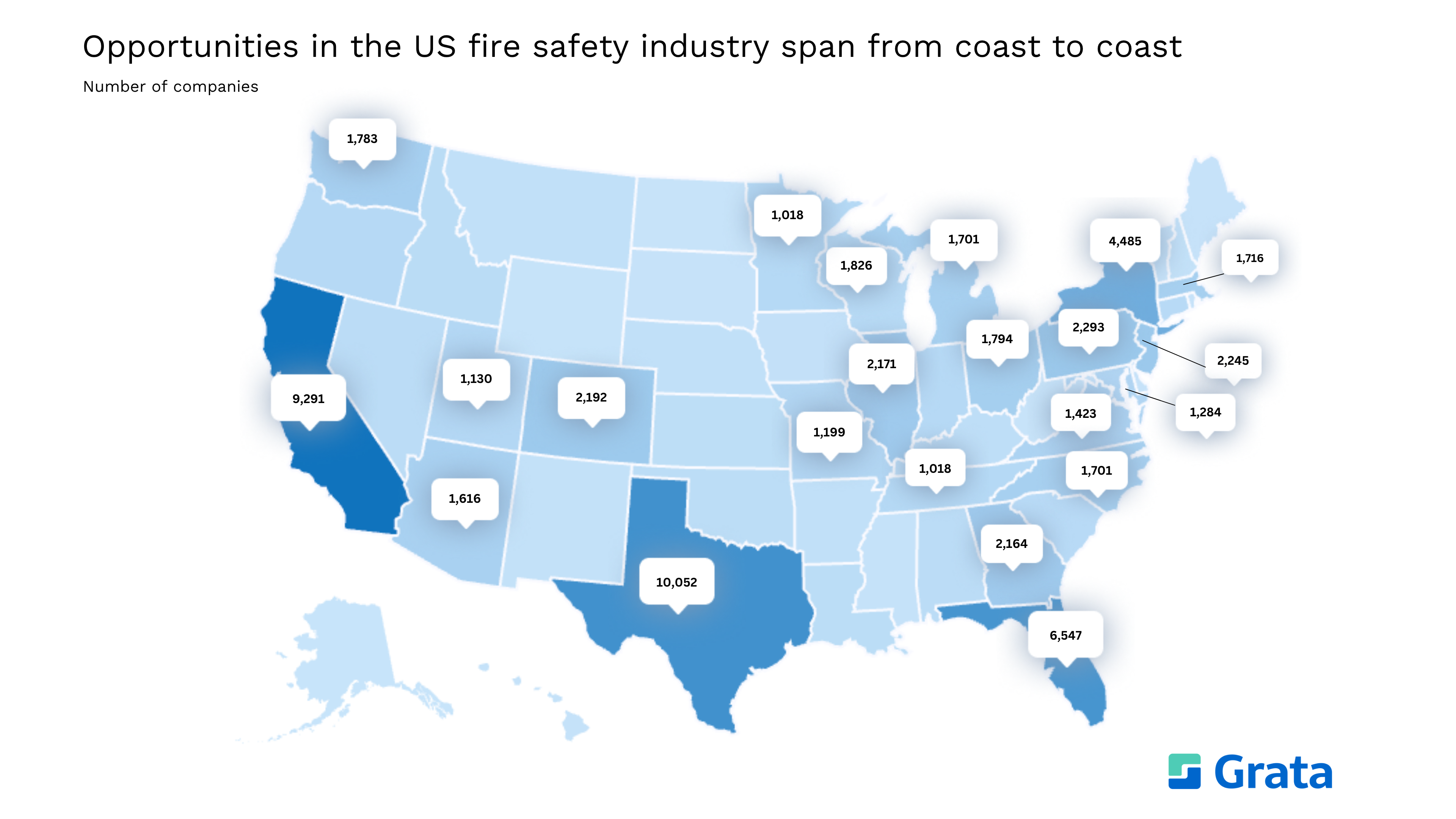
For US-focused dealmakers, opportunity runs from coast to coast. Here are some key trends to consider:
.png)
Source: Grata
The fire safety industry is highly fragmented. Privately owned companies account for a staggering 73% of the industry. There are currently over 118,000 privately owned fire safety companies that are ripe for acquisition.
.png)
Source: Grata
This report focuses on the following segments of the fire safety industry. Grata users can see curated lists of some of the companies used to create each segment by clicking the links below.
Source: Grata
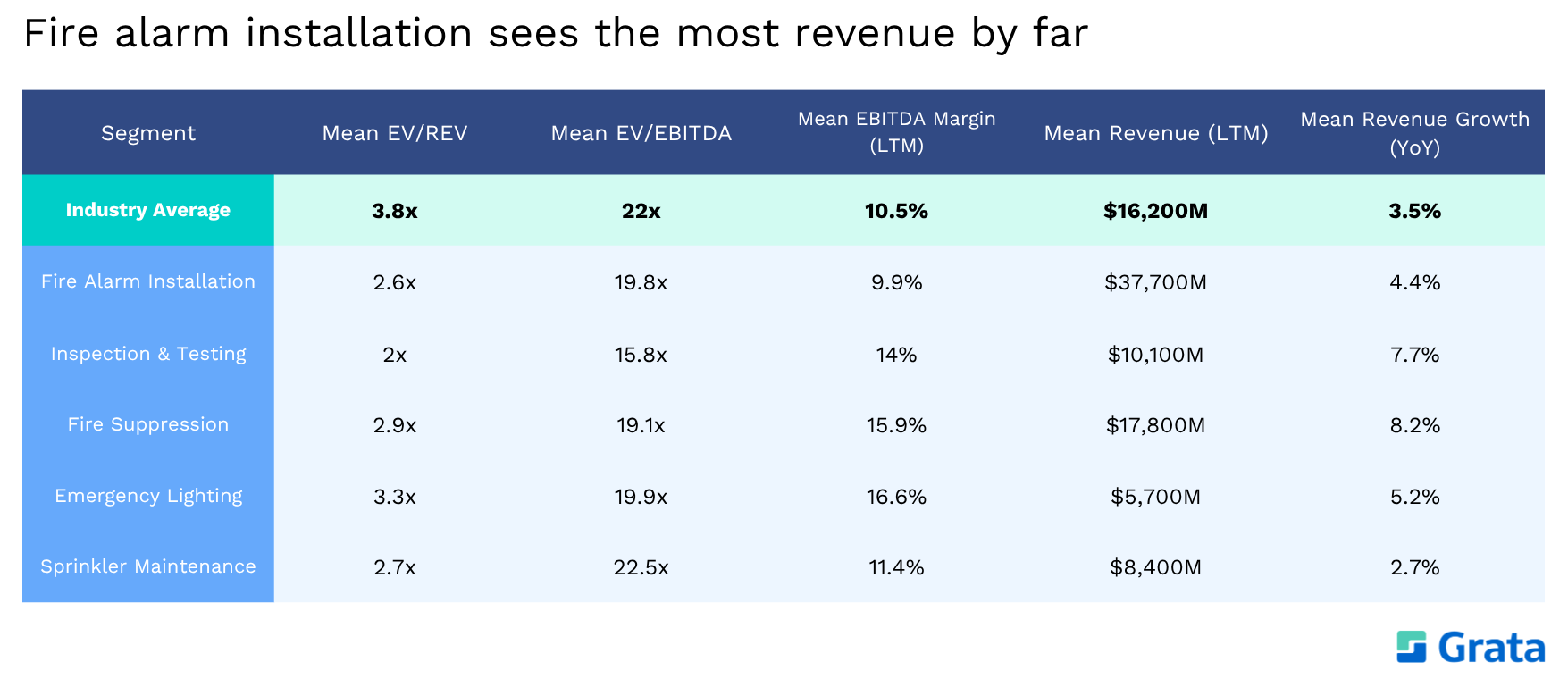
Fire alarm installation pulls in the most average revenue of the segments analyzed in this report by far. This isn’t surprising — fire alarm systems affect nearly every commercial and residential building type.
The fire suppression sector shows the strongest average revenue growth in the public realm, with inspection and testing following close behind. Two infrastructure booms are driving the momentum: data centers and energy storage. Massive data centers are popping up all over the place, and they need fire suppression coverage across data halls and UPS rooms at a scale that most facilities never required before.
At the same time, grid-scale battery energy storage is expanding rapidly, and lithium-ion batteries carry a distinct fire risk. A failing battery cell can trigger thermal runaway, releasing toxic gas and reigniting days after the initial fire appears out. In the US, the National Fire Protection Association (NFPA) updated its technical standard for battery storage installation in 2026 to make a formal fire hazard assessment the default requirement and tightening suppression, detection, and spacing rules across 19 battery chemistries.
Emergency lighting sees the highest average EBITDA margin of the sectors analyzed in this report. One likely reason is that the space is comprised of more products sold by large manufacturers than field labor-intensive installation and inspection work. Newer self-testing fixtures with remote monitoring can also cut the technician visits otherwise needed to verify compliance, shifting more of the value into the actual product.
Source: Grata
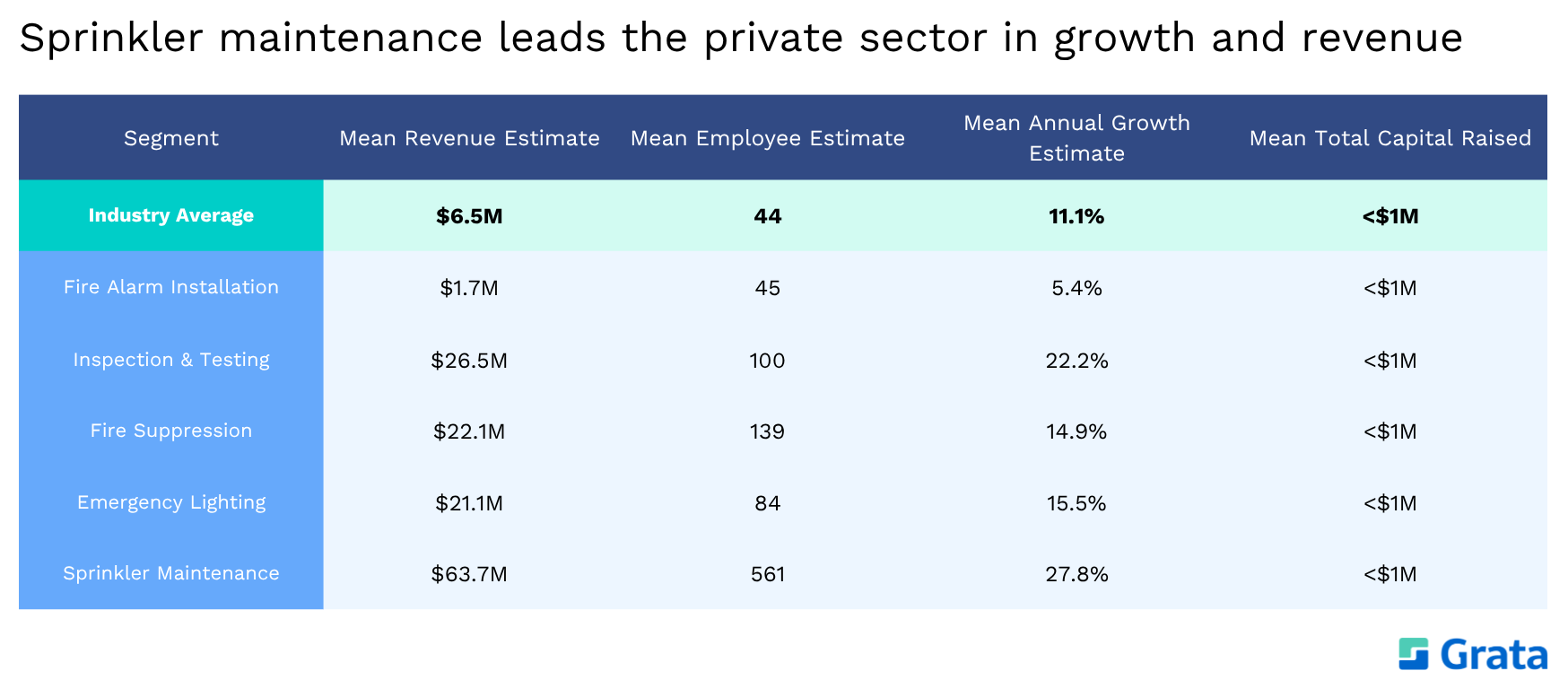
Sprinkler maintenance is the standout sector in the private sphere. Though it’s the smallest segment in the fire safety industry by company count, it leads in average revenue and average annual growth. The NFPA requires sprinkler systems to be inspected, tested, and maintained on a set schedule, and insurers are increasingly conditioning coverage on proof of that maintenance. Private sprinkler maintenance companies also tend to run larger crews than the industry average, since the work requires licensed fitters rather than general laborers.
The fire alarm installation segment shows the opposite pattern. It's the largest by count, but private companies in the space are seeing the slowest average growth and the lowest average revenue The segment is crowded with small, project-based installers competing on price for one-time jobs rather than building recurring service contracts. That combination of scale and thin growth makes fire alarm installation fertile ground for a buy-and-build strategy.
Fire suppression and emergency lighting sit in the middle, growing at 14.9% and 15.5% respectively. Fire suppression benefits from the same data center and battery storage buildout lifting the public comparables, though private players tend to serve smaller regional accounts rather than hyperscale campuses or utility-scale storage projects.
.png)
Source: Grata
In February, UK construction group Galliford Try acquired Northamptonshire-based Nene Valley Fire & Acoustic, a specialist in fire door installation and maintenance. Nene Valley is combining with Galliford Try's existing Oak Fire Protection and Asset Intelligence businesses to offer a single, in-house passive and active fire safety capability, giving the group access to what it estimates is a £1B addressable market in UK fire protection.
If you're an investor interested in companies similar to Nene Valley Fire & Acoustic, try these:
In March, 3M and Bain Capital agreed to acquire Madison Fire & Rescue from Madison Industries for $1.9B, structured as a new joint venture. 3M is contributing its Scott Safety self-contained breathing apparatus business into the venture and will hold a 50.1% stake, with Bain Capital owning the remaining 49.9%. Madison Fire & Rescue's brands, including Holmatro, Amkus, Task Force Tips, and Waterax, cover rescue technology and fire suppression equipment used by municipal, industrial, and wildland first responders.
The joint venture itself is newly formed and not yet indexed in Grata, but if you're an investor interested in companies similar to its Task Force Tips brand, try these:
In May, MSA Safety agreed to acquire Norway-based Autronica Fire and Security for approximately $555M. Founded in 1957, Autronica designs and supplies fire detection, gas detection, and alarm systems for critical infrastructure, energy, and maritime customers, and it reported about $160M in 2025 sales with a roughly 20% adjusted EBITDA margin. The acquisition expands MSA's fixed detection platform into a market the company values at more than $3B.
If you're an investor interested in companies similar to Autronica Fire and Security, try these:
In June, CECO Environmental acquired Thermon Group Holdings for an enterprise value of $2.2B. Thermon manufactures industrial process heating and heat-tracing systems used to maintain temperature in pipes, tanks, and processing equipment across energy, chemical, and power generation facilities. CECO's stated rationale centers on industrial reshoring, power generation, and AI-driven data center demand broadly, including Thermon's liquid load bank products used to test cooling systems in data centers, rather than any fire or life-safety application specifically.
If you're an investor interested in companies similar to Thermon Group Holdings, try these:
In June, APi Group closed its acquisition of Onyx-Fire Protection Services, a leading inspection-first provider of fire and life safety services. Onyx-Fire serves building owners and facility operators across industries such as healthcare, data centers, manufacturing, retail, distribution and multi‑family housing and claim nationwide scale, broad service coverage and 24/7 emergency response.
If you're an investor interested in companies similar to Onyx-Fire Protection, try these:
Also in June, Spanish infrastructure group Ezentis acquired a majority stake in Exyde Techfire, a Barcelona-based specialist in the design, installation, and maintenance of active fire protection systems. Exyde built its business on a roughly even split between installation projects and recurring maintenance contracts, giving it a diversified revenue base across industrial, infrastructure, and high-security building clients. The deal marks Ezentis's entry into fire protection in Spain and is its third inorganic growth move of the year.
If you're an investor interested in companies similar to Exyde Techfire, try these:
Hundreds of active mandates are being showcased on the Grata Deal Network. If you’re interested in sourcing live deals in the fire safety space, register to learn more here.
Are you a sell-side advisor interested in generating inbound leads for your data center infrastructure deal? Get started here.
Grata makes it easy for dealmakers to find conferences, events, and trade shows in their industries. See attendee lists so you can set up meetings beforehand and make the most of your travel time. Check out which companies attended past events to find more potential targets.
Here are a few of the events related to the fire safety industry that dealmakers can find and track in Grata:

If you’re an investor interested in making moves in the fire safety space, Grata can help you put the insights in this article into action.
From in-depth market research to sourcing to pipeline management and relationship nurturing, Grata’s end-to-end dealmaking platform streamlines your workflows so that you can close more deals.
Schedule a demo today to get started.

Monthly tactics from Grata’s team and operators.
From market trends to career advice, Grata’s content fuels smarter decisions.
.png)
.png)

.png)
.webp)