AI & Automation
Workflows
The Economics of Agentic AI in M&A: Tokens, Costs, and ROI
Dig into how token efficiency impacts costs and ROI for agentic AI in M&A, and how Grata Intelligence helps firms maximize value.



Analysts rarely start the deal sourcing process with a taxonomy. They usually begin with some investment criteria: "electric vehicle manufacturers in the Pacific Northwest," "healthcare software vendors with PE backing," "companies like this one."
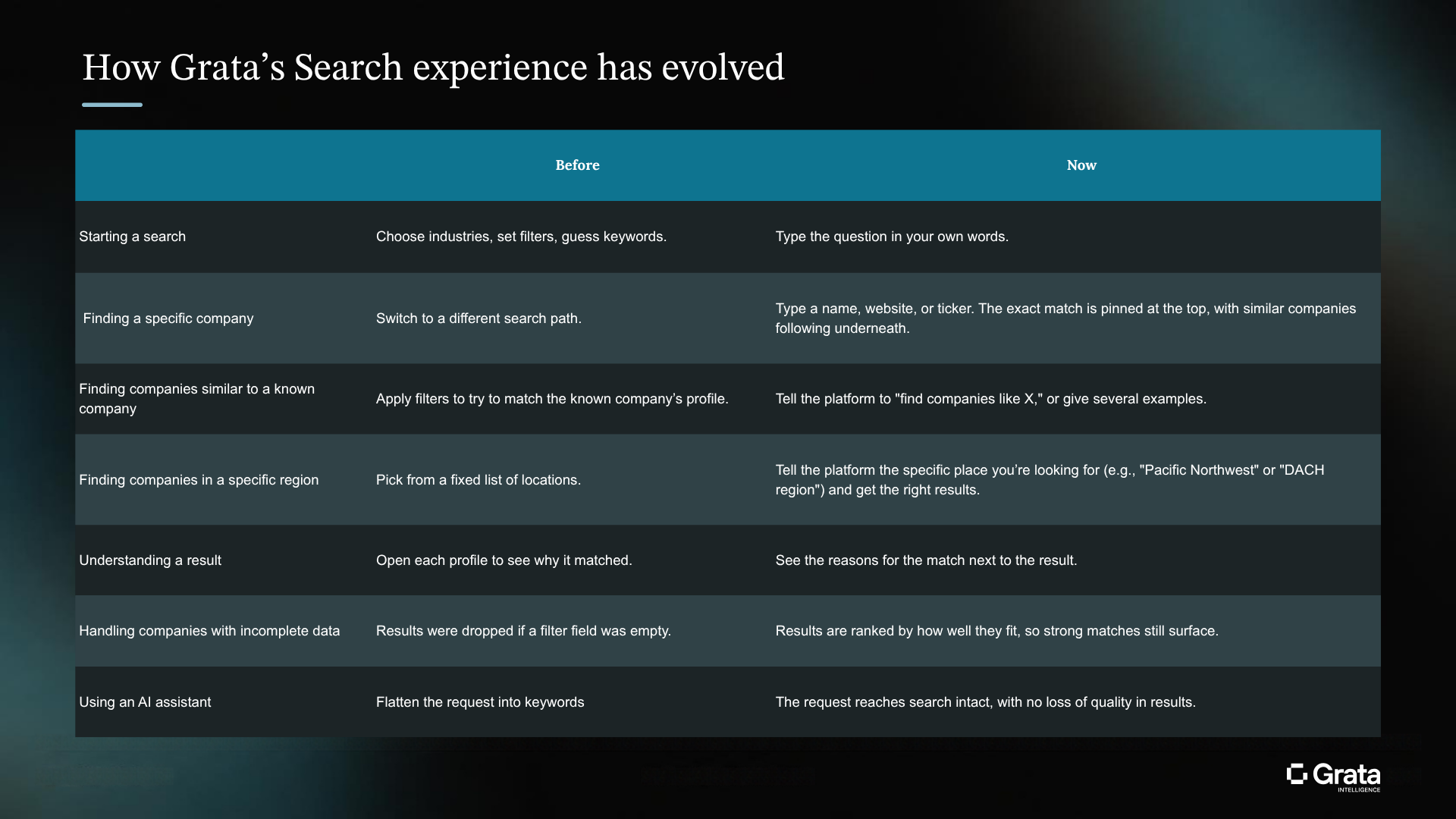
For years, finding relevant results in the Grata platform required the analyst to translate the criteria into the language of our index. Pick an industry from a list, set a location, add a few keywords, and hope the vocabulary matched.
But over the past year, the Grata team rebuilt our Search feature so that the system does that translation itself. Users can ask questions the way they would ask a colleague, and Grata Intelligence understands what you mean. The same engine now powers the Grata Intelligence app, the Blueflame agent, and third-party AI assistants connected through our MCP server.
In short, Grata Intelligence's Search now asks less of you and gives you more: fewer steps to start and more relevant companies on the first page in half the time.
Classic search treats every part of a query as a hard filter, so a company that matches four of five criteria disappears. We changed that. Everything we understand from a question becomes a signal that pulls a company up or down the list. We retrieve a broad set of candidates and rank them by how closely they fit the user's intent.
That is why a short, natural question now works. You no longer need to know which field or keyword the index expects, because the system carries that knowledge for you.
Before any index is touched, a query intent understanding layer reads the question and turns it into a query execution plan. The plan decides what to look for, how much each part ofthe question matters, and how the search should run. Everything downstream, from ranking to the evidence shown with each result, follows from that plan.
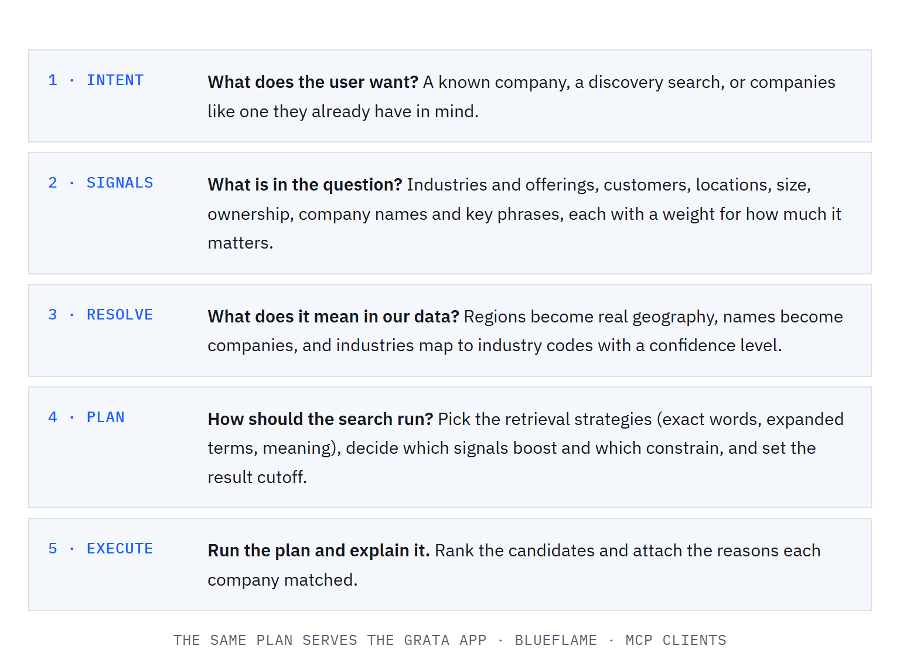
Say you search "B2B SaaS companies in healthcare withPE backing" in the Grata Intelligence platform. The query intent layer recognizes a discovery request, extracts the signals inside it, and builds a plan around them.
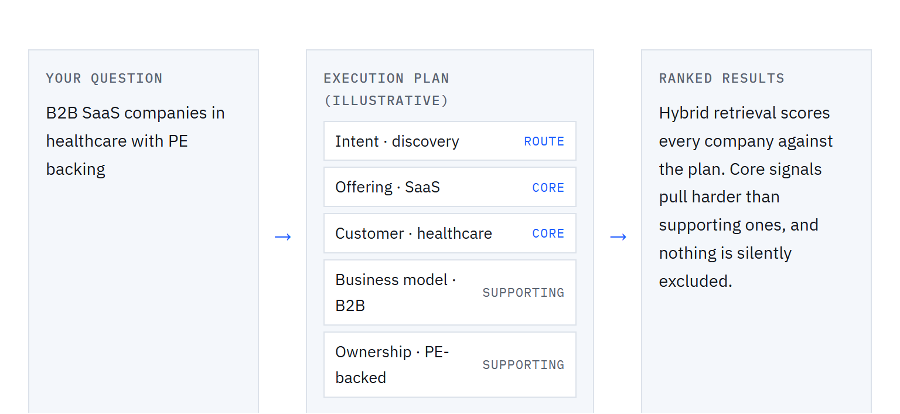
Because weights travel with signals, the plan can identify "healthcare" as the heart of a query from "healthcare" as a passing detail. This unlocks:
• The right path for the intent. A name, website, or ticker becomes a lookup: the exact match is pinned at the top and similar companies fall in beneath it. "Companies like X" runs a similarity strategy. A descriptive question runs a ranked discovery search. The user never has to choose.
• Business intent, not just words. If you search for "electric vehicle manufacturers," the plan understands the kind of business you want. Makers rise ahead of vendors, agencies, and single-site operators.
• Real-world geography. Regions like "DACH," "Pacific Northwest," or "Permian Basin" are aligned to the specific places users mean and applied as a boost or filter where relevant.
• Evidence you can see. Every result carries the reasons the company matched, grounded in data. You see what was understood and can refine with confidence. Agents get the same evidence to reason over.
• Consistency. Asking again returns the same results. In our consistency tests, identical plans always produced identical results (all 9 groups across 36 runs). Note that rephrasing still matters, because "healthcare SaaS" and "software vendors serving hospitals" are different (but related) questions.
We compared Agentic Search, our earlier LLM agent approach, with Intelligence Search on the same company search benchmark. The chart below plots normalized discounted cumulative gain at rank 50 (NDCG@50), which measures ranking quality down to the top 50 items, against search latency.
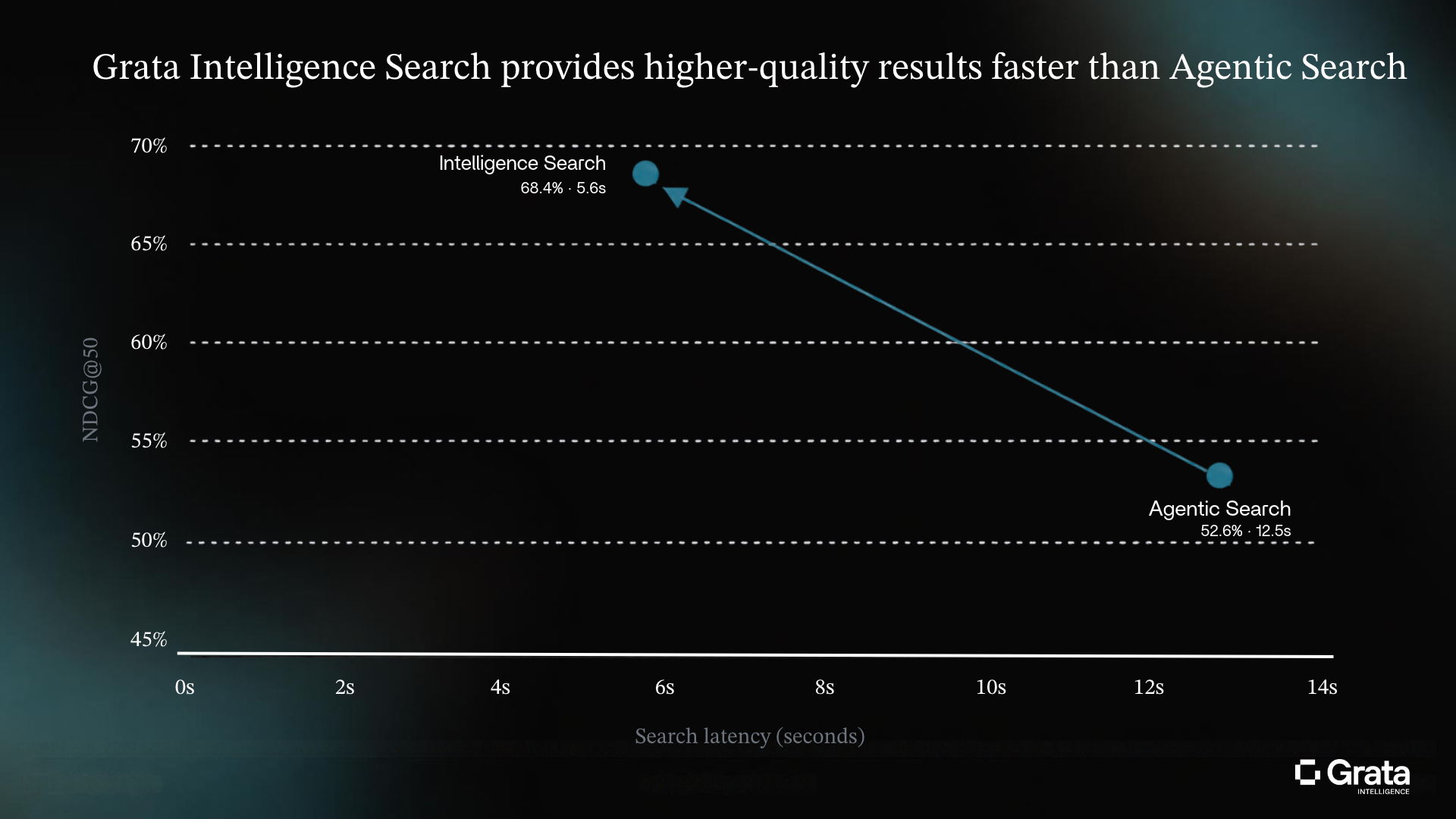
Company search precision benchmark. Intelligence Searchranks about 30% better (NDCG@50 of 0.684 against 0.526) and answers in 5.6seconds instead of 12.5.
High quality carries through the entire picture of a market, not just on the first page of results. Our market-sizing benchmark scores precision at five check points along each result list: the head, the 25th, 50th and 75th percentiles, and the tail. It then combines them into one estimated precision per query.
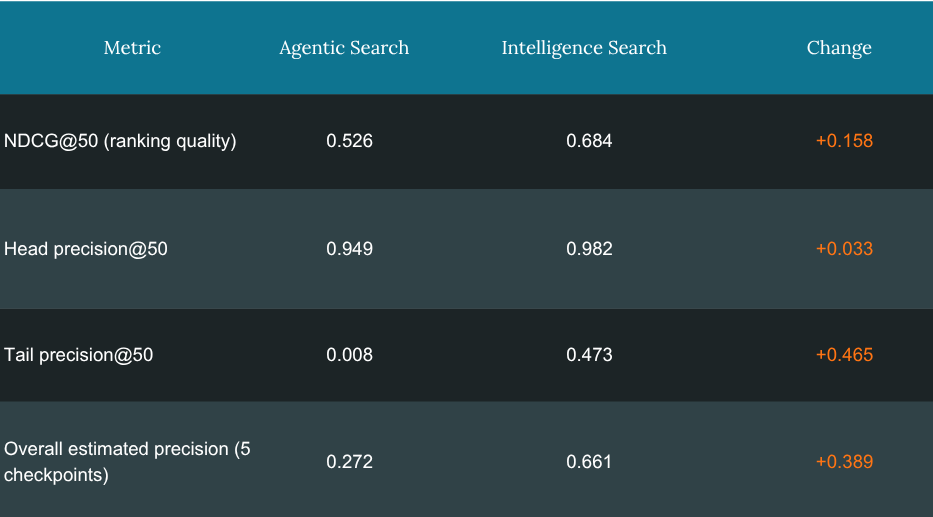
Before, Search asked Grata users to provide the right industry, filters, and keywords to find the best opportunities. Today, it just asks for the one thing users already have: the question behind their search. A query intent layer reads it, builds an execution plan, and ranks companies by how well they fit, with the reasons shown beside each result.
The payoff shows up in the work. Analysts start with fewer steps, see more relevant companies on the first page of results, and get answers in less than half the time.
In short, a more complex, sophisticated system simplifies workflows for the user — and improves quality along the way.
Want to try it for yourself? Schedule a Grata Intelligence demo here.

Monthly tactics from Grata’s team and operators.
From market trends to career advice, Grata’s content fuels smarter decisions.