Private Equity
Market Trends
North America
The PE Playbook: Death Services
Understand the key private market trends shaping the death services industry - growth segments, M&A, and top roll-up strategies.




Agentic AI’s reach in the M&A world is expanding, and it’s not showing any signs of slowing down.
For the analyst, key workflows from sourcing to market research to diligence are becoming more straightforward and efficient. They can explore an idea, map a market landscape, and build a list of promising targets with a single prompt.
But to make that happen, AI agents are taking on increasingly complex tasks behind the scenes. As the agents put more work in, the team’s token consumption rises — which can also drive up costs. So as deal teams evaluate their agentic AI tools, the question they have to answer is this: “How much high-quality, useful work are we getting out of each dollar we spend?”
Below, we break down how AI tokens work, how agentic AI is changing the equation, and how Grata Intelligence, the new agentic M&A workspace from Datasite, reduces unnecessary work and optimizes token efficiency.
AI models process information — such as numbers, text, images, spreadsheets, or audio files — piece by piece. A token is the single smallest piece of information processed by an LLM. AI models read prompts as a sequence of input tokens, then generate responses one output token at a time.
Each model also has a context window, which represents the maximum amount of data — measured in tokens — the model can read, process, and “keep in mind” in one call. When a model has too much context for a given task, information can get lost in the middle. That’s why key considerations of token efficiency often overlap with considerations of context management.
Agentic AI allows for workflows that involve a larger number of discrete steps, interactions, and more intricate processes than a simple chatbot. An interaction with a chatbot makes one model call. But agentic workflows link many calls together, carrying context forward and adding in new information as it works through the turns.
Token consumption racks up across every step.
Major players like OpenAI, Anthropic, and Google sell access to their models in two main ways:
Model prices vary widely. Each provider sells a range of models and tiers, from small, fast models to large frontier models built for deep reasoning, and the per-token rate generally climbs with capability. For leading providers, prices range from $0.10 to $20+ per million input tokens and $0.50 to $50 per million output tokens — a 100x difference between lower-cost and premium-model tiers.
When it comes to calculating the cost of pricing an agentic system, there are three main drivers:
Agentic workflows compound each of these factors, because each step adds model calls, context, and output. As dealmakers pass off more tasks to AI agents, they need to consider how much high-quality work they’re actually getting out of their tokens.
For dealmakers, integrating agentic AI into M&A workflows can get expensive quickly — especially if they’re using a general-purpose LLM versus a purpose-built platform like Grata Intelligence.
Let’s say an analyst asks an AI agent to find software companies that match a specific investment thesis, identify the strongest targets, compare them with the firm’s previous investments, and put together an initial screening analysis. For the analyst, that’s all one instruction. But behind the scenes, the agent has to run a chain of operations that can invoke multiple models and tools.
Without direct access to pre-processed deal intelligence to pull from, the agent has to assemble its own picture of the market. It wastes tokens repeatedly searching the web for information about company ownership or headcount, and digging through multiple disparate systems for transaction information, VDR documents, CRM data, and more.
However, that doesn’t mean that efficiency = fewer tokens used. Efficiency boils down to what the team gains from the tokens that are used. Grata Intelligence brings the sources closer to Blueflame, Datasite’s M&A agent, so that it spends less computational effort gathering the context to complete a request.
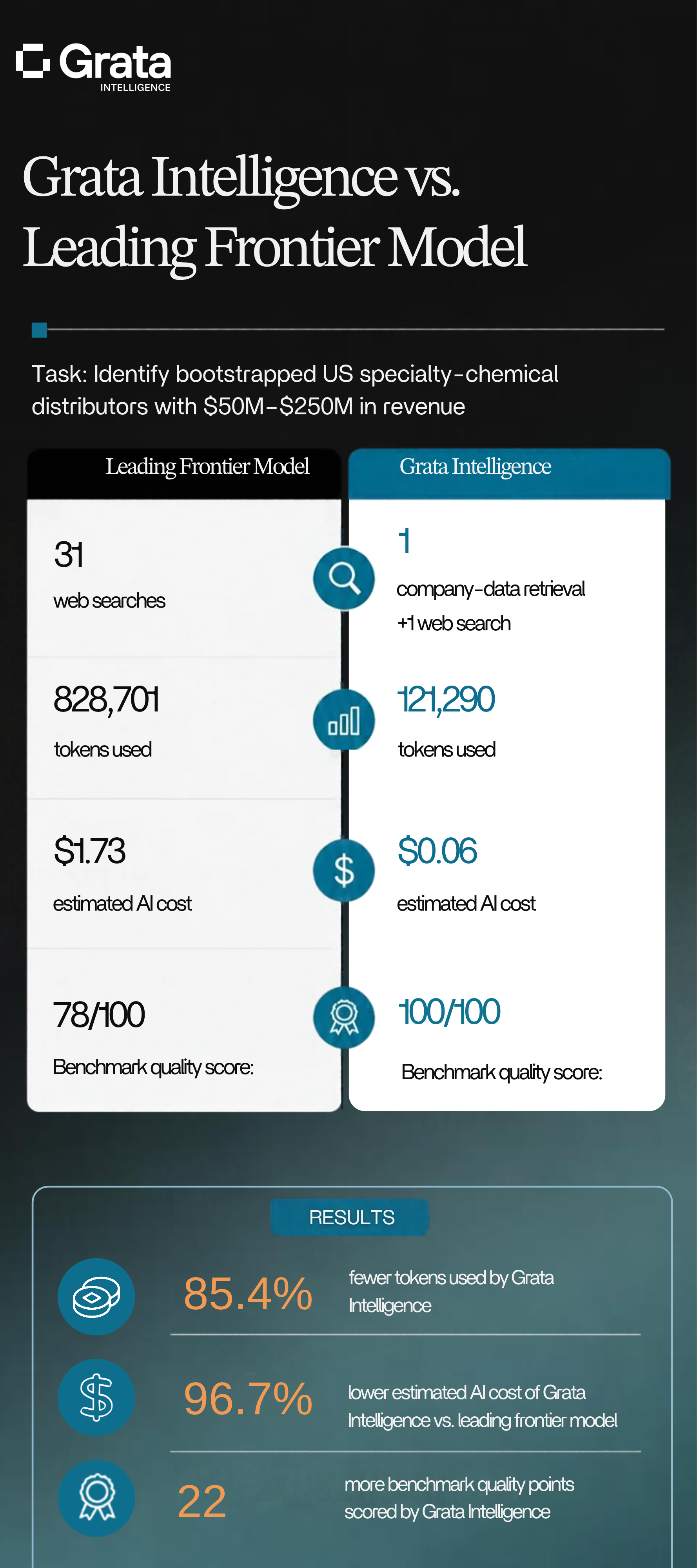
For example, when prompted to, “Give me a first-pass list of bootstrapped specialty chemical distributors in the US with revenue between $50M and $250M,” Grata Intelligence completed the task using 85.4% fewer tokens at 96.7% lower AI cost than a leading frontier model. Grata Intelligence’s output quality scored 100/100, compared to 78/100 for the alternative.
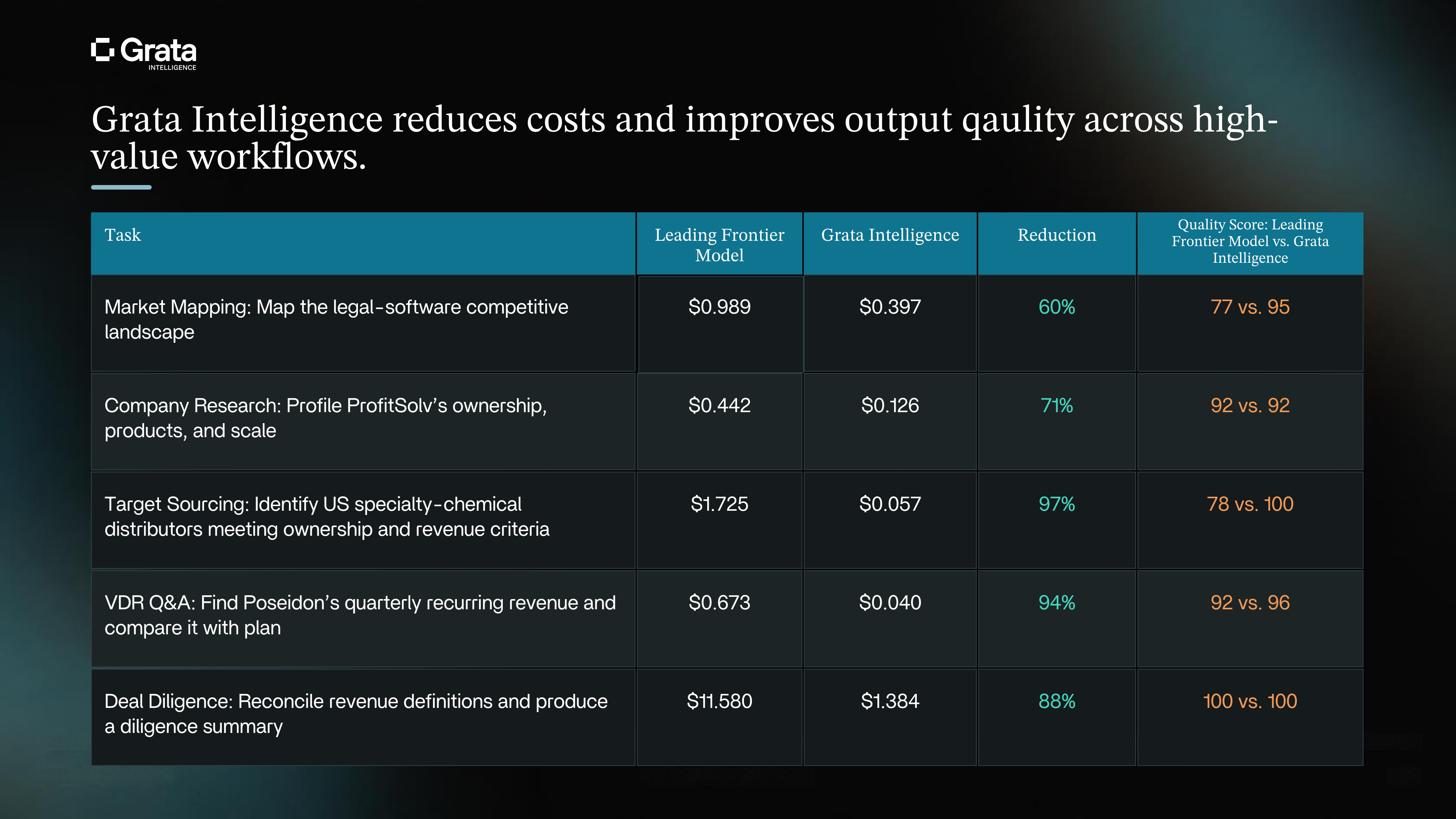
In a separate scenario, Grata Intelligence reviewed an acquisition target’s revenue and produced a diligence summary using 11% fewer tokens, and at an estimated 88% lower AI cost, than Claude Code — while matching its output quality score.
The Grata Intelligence system relies on four architectural components to maximize efficiency:
Here’s how they work in practice.
When an AI agent lacks direct access to the data it needs, it pays a search tax. That's the computation an agent spends searching, opening sources, ingesting pages, deciding which ones matter, reconciling conflicting information, and extracting the facts — all before it can start the analysis that the dealmaker requested.
Take market mapping, for example. A complete market map has to paint the entire picture of a given industry, including the private companies that surface-level research misses. If an AI agent has to rely on searching multiple disparate sources across the web, it wastes valuable tokens on a process that will ultimately miss huge swaths of the market anyway.
Grata Intelligence eliminates the search tax by bringing the AI agent closer to structured, verified private market intelligence. The Blueflame agent can retrieve the precise information needed for the task directly from Grata’s deep data reservoir, without any of the extra hassle. This way, more of the AI token budget goes to analysis.
Source: Grata Intelligence
Efficient architecture for M&A workflows identifies which information is relevant to the task at hand and provides that information as context. Retrieve what matters first, then conduct the analysis.
Grata Intelligence's integrated AI agent, Blueflame, uses graph-based retrieval-augmented generation (GraphRAG) to organize the data it retrieves as a knowledge graph. It maps the companies, people, transactions, and documents relevant to a deal and identifies the connections between them.
Say an analyst is looking for founder-owned regional HVAC companies that compete with one of the firm’s portfolio companies. GraphRAG starts at the portfolio company and follows the lines outward, first to its competitors, then to each competitor’s owners. The agent passes the model only those connected pieces, conserving input tokens.
In the M&A world, that’s a crucial advantage. Private market data is difficult to find, especially all in one place. Grata Intelligence not only holds all of the pieces that dealmakers need, it makes the connections before the analysis stage so that users get the most out of their AI tokens every time.
Each task in an M&A workflow calls for a different level of model capability. Extracting a field from a filing, for example, and reasoning through a valuation question each use different amounts of computing power.
Running a frontier model on every step would be like putting a managing director on spreadsheet duty. A junior-level analyst can pull revenue from a filing, tag documents, and log comps just as well; save the managing director’s time for valuation judgments and deal structuring.
Blueflame’s architecture is model-agnostic. It supports models from Claude, ChatGPT, Gemini, and other providers, but it knows that those aren’t right for every task. Blueflame helps dealmakers get the most out of their AI consumption by choosing the model that makes the most sense for the work at hand, balancing speed, accuracy, and cost.
Datasite’s data science team builds benchmarks based on the challenges that AI encounters in financial workflows and tests the full system around each model. The results decide which models and approaches handle each task best.
Users can also choose a specific model if they know it’s appropriate for their task at hand, or if they prefer to keep hold of the reins when making decisions around speed, cost, and accuracy trade-offs. Even in this case, the user would still retain Blueflame’s GraphRAG, memory system, context management, and integrations with their chosen model.
It’s easy to compare AI tools by price per token, but that won’t tell you much about token efficiency. The metric that dealmakers need to consider is cost per completed task. This accounts for everything a firm pays to get quality work: model usage, retrieval, tools, and the time an analyst spends reviewing and fixing the output.
Say Tool A completes a task for $0.70 in AI usage and Tool B costs $1.10. On the surface, Tool A looks cheaper. But then the analyst spends 20 minutes correcting Tool A’s output, while Tool B’s output is ready to go. Counting the analyst’s time, Tool B works out to be cheaper.
So, how do Grata Intelligence’s data, retrieval, and model orchestration work out when it comes to lowering the cost of high-quality M&A work? See for yourself.
Source: Grata Intelligence
Grata Intelligence is part of a larger vision for how M&A gets done. Datasite is building the essential infrastructure for M&A — secure, AI-native technology, integrated product and market intelligence, and enterprise systems designed to support dealmakers at global scale.
Grata Intelligence advances that vision by connecting more of the information, context, and execution behind the deal lifecycle. As AI takes on a larger role in complex M&A work, the advantage will come not from AI alone, but from giving it the right data and context to work alongside dealmakers effectively.
Grata Intelligence helps deal teams make better-informed decisions, accomplish more, and move the right opportunities forward with greater speed and conviction.
Ready to see it in action? Request a demo here.
Grata Intelligence is an agentic M&A workspace. It combines Grata’s proprietary market data and signals, firm knowledge, VDR content, transaction data, and evolving deal context with Blueflame, Datasite’s M&A agent. Dealmakers use it to execute deals from sourcing and research through diligence, close, and monitoring.
A token is a unit an AI model uses to process and generate information. Input tokens cover what the model reads, and output tokens cover what it generates. AI providers price the two differently.
A chatbot responds to a prompt. An agent can execute multi-step workflows that call multiple models, tools, skills, files, and data to complete the request. Token consumption can increase with the amount and complexity of the work.
Token efficiency measures how effectively AI consumption converts into useful work. The most efficient system delivers the most useful work per unit of consumption.
The search tax is the computation an AI agent spends searching, reading, reconciling, and extracting facts from the web before it can start analysis. Direct access to clean, structured data reduces it.
It works at four points. Blueflame has direct access to structured Grata company and market data, which allows the agent to search and retrieve relevant information more efficiently. Multi-model orchestration selects the model for each task that best optimizes for speed, efficiency, and cost. Persistent deal context lets Blueflame reuse what it already knows without rebuilding at every step.

Monthly tactics from Grata’s team and operators.
From market trends to career advice, Grata’s content fuels smarter decisions.