
Search
Workflows
From Filters to Intent: How Grata Intelligence's Search Evolved to Understand Users' Questions
Understand how Grata Intelligence's Search feature has evolved to provide the most relevant results for dealmakers, faster.




When it comes to total addressable market, no industry compares to death services.
Thinking about the end of life may be uncomfortable, but businesses in the death services space are working to provide as much agency, personalization, and peace of mind as possible.
Companies operating in the funeral homes, coffins, caskets, & urns, pre-need planning, and cremation services sectors also present a wealth of opportunities for private market dealmakers.
In this PE Playbook, the Grata team has put together the need-to-know trends for investors considering making moves in the death services market, including:
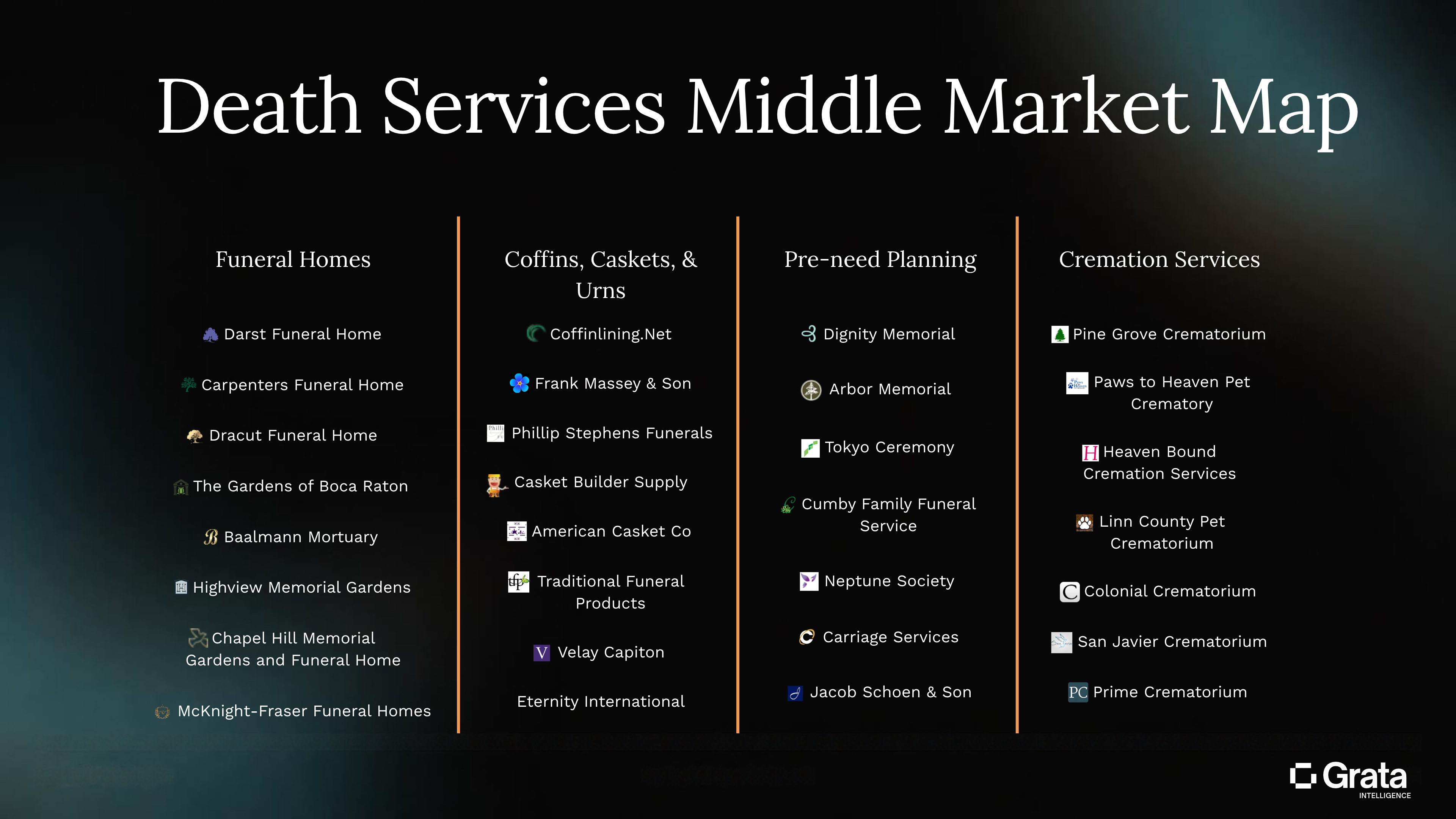
Source: Grata Intelligence
The market map above is not intended to be an exhaustive representation of companies in the space.
Companies that provide services that fall into multiple segments are categorized in this report by their primary offering.
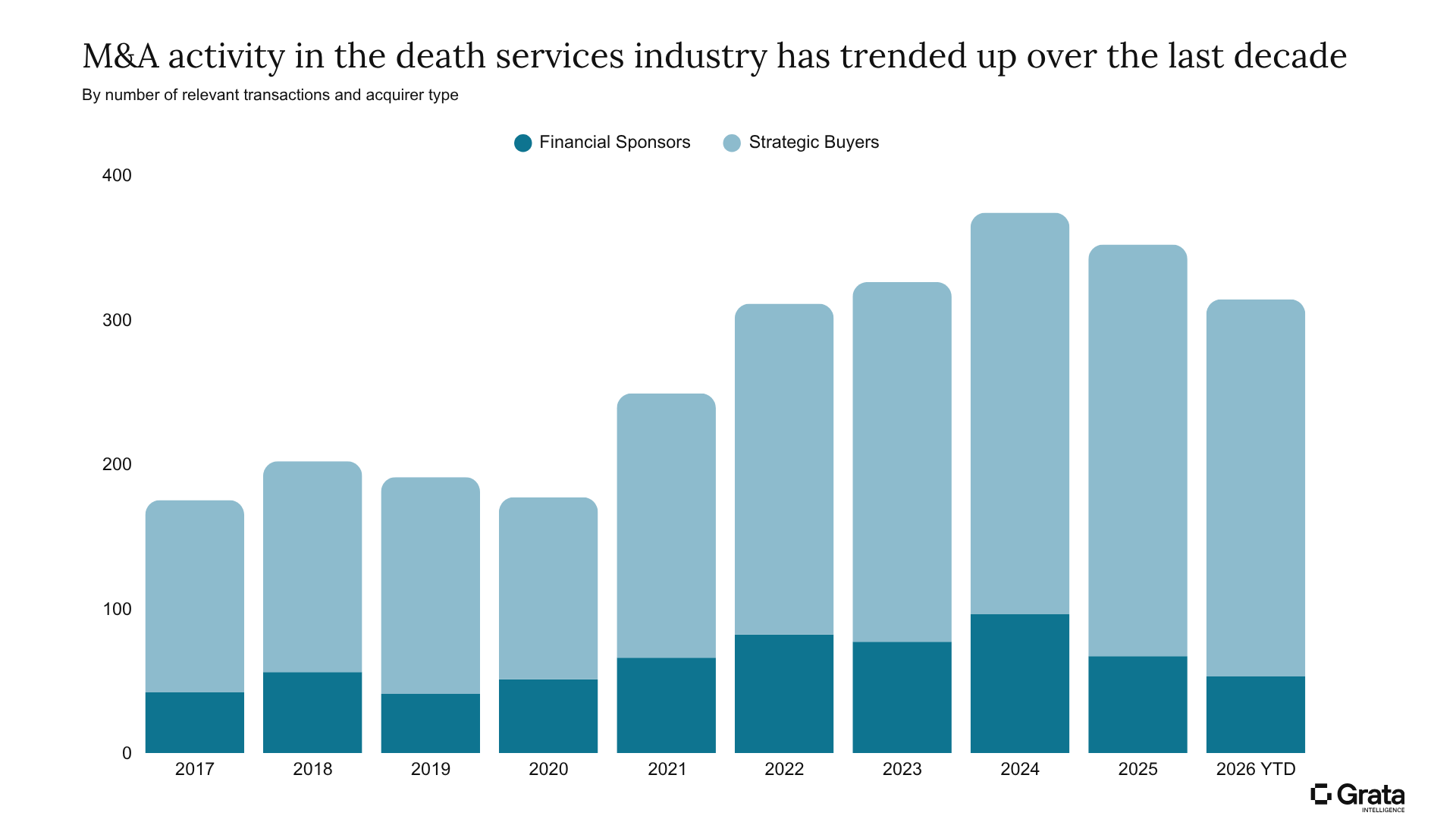
Source: Grata Intelligence
M&A transactions in the death services industry have roughly doubled over the course of the last 10 years, led by strategic buyers. 2026 is on pace to rival the peak the industry saw in 2024, with over 300 deals closed so far.
A few key factors are driving the activity:
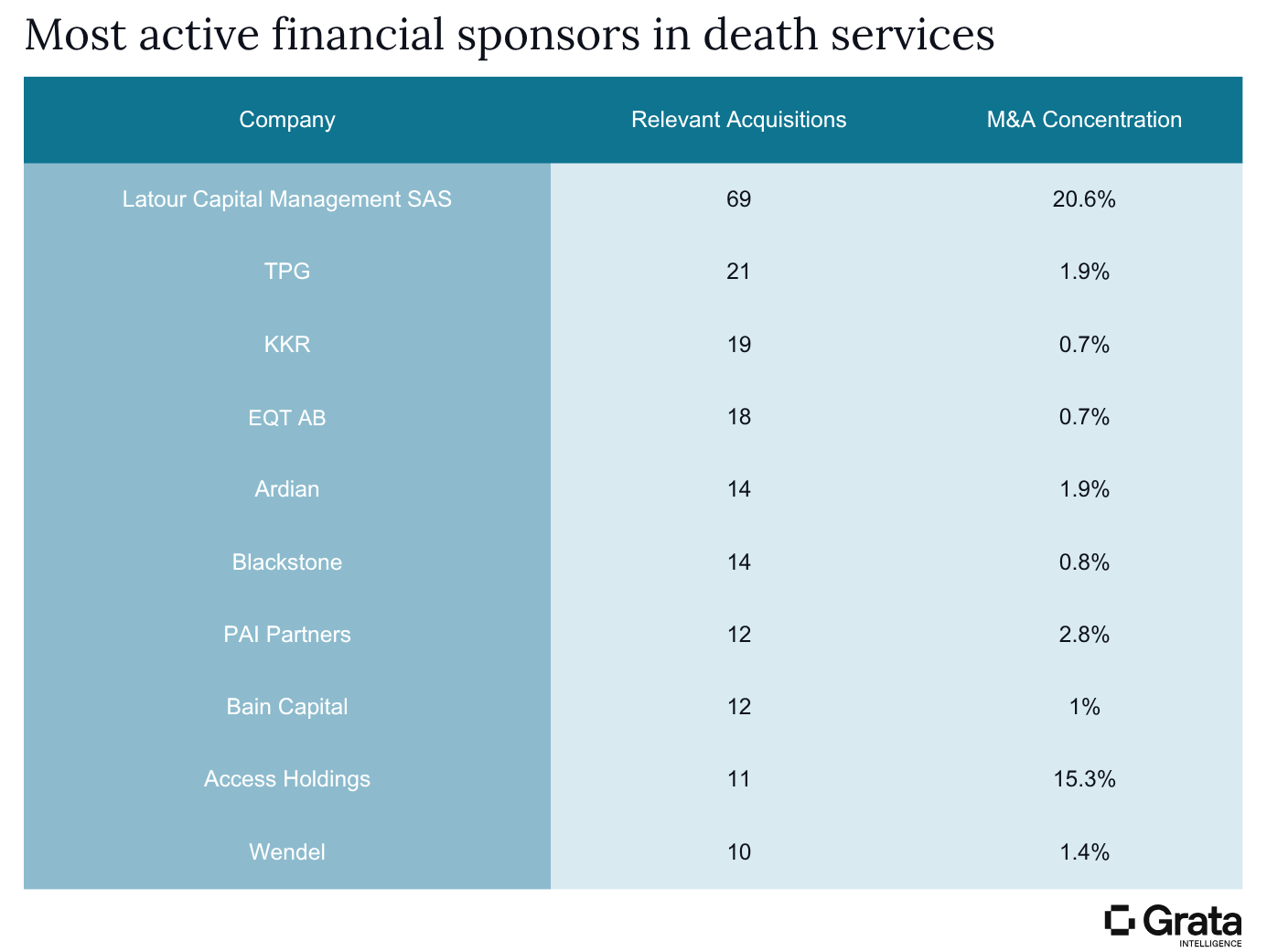
Source: Grata Intelligence
Latour Capital Management tops the list of most active financial sponsors in the death services industry with 69 relevant transactions. Its activity in the space focuses on funeral homes, crematoria, and coffin material suppliers.
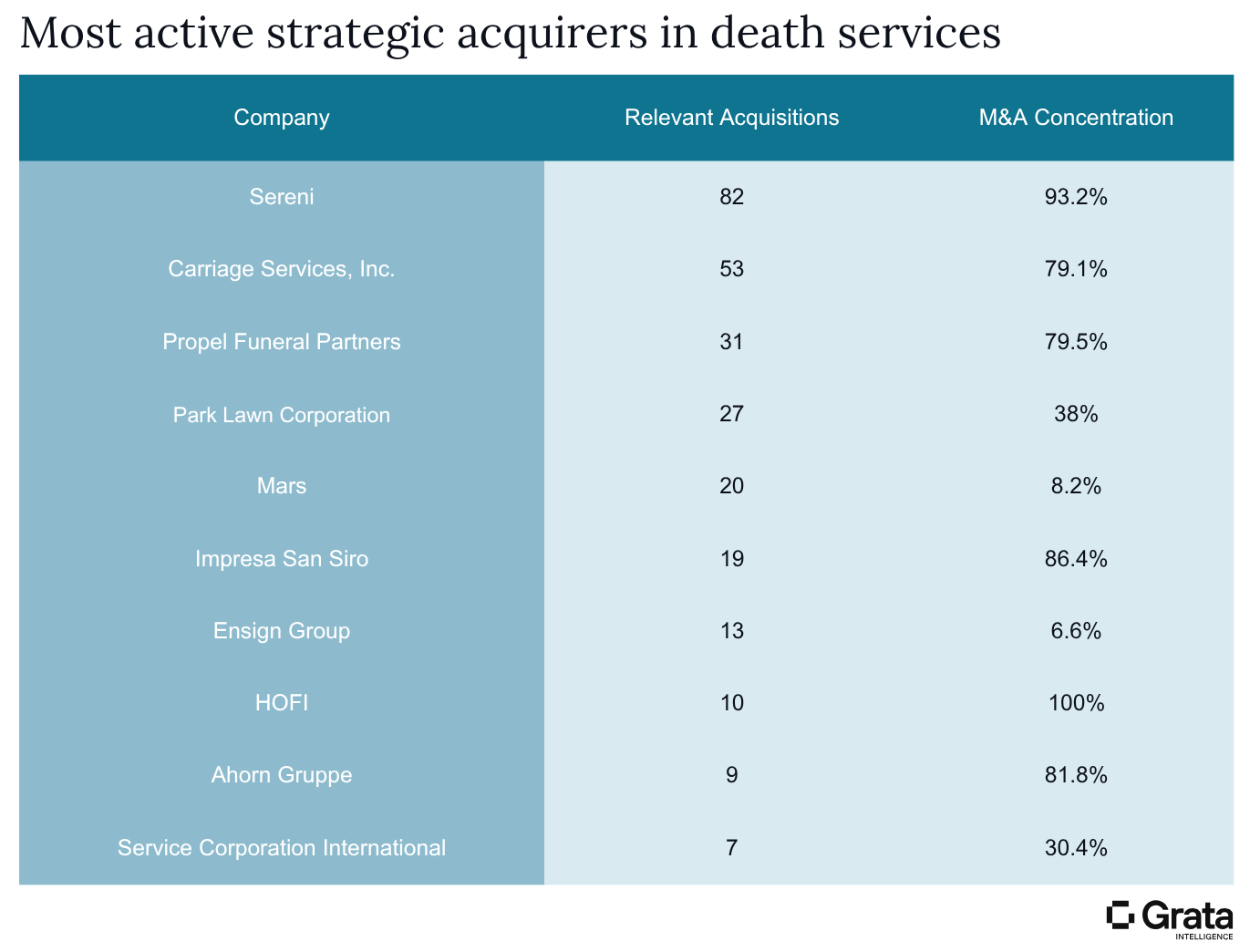
Source: Grata Intelligence
Sereni is the most active strategic acquirer in the death services industry with 82 relevant deals. The company operates around 450 funeral homes across Belgium, Germany, and Poland. It added approximately 300 funeral homes in the UK through its merger with Funeral Partners in August.
Source: Grata Intelligence
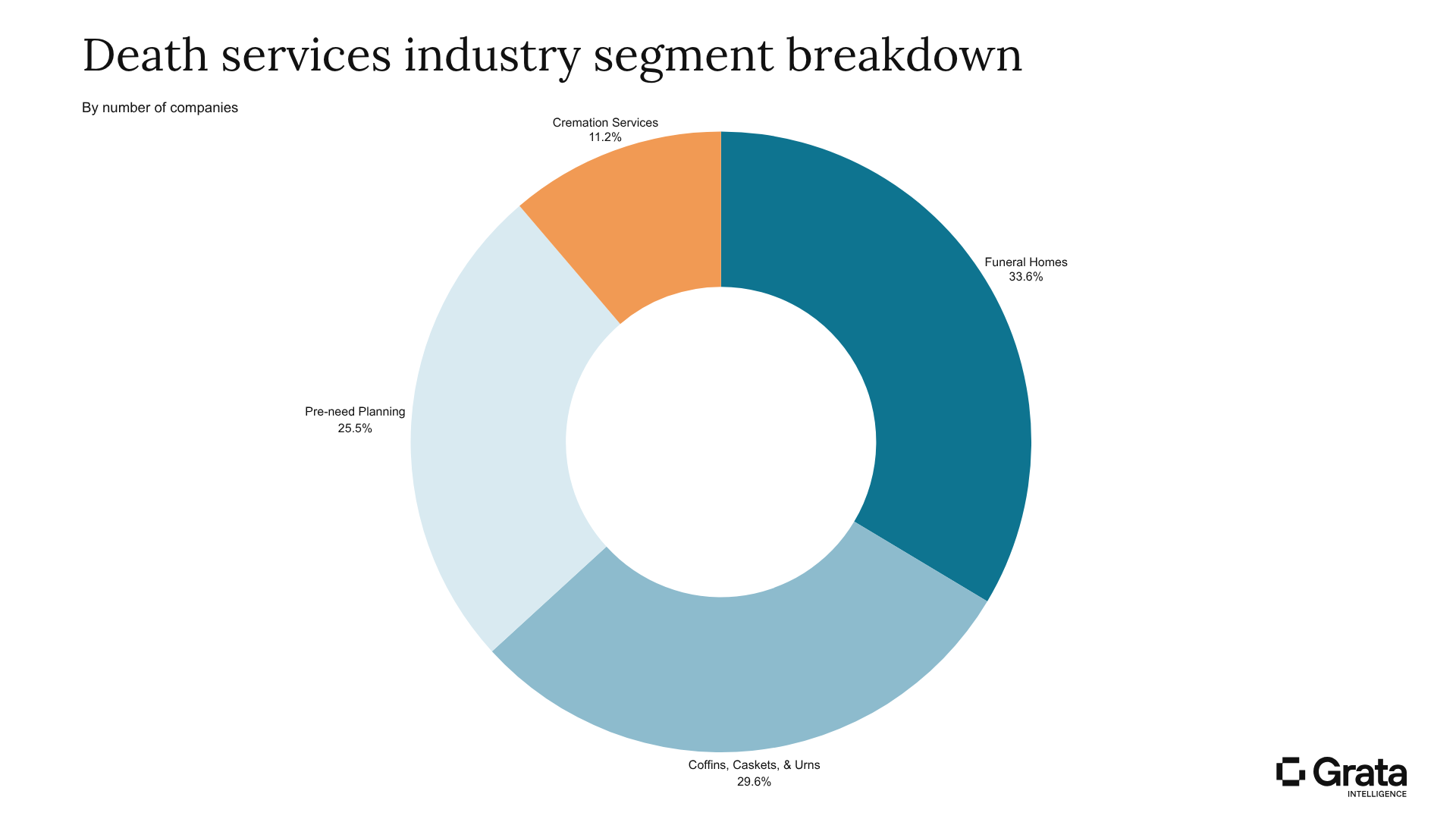
This report focuses on the following segments of the death services industry:
Source: Grata Intelligence
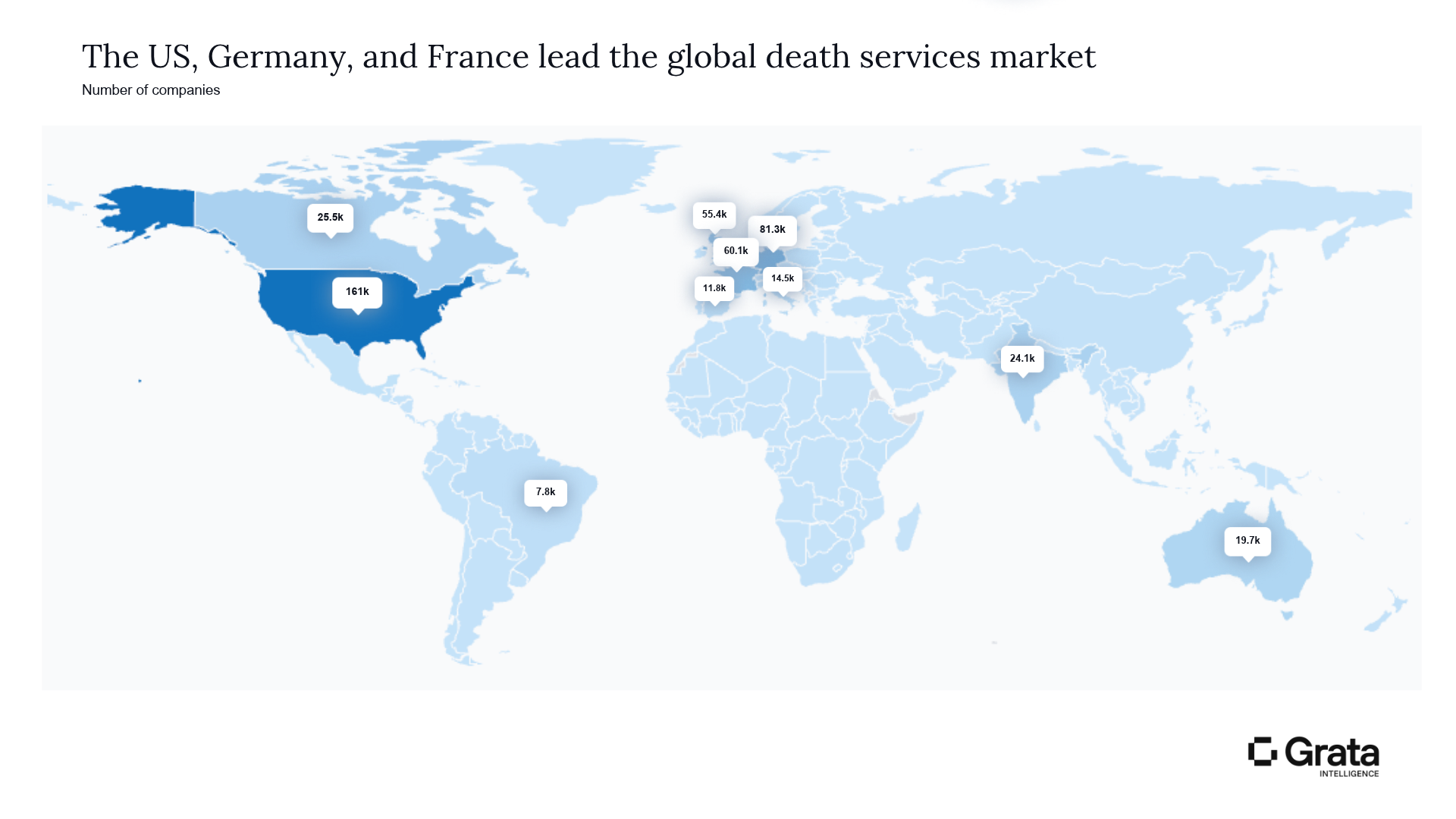
The US leads the global death services market by a wide margin, with over 161,000 companies. Germany and France are the next-largest markets, with approximately 81,300 and 60,100 companies, respectively. The UK follows with about 55,400. Other notable markets include Canada, India, and Australia.
Source: Grata Intelligence
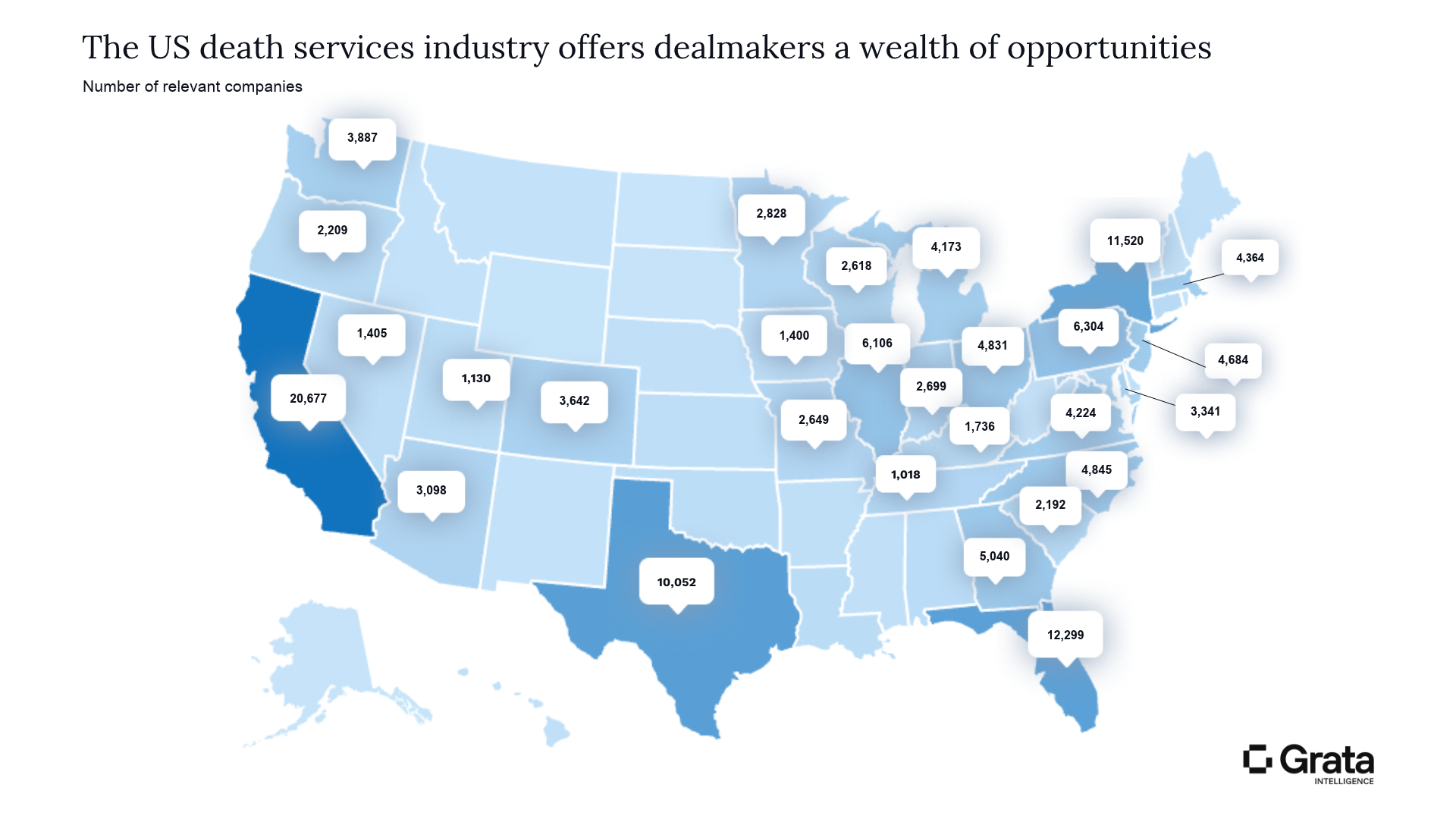
For US-focused dealmakers, opportunity runs from coast to coast. Here are some key trends to consider:
Source: Grata Intelligence
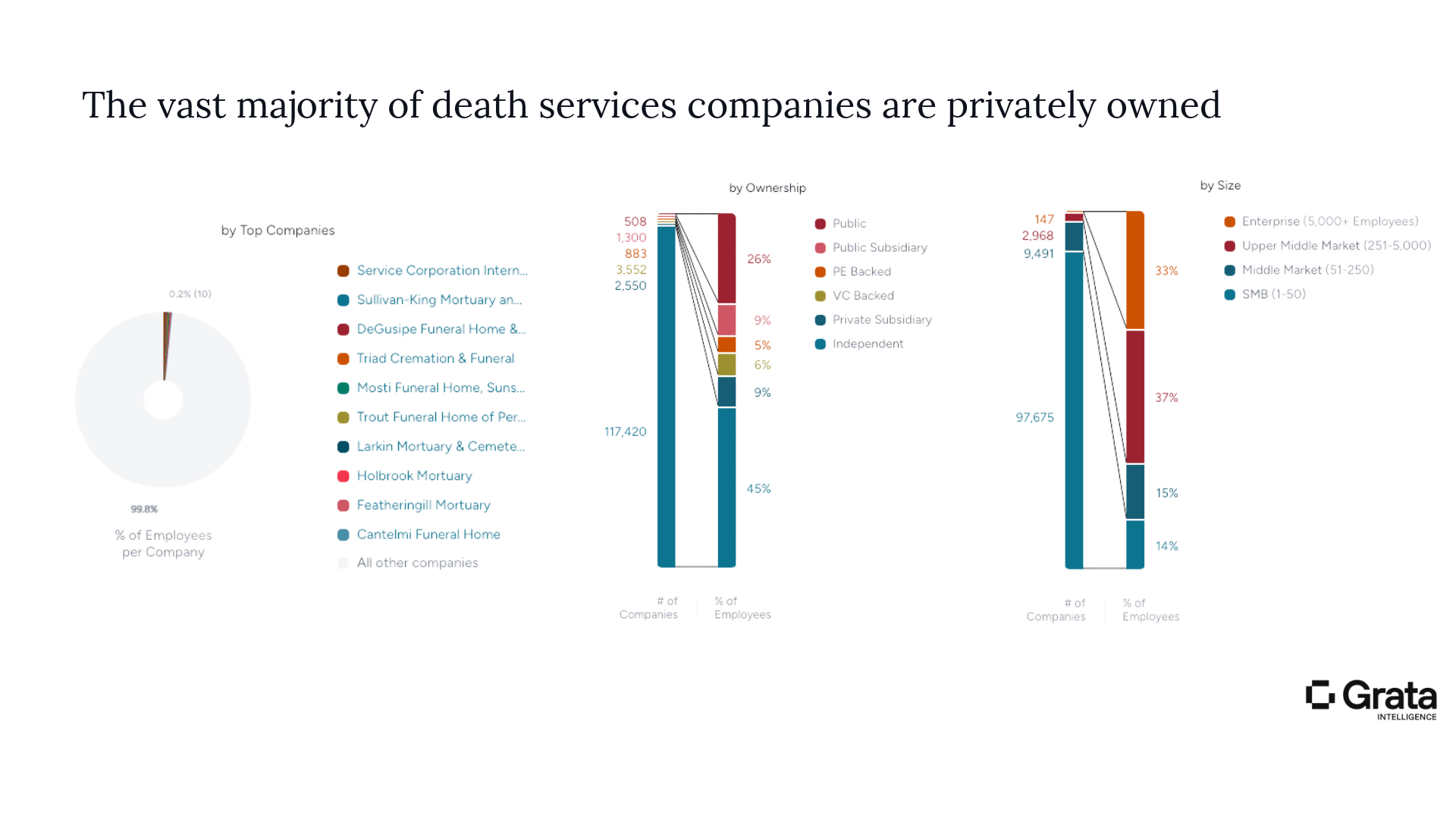
The vast majority of companies in the death services industry are privately owned. There are currently over 124,000 companies in the space that are ripe for acquisition.
Source: Grata Intelligence
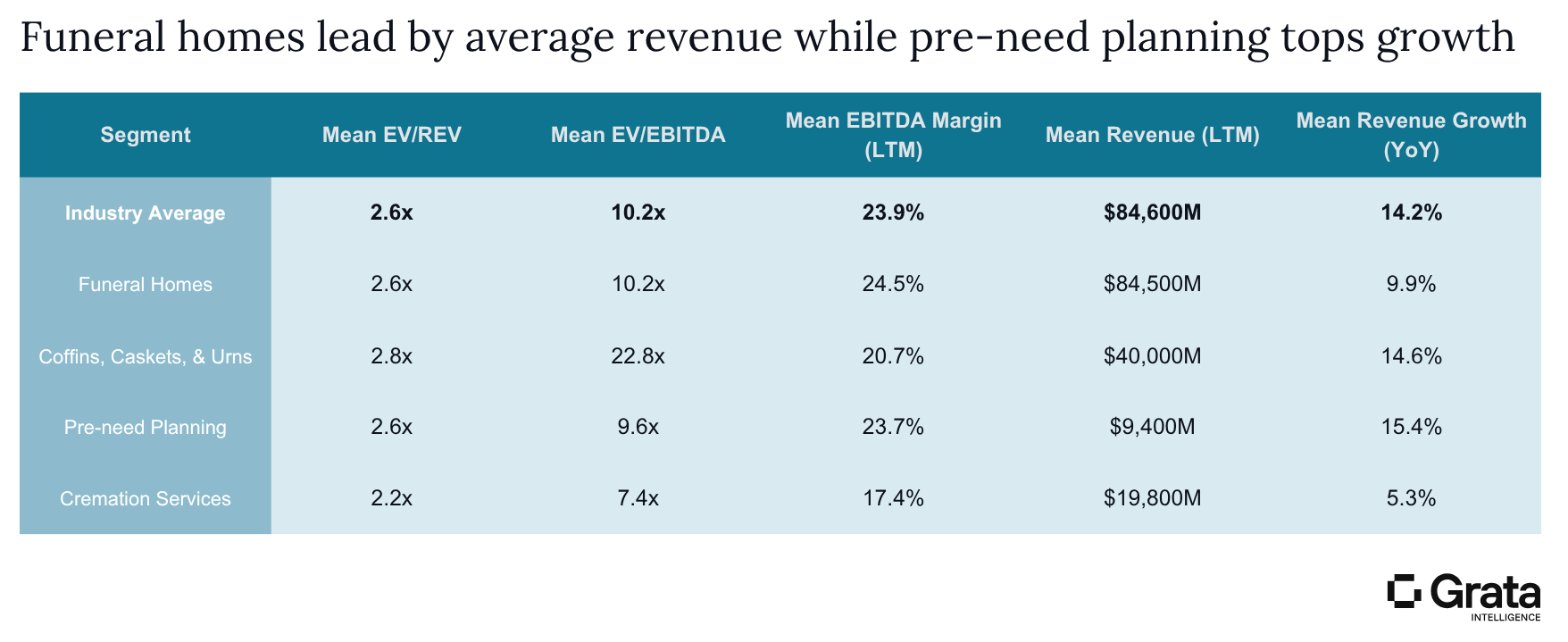
In the public realm, the pre-need planning sector leads the global market in terms of average growth. Funeral homes grow 9.9% and cremation services 5.3%. One likely reason is that prepaid contracts commit families to future services, which gives listed planners a visible revenue pipeline.
Funeral homes earn the highest average EBITDA margin at 24.5% and lead on average revenue, while cremation services earn the lowest margin at 17.4%. Cremation funerals cost families less than burial funerals, which likely holds down margins. In the US, a funeral with viewing and burial cost a median $8,300 in 2023, compared with $6,280 for a funeral with cremation, according to NFDA.
The public coffins, caskets, and urns sector commands the highest valuation at 22.8x EV/EBITDA, more than double funeral homes (10.2x), pre-need planning (9.6x), and cremation services (7.4x). By region, the segment's multiple ranges from 7.6x in APAC to 25.4x in the US, which indicates that a few listed companies set each regional mean.
Source: Grata Intelligence
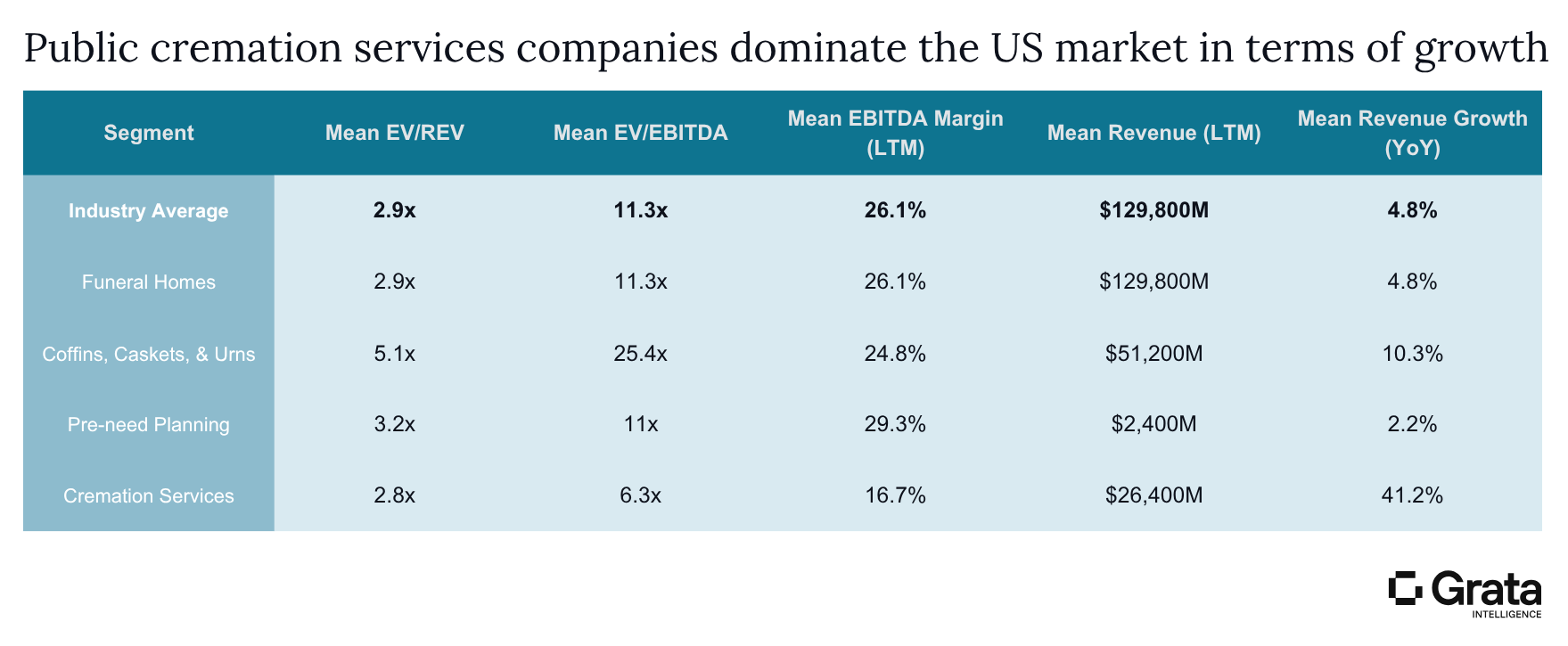
In the US, public cremation services companies see the highest average growth at 41.2%, far ahead of the next segment, coffins, caskets, and urns (10.3%). NFDA estimated the US cremation rate at 63.4% in 2025, up from 61.9% in 2024.
Cremation services also post the lowest margin (16.7%) and the lowest EV/EBITDA (6.3x) in the US set, which makes sense given cremation's lower price per service.
Source: Grata Intelligence
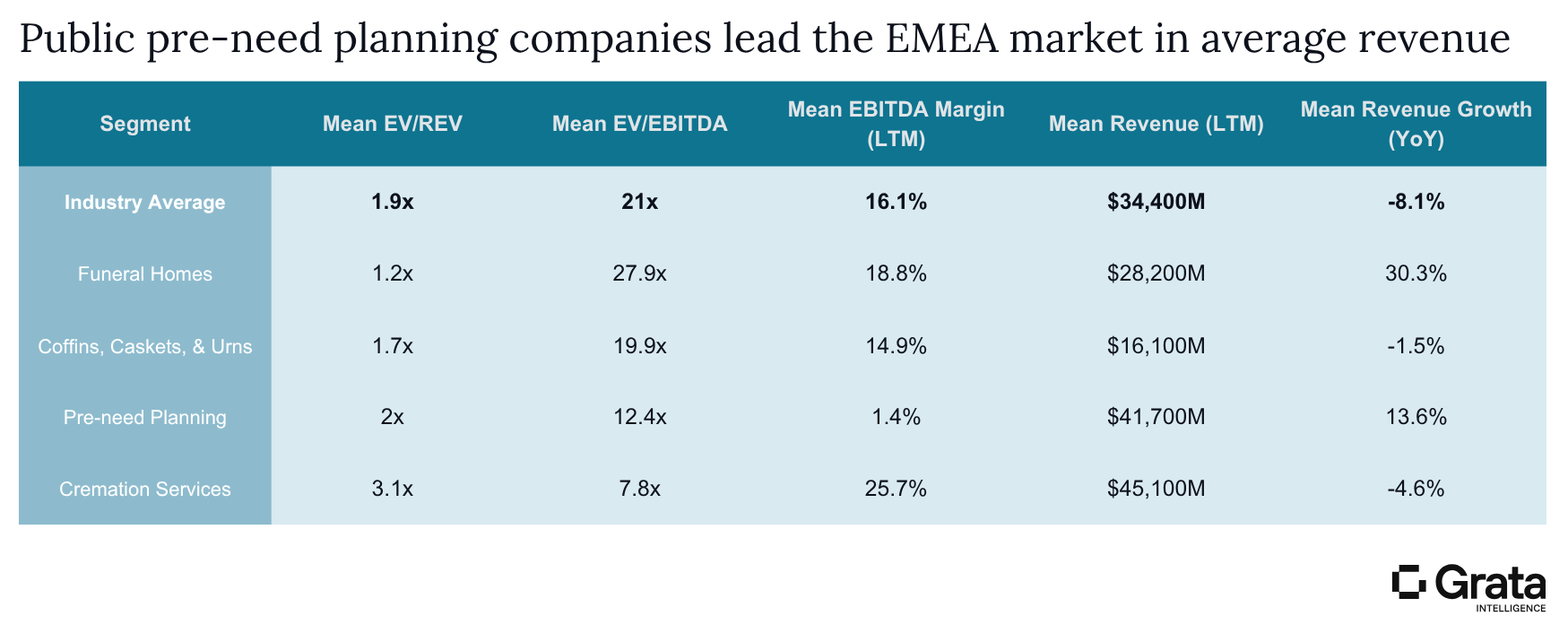
Funeral homes lead EMEA’s public death services industry by growth at 30.3% and carry the highest EV/EBITDA at 27.9x. Acquisitions likely lift reported growth, since consolidators in the region are paying for scale.
Cremation services lead on average revenue and margins. Mature cremation markets likely leave little room for share gains. When Ontario Teachers' and USS bought Westerleigh in 2016, more than 75% of UK deaths already ended in cremation.
Source: Grata Intelligence
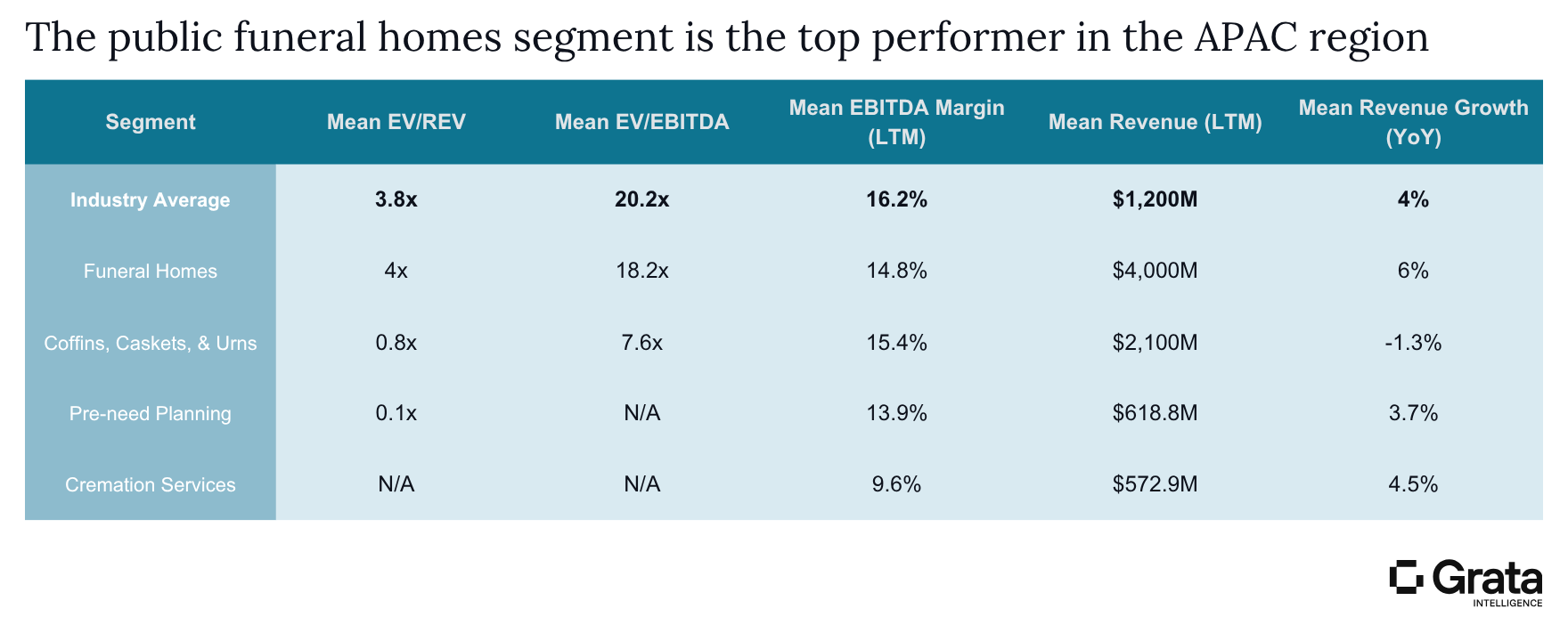
Funeral homes top the APAC public set on growth, revenue, and valuation, at 4x EV/REV and 18.2x EV/EBITDA. Coffins, caskets, and urns shrank 1.3% and trade at 0.8x EV/REV and 7.6x EV/EBITDA. Funeral homes earn a fee on every death, so listed operators likely benefit as the region's populations age.
Grata shows no EV/EBITDA for pre-need planning and neither multiple for cremation services in APAC, which points to a very small listed set in those segments. Pre-need planning grew 3.7% and cremation services 4.5%, on EBITDA margins of 13.9% and 9.6%.
Source: Grata Intelligence
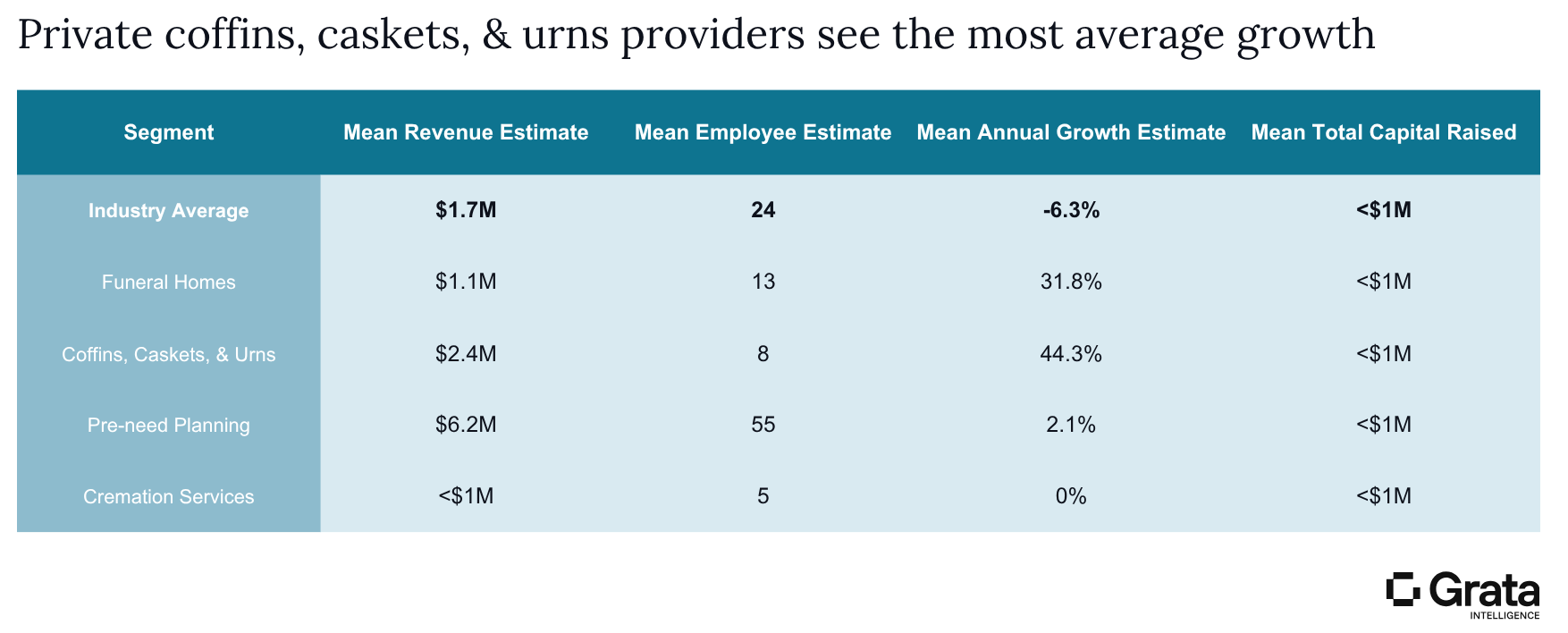
In the private sphere, coffins, caskets, and urns companies are seeing the fastest growth worldwide at 44.3%. The segment averages eight employees and $2.4M in revenue, so a few fast-growing firms can elevate the mean.
Pre-need planning companies are the largest private group by revenue at $6.2M and by headcount at 55 employees. Prepaid plans tie a provider to obligations that run for years, which likely favors larger firms with more capital.
Private companies trail public peers in pre-need planning (2.1% versus 15.4%) and cremation services (0% versus 5.3%). Capital access likely explains much of the gap, since every private segment shows an average of less than $1M raised.
Source: Grata Intelligence
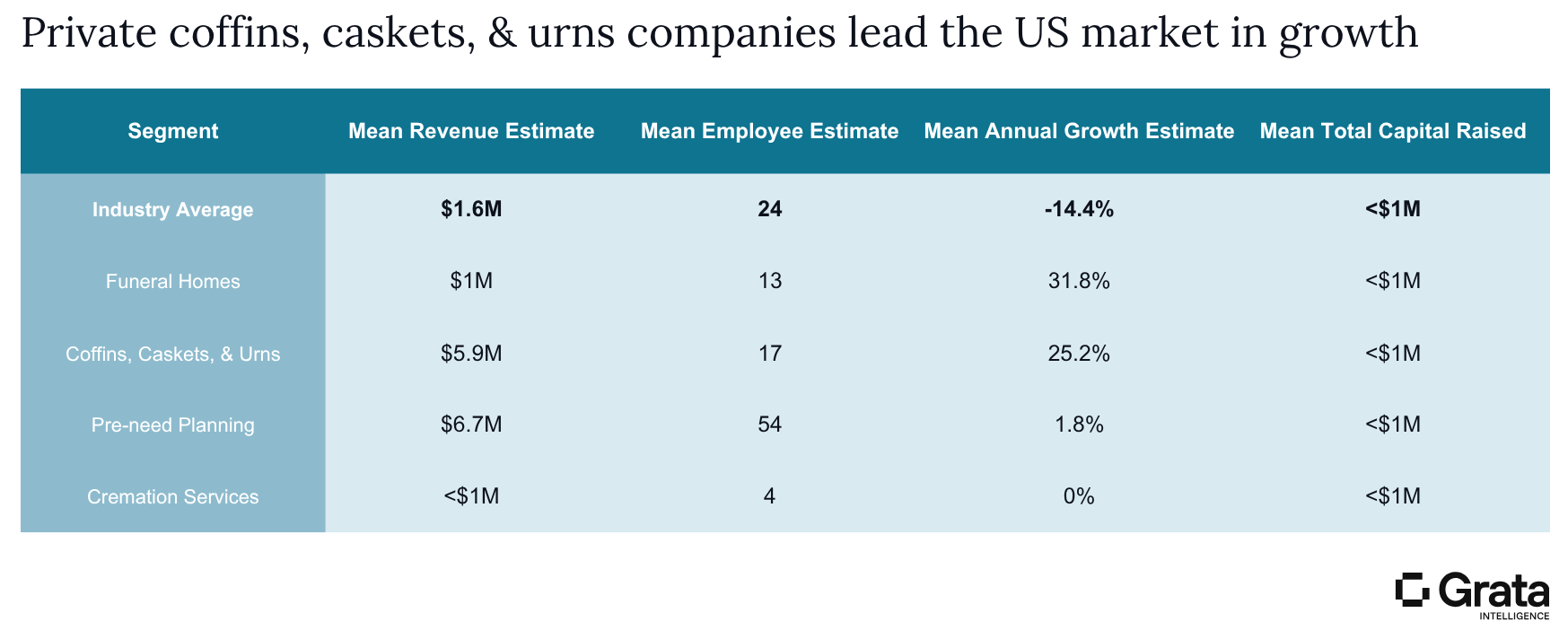
Within the US, private funeral homes see the fastest average growth at 31.8%, ahead of coffins, caskets, and urns at 25.2%. Note that both segments are tiny, with companies employing an average headcount between 13 and 17, so a few expanding firms can lift the mean.
The national backdrop is slower. US funeral homes are a mature, mostly independent industry, and the casket market is shrinking as families choose cremation. Funeral Director Daily reports that national casket sales fell from more than $700M in 2014 to about $550M in 2018, with two companies, Batesville and Matthews, holding most of the market. Growth among private casket and urn companies therefore likely comes from urns and niche sellers, since burial volume is falling.
Source: Grata Intelligence
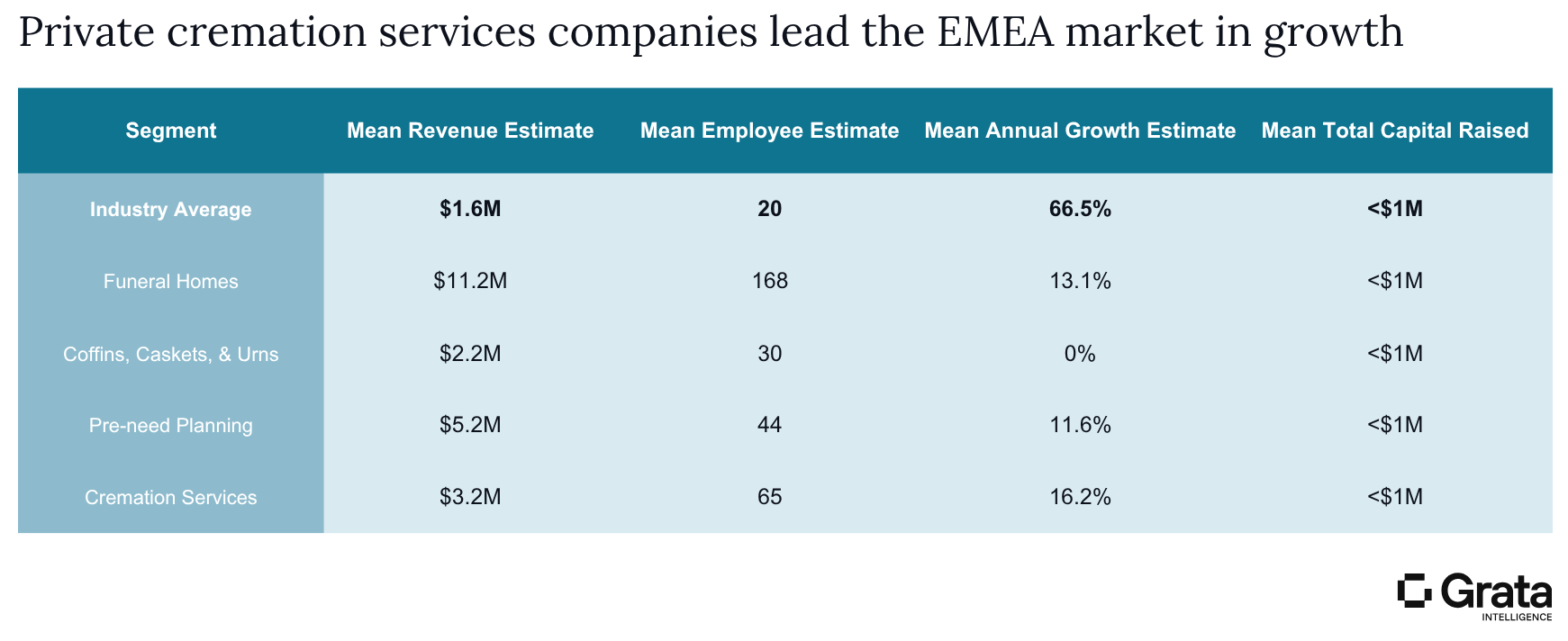
Private cremation services companies lead by growth in the EMEA market, with pre-need planning close behind. Direct cremation, a low-cost cremation with no service, is a big reason in the UK. Direct cremation plans now make up over 60% of the UK funeral plan market, according to the 2025 Funeral Solutions Expert report.
Regulations have also reshaped pre-need planning in the region. The FCA has regulated prepaid funeral plans since July 2022, after collapses such as Safe Hands affected about 46,000 customers, pushing providers out of the market.
Crematoria are also drawing buyers. Westerleigh has opened 21 since 2016, and ICG Infra agreed to buy it in September. UK crematoria have also drawn regulatory scrutiny, since the Competition and Markets Authority found competition problems in the markets for funeral directors and crematoria and ordered price transparency in 2021.
EMEA's private funeral homes are the largest of any region analyzed in this report, averaging $11.2M in revenue and 168 employees. Groups with many sites likely lift that mean. Sereni operates about 450 funeral homes with 1,800 staff, and Funeral Partners operates about 300 with 1,300 employees.
Source: Grata Intelligence
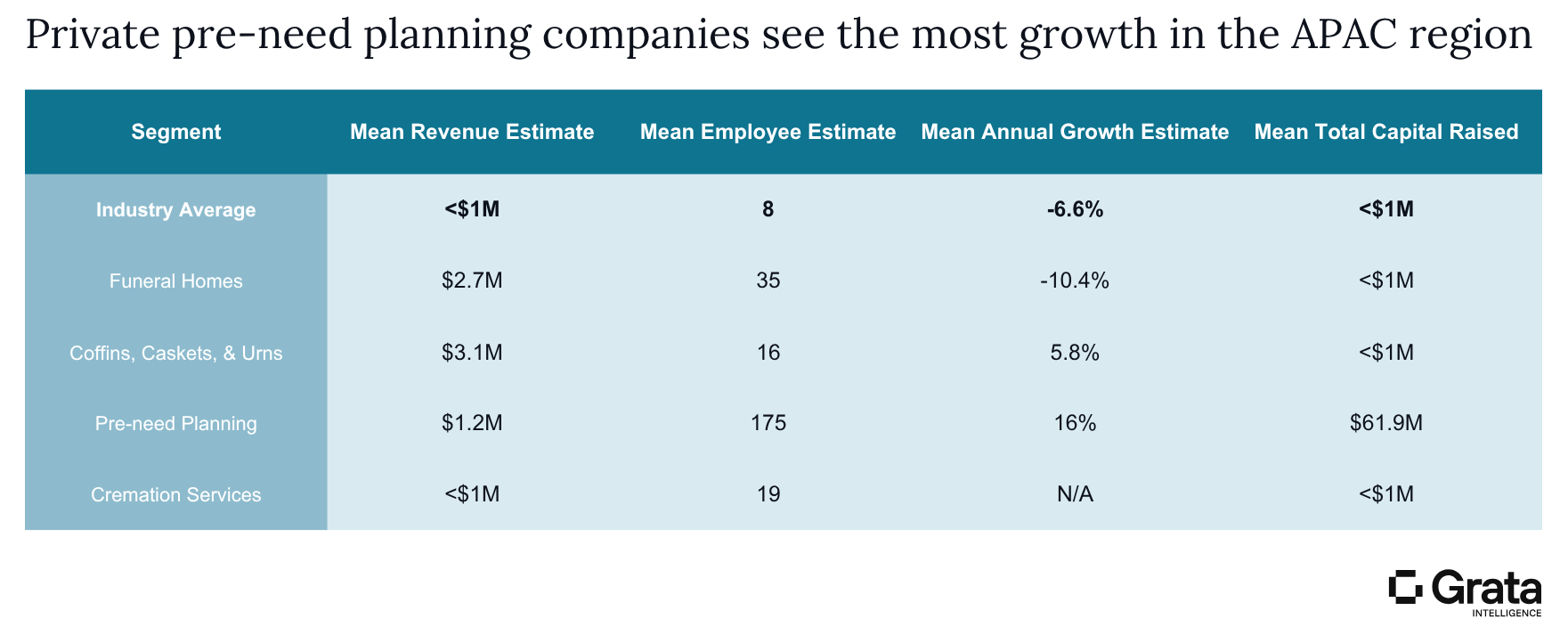
The pre-need planning sector leads the private APAC death services market in terms of growth at 16%. It is also the only segment with meaningful capital raised. Japan exemplifies why demand is shifting. Deaths topped 1.6M in 2024, according to Japan's health ministry. Families are increasingly choosing small family funerals or direct cremation — Keio University estimates they account for 20% to 30% of funerals in Tokyo. Yoriso, a Tokyo platform that sells fixed-price funerals and direct cremation, has raised $61.8M, which likely explains the segment's capital raised figure.
Private funeral homes shrank 10.4% on average in the APAC region, while public funeral homes grew 6%. Again, Japan offers context. Researchers describe online discount funeral companies that undercut traditional funeral homes on price, alongside a trend toward concentration that pushes out many small undertakers.
Source: Grata Intelligence
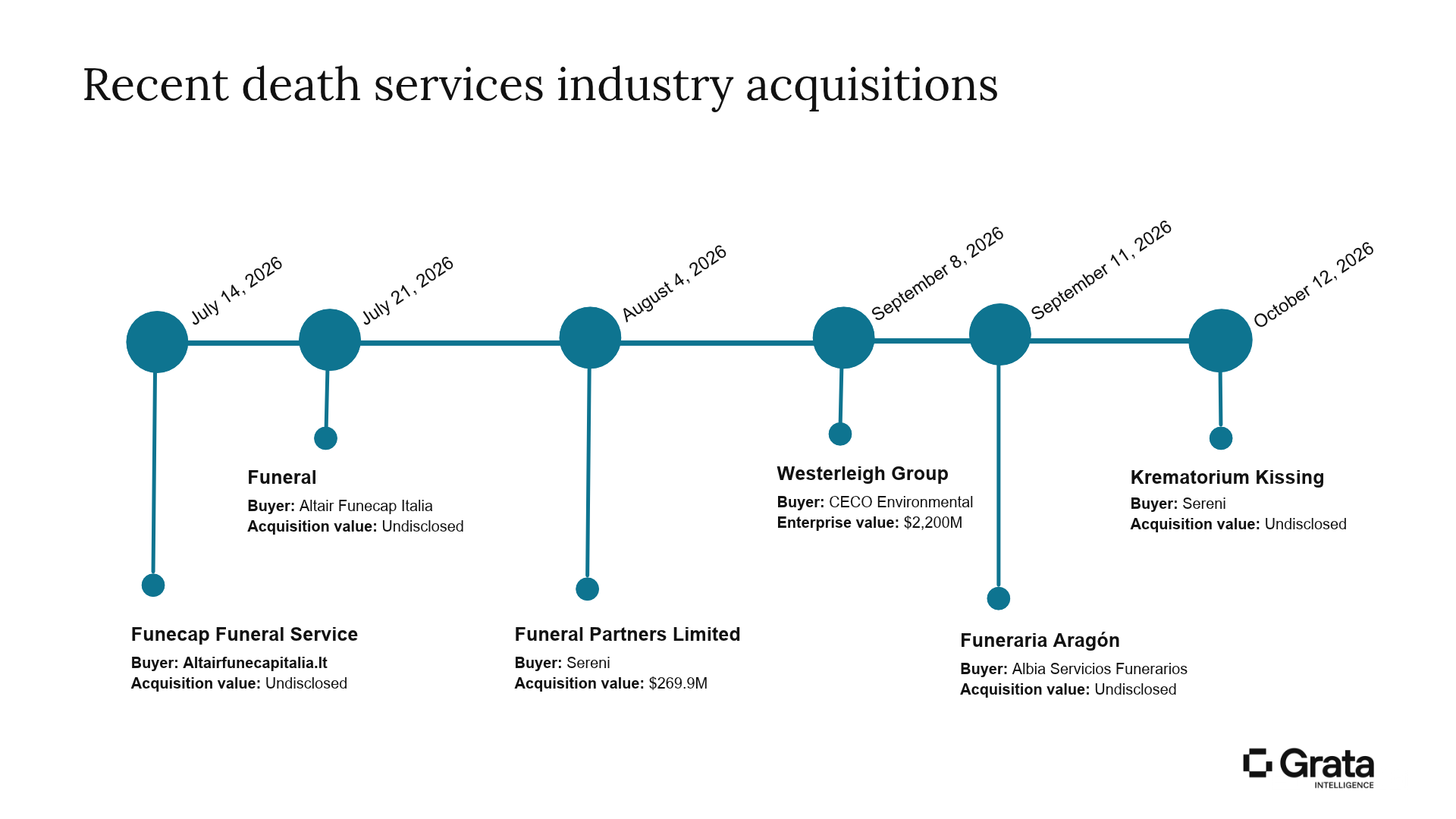
In October, Sereni Deutschland acquired Krematorium am Auenwald, the private crematorium in Kissing near Augsburg that Krematorium HR GmbH runs and that has served the region since 2011.
Baker Tilly, which advised Sereni, said the deal adds cremation to the network's services and strengthens vertical integration. Sereni bought the crematorium alongside two other businesses, Die Bestatterfamilie and G+R Bestattungstransporte und Service. Financial terms were not disclosed.
If you're an investor interested in companies similar to Krematorium Kissing, try these:
In September, ICG Infra agreed to acquire Westerleigh Group from Ontario Teachers' Pension Plan and Universities Superannuation Scheme, which had jointly owned the business since 2016. Westerleigh operates 42 crematoria across England, Scotland, and Wales and has opened 21 new ones since 2016. The parties did not disclose the financial terms of the deal.
If you're an investor interested in companies similar to Westerleigh Group, try these:
In August, Belgium-based funeral platform Sereni combined with Funeral Partners, one of the UK's largest funeral providers. Funeral Partners operates about 300 funeral homes with almost 1,300 employees and supports around 30,000 funerals a year.
Together the companies serve more than 75,000 funerals a year across Belgium, Germany, Poland, and the UK. Grata data values the deal at $269.9M, and both companies keep their local brands.
If you're an investor interested in companies similar to Funeral Partners, try these:
In July, Altair Funecap Italia, the Italian holding company of France's Funecap Group, completed the acquisition of 100% of Eurocof S.r.l. and Funeral S.r.l., two funeral businesses in Rome. Eurocof supplies funeral homes with coffins, urns, and funeral vehicles. The deal marks the group's first direct investment in the Rome area, and local families joined the group in a regional holding company. Financial terms were not disclosed.
If you're an investor interested in companies similar to Eurocof, try these:
In July, Albia Gestión de Servicios, a Santalucía group company, agreed to buy 100% of Pompas Fúnebres Aragón, which operates as Funeraria Aragón in Zaragoza province. Pompas Fúnebres Aragón runs two funeral homes in Zaragoza city, a funeral home and a crematorium in Tarazona, and funeral homes in Añón de Moncayo and Ainzón. Spain's competition authority received the notification on July 8, and its staff recommended approval in the first review phase. The parties did not disclose terms.
If you're an investor interested in companies similar to Funeraria Aragón, try these:
There are currently 43,178 companies in the death services space showing intent to sell. Of those, 3,482 are showing high intent.
There are also 43 actionable death services companies in the Grata platform that have yet to be discovered.
Download our white paper to learn about how Grata’s Seller Intent surfaces key signals of transaction readiness months before the rest of the market.
Active Mandates in Death Services
Hundreds of active mandates are being showcased on the Grata Intelligence platform. If you’re interested in sourcing live deals in the death services space, register to learn more here.
Are you a sell-side advisor interested in generating inbound leads for your data center infrastructure deal? Get started here.
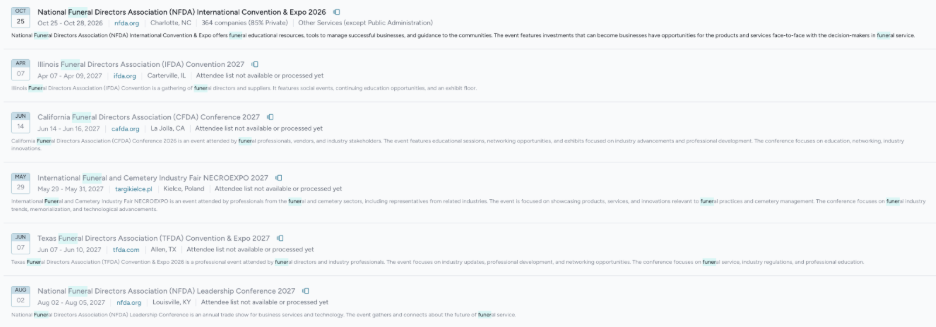
Grata makes it easy for dealmakers to find conferences, events, and trade shows in their industries. See attendee lists so you can set up meetings beforehand and make the most of your travel time. Check out which companies attended past events to find more potential targets.
Here are a few of the events related to the death services industry that dealmakers can find and track in Grata:
Source: Grata Intelligence

Monthly tactics from Grata’s team and operators.
From market trends to career advice, Grata’s content fuels smarter decisions.