.avif)
AI & Automation
Datasite Brings AI to the Entire Deal Lifecycle – from Target to Transaction
Grata Intelligence and Datasite Connect allow deal teams to use AI from opportunity discovery through diligence while retaining document-level permissions.



Building proprietary deal flow is more challenging than ever before. While AI has undeniably accelerated the sourcing process, generalist models have also inadvertently created more noise across the market: more competition for a narrower set of visible targets, and more emails competing for the same shrinking pool of attention.
That’s why the new private market competitive advantage lies in early deal intelligence. Dealmakers have to act as early as possible to edge out the competition. Grata’s Seller Intent was built to detect and monitor the subtle signals that every company gives off 6-12 months before it goes to market.
Below, we’ve used Seller Intent to pinpoint 10 industries with the largest increases in high-intent companies (Seller Intent scores of 70+) over the last year.

Source: Grata
Here's what private dealmakers need to know.
Source: Grata
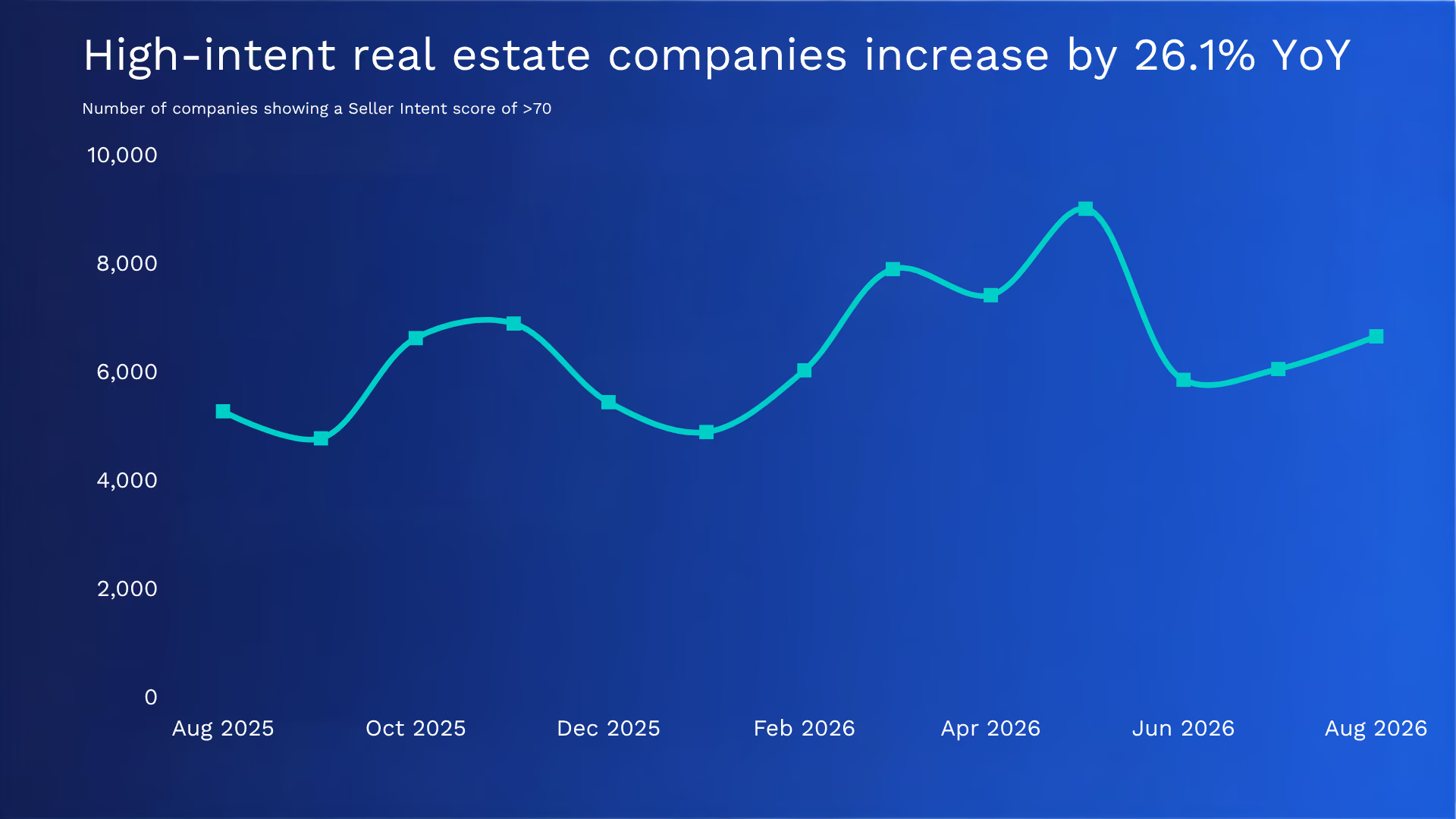
The real estate industry saw the biggest year-over-year surge in high-intent companies at 26.1%. The rise can partially be attributed to a growing gap between public and private pricing. US equity REITs started 2026 trading at a median 16.2% discount to net asset value, according to PwC’s real estate outlook. That difference is pushing owners to strategic sales and take-privates.
Another factor at play here is that smaller players in the real estate industry are finding it more expensive to borrow money than their larger peers. This makes it more difficult to compete or grow on their own, which is pushing some to sell.
Meanwhile, investors in the industry are beginning to shift their focus to data centers, logistics, senior housing, and rental housing. Owners of office buildings and retail centers may be looking to sell now, before interest in their assets completely dissipates, rather than waiting until later.
The information industry saw a 22.5% increase in companies showing high seller intent from August 2025 to August 2026. One key factor here is that buyers are starting to show more caution when it comes to buying AI software companies. Valuations in the sector have deflated as buyers reconsider how AI disruption will affect the software industry overall, according to PwC. As a result, some owners are looking to sell now before buyers tighten their purse strings further.
Buyers are increasingly on the hunt for data processing, hosting, and IT services companies with proven track records. Many owners are looking to capitalize on the opportunity now.
High-intent companies in Retail Trade increased by 17.3% year-over-year. Public market investors have applied a blanket discount to the entire retail sector, regardless of whether an individual company is underperforming, according to PwC's consumer markets outlook. As a result, PE firms spent the first half of 2026 taking retailers private at prices the public market wouldn't pay, betting that a multi-year operational reset is worth more separate from the pressure of quarterly earnings.
Another factor at play here is succession. A generation of founder-led and family-owned retail businesses is approaching a transition point, with owners increasingly looking to sell rather than waiting out the cycle.
The Finance & Insurance industry saw a 16.1% year-over-year increase in high-intent companies. Big insurance platforms in the US and the UK insurance platforms are pursuing tuck-in deals to add specialists, employee benefits, and regional capabilities, according to PwC.
Meanwhile, the fintech and payments spaces are consolidating. Larger players are snapping up smaller firms with differentiated AI capabilities, while banks are buying fintech startups to build embedded finance and digital assets, Freshfields reports.
The number of companies with high Seller Intent scores in the Manufacturing industry rose by 9.8% from August 2025 to August 2026. Two main forces are driving the increase:
Other Services companies with high Seller Intent scores increased by 9.1% YoY. The companies showing the most intent here skew toward religious, civic, and membership organizations instead of traditional small businesses.
Several federal funding sources were cut in 2025 with limited warning, and that pressure has carried into 2026. More than half of nonprofits now hold three months or less in cash reserves, according to the Nonprofit Finance Fund, and a growing share are running deficits. For boards facing that kind of runway, merging with another organization or combining under a leadership transition is often a more viable path than continuing to operate alone.
Healthcare and Social Assistance saw an 8.3% rise in high-intent companies. In the US, Medicaid cuts from the 2025 reconciliation bill take full effect in 2026, and hospital operating margins have been sliding as a result, according to The Health Management Academy. Labor, drug, and supplies costs are rising faster than reimbursement, and an ACA subsidy cliff is pushing more patients to self-pay and uncompensated care. As a result, hospitals and healthcare conglomerates are increasingly divesting lab services, and administrative support functions to raise cash and refocus on core operations, according to Cherry Bekaert's 2026 PE outlook.
Separately, buyers have money ready to spend. Healthcare PE deal value surpassed $191B in 2025, the highest total on record, per Bain's Global Healthcare Private Equity Report.
The number of high-intent companies in Professional, Scientific, and Technical Services rose by 8.2% YoY. Many PE-backed platforms that launched in this space over the past several years are approaching the end of typical hold periods, and sponsors need to exit to return capital to their own investors, according to Cherry Bekaert.
Demand for non-sponsor-backed firms is also strong right now. Seventy percent of UK-based PE firms plan to increase their investment in 2026, and they rank professional services as a top target, Grant Thornton UK's Private Equity Pulse survey shows. Meanwhile, genAI adoption among these firms reached 40% in 2026, according to the Thomson Reuters Institute. That's a big reason to sell now instead of waiting to see how AI reshapes pricing over the next few years.
High intent in Administrative and Support Services grew by 7.5% YoY. Many staffing firm owners have been waiting for valuations to return to the levels seen in 2021 and 2022. That still hasn’t happened. Founders are now choosing to work with what they’ve got and transact on today's terms instead, according to Momentum Advisory Partners.
Some owners of high-performing companies are also looking to sell now due to concern that AI could disrupt the staffing model over the next several years.
Construction saw the smallest gain of the industries analyzed in this report, with high-intent companies up 4.6%. Rising material costs from tariffs and swelling labor costs from worker shortages are squeezing smaller contractors' margins. Folding into a larger platform is often more sustainable than absorbing those costs alone.
Private equity buyers are also currently paying a premium for specialty trade contractors at an average of roughly 10.6x EV/EBITDA between 2018 and 2025, compared with 7.5x for strategic buyers.
Grata's Intent Data identifies early signs of sale preparation, often 6-12 months before a transaction, by monitoring aggregated and anonymized behavioral patterns at scale. It's designed for early prioritization, not certainty.
It's important to note that Seller Intent offers real data and our predictions from that data, not guaranteed outcomes. Many flagged companies will not ultimately transact, and this is by design. Seller Intent was built to surface early activity, not only confirmed outcomes.
Learn more about how Seller Intent works here. Ready to find sellers before your competitors? Schedule a demo to get started with Grata.
Seller Intent is a Grata score built from four components tracked over time: an M&A activity score, a data room activity score, an advisory engagement score, and a financial sponsor score. Together they estimate how likely a private company is to be exploring a sale, a raise, or another liquidity event.
Among the ten industries covered in this piece, Information shows the largest increase, with signal volume up 21% in the first seven months of 2026 compared with the second half of 2025, according to Grata platform data.
Seller Intent is a leading indicator built from company-level signals. Closed deal volume reflects transactions that have already cleared diligence, financing, and legal review, a process that can take months after a company first shows up as a likely seller. A rise in Seller Intent points to more companies entering that pipeline. Whether that pipeline converts into closed deals at the same pace depends on financing conditions, buyer appetite, and other factors covered above.

Monthly tactics from Grata’s team and operators.
From market trends to career advice, Grata’s content fuels smarter decisions.

.avif)

.avif)
.avif)