.png)
AI & Automation
Sell-Side
How Agentic AI Is Changing Buyer List Building
See how agentic AI is driving efficiency in M&A buyer list building, from testing strategies to qualifying, prioritizing, and keeping the buyer universe current.

.png)

The global sports industry is expected to be worth a whopping $654B by 2030. Private market dealmakers are no longer content with sitting in the stands — they want in on the fun themselves.
Private capital is reshaping every level of the sports services space on every continent. In the US, leagues can now sell stakes to private equity funds, and the House vs. NCAA settlement lets American schools pay college athletes directly for the first time. Meanwhile, a wave of PE and multi-club ownership groups is buying into European football and rugby clubs. That's pulling billions of dollars into the agencies, data platforms, and compliance providers built to manage it all.
With over 246,000 privately owned sports services companies ripe for acquisition, the industry offers a deep bench of opportunities for private market dealmakers around the world.
In this PE Playbook, the Grata team has put together the need-to-know trends for investors considering making moves in the sports services market, including:
.png)
Source: Grata
The market map above is not intended to be an exhaustive representation of companies in the space.
Companies that provide services that fall into multiple segments are categorized in this report by their primary offering.
Source: Grata
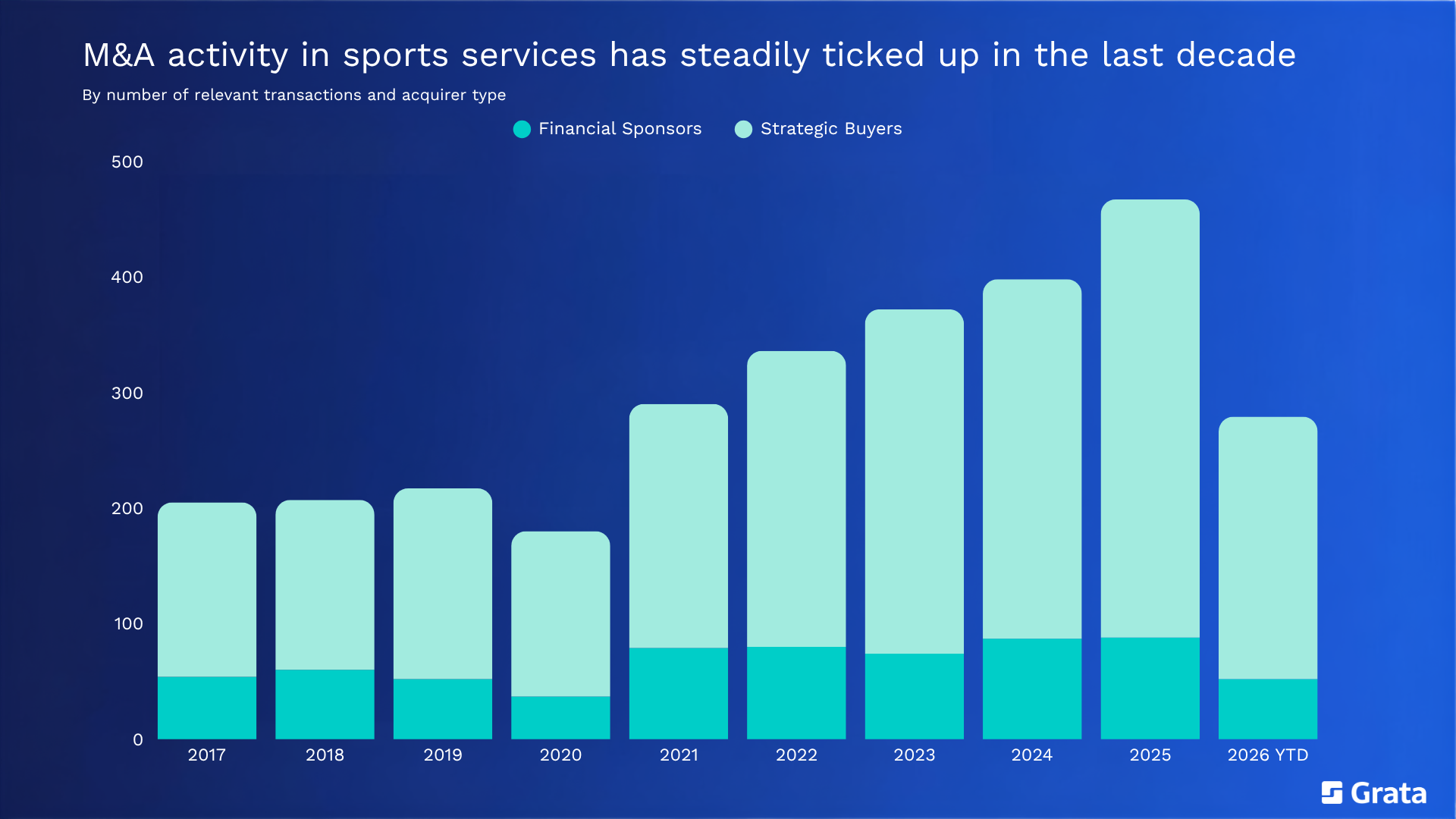
M&A deals in the sports services industry have more than doubled over the last decade, and 2026 is on pace to be another strong year. Strategic buyers have driven the majority of the activity, though financial sponsors have grown their share since 2021.
A few key factors are driving the surge:
.png)
Source: Grata
Charterhouse Capital Partners tops the list of most active financial sponsors in the sports services industry with 43 relevant acquisitions. Its most visible platform in the space is sports marketing agency Two Circles, which works with rights holders including the NFL, F1, and the Premier League.
Source: Grata
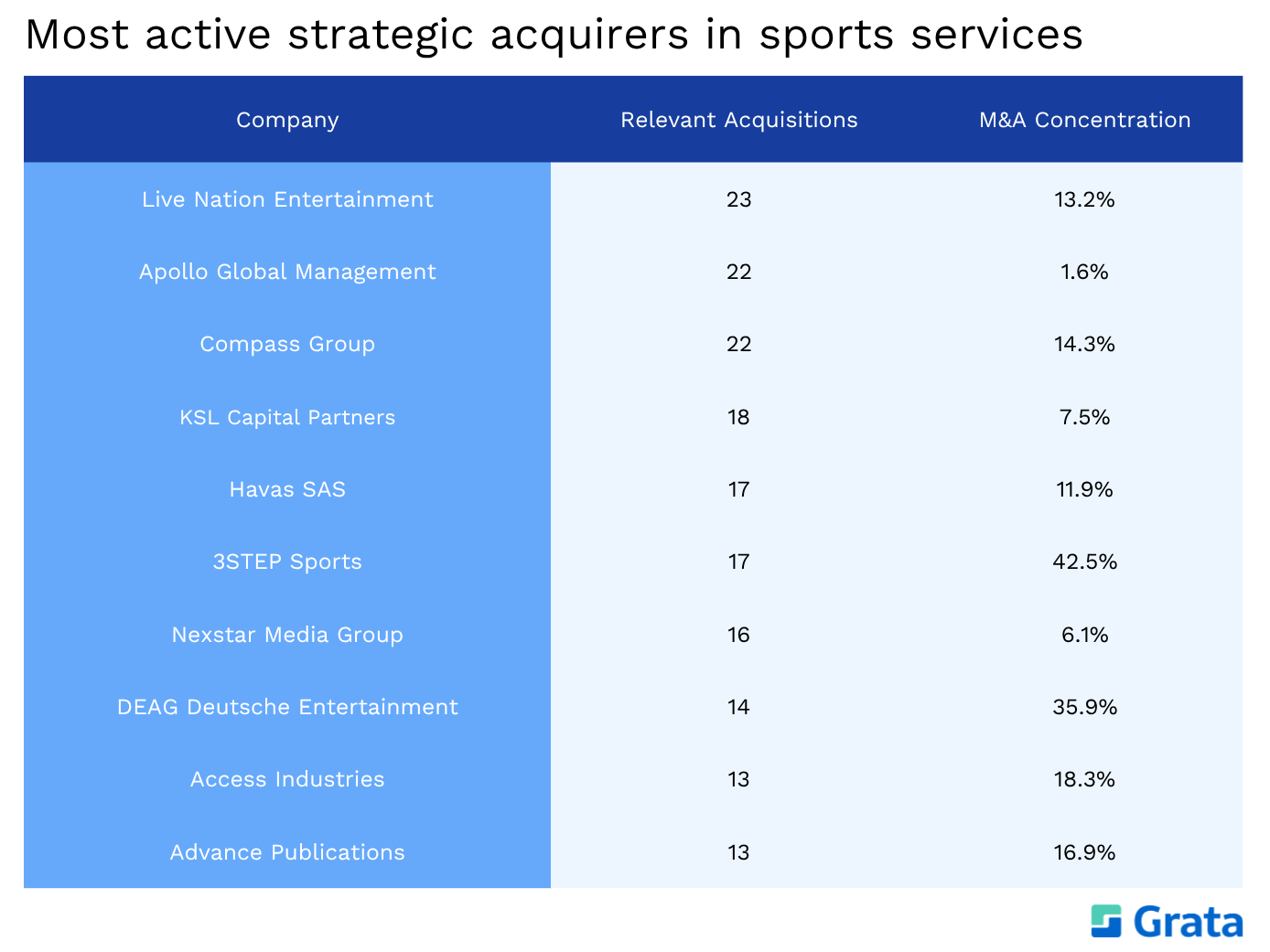
Live Nation Entertainment is the most active strategic acquirer in the sports services industry, with 23 relevant acquisitions. Several of its recent deals are arena and venue acquisitions, including Paris's La Défense Arena and Buenos Aires's Movistar Arena.
Source: Grata
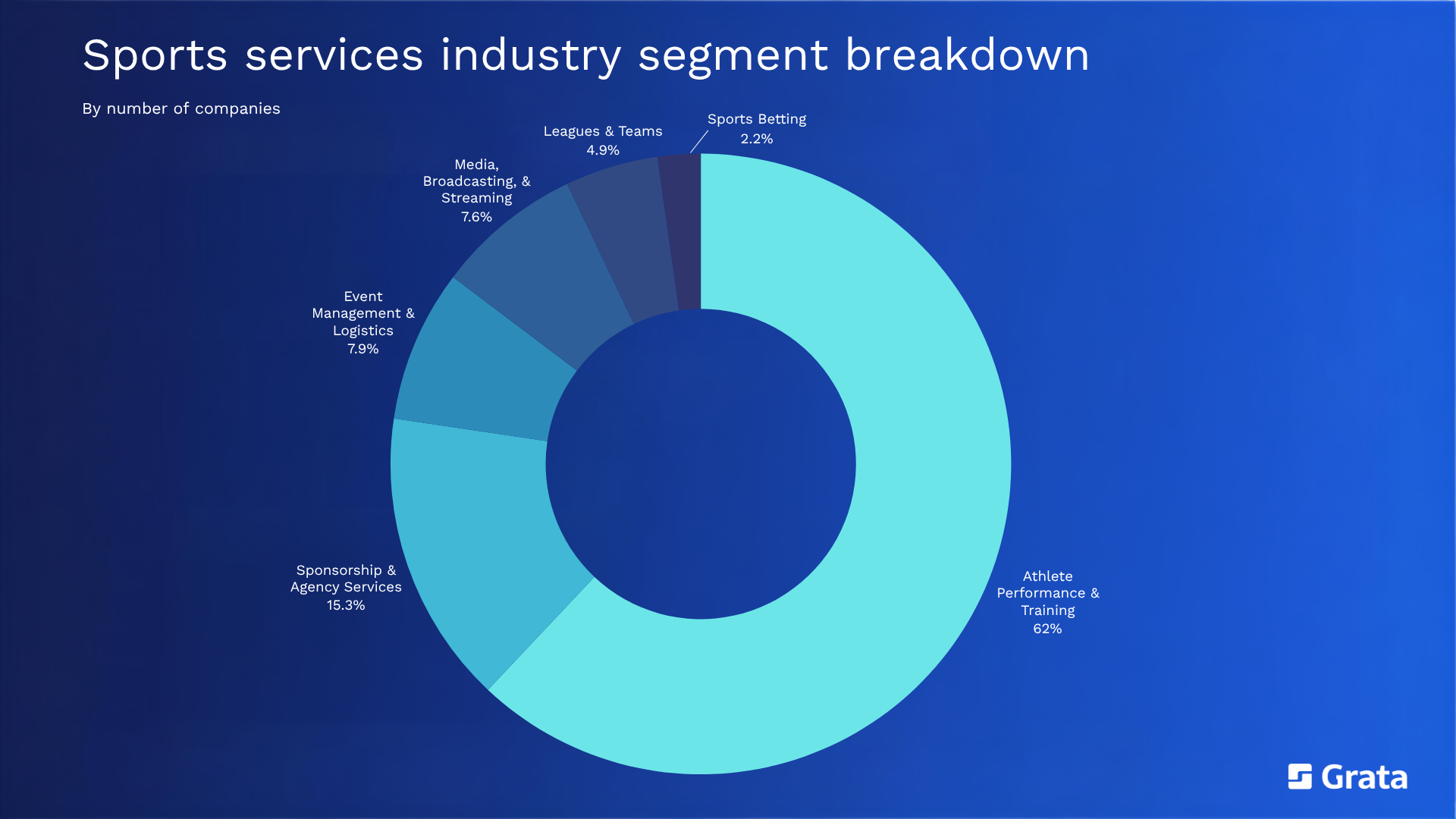
This report focuses on the following segments of the sports services industry:
Source: Grata
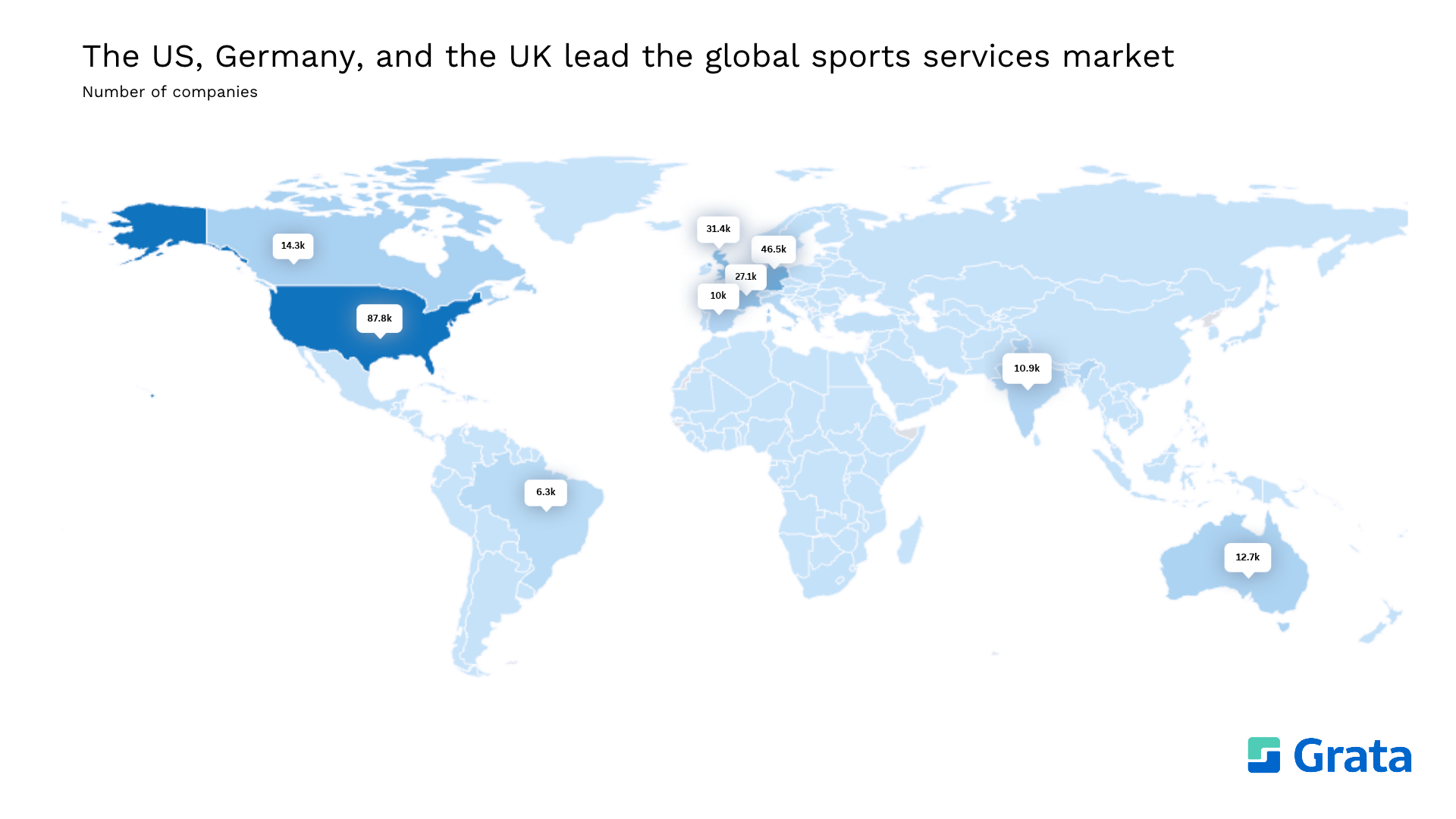
The US leads the global sports services market by a wide margin, with roughly 88,000 companies. Germany and the UK are the next-largest markets, followed by France, Australia, Canada, and India.
Source: Grata
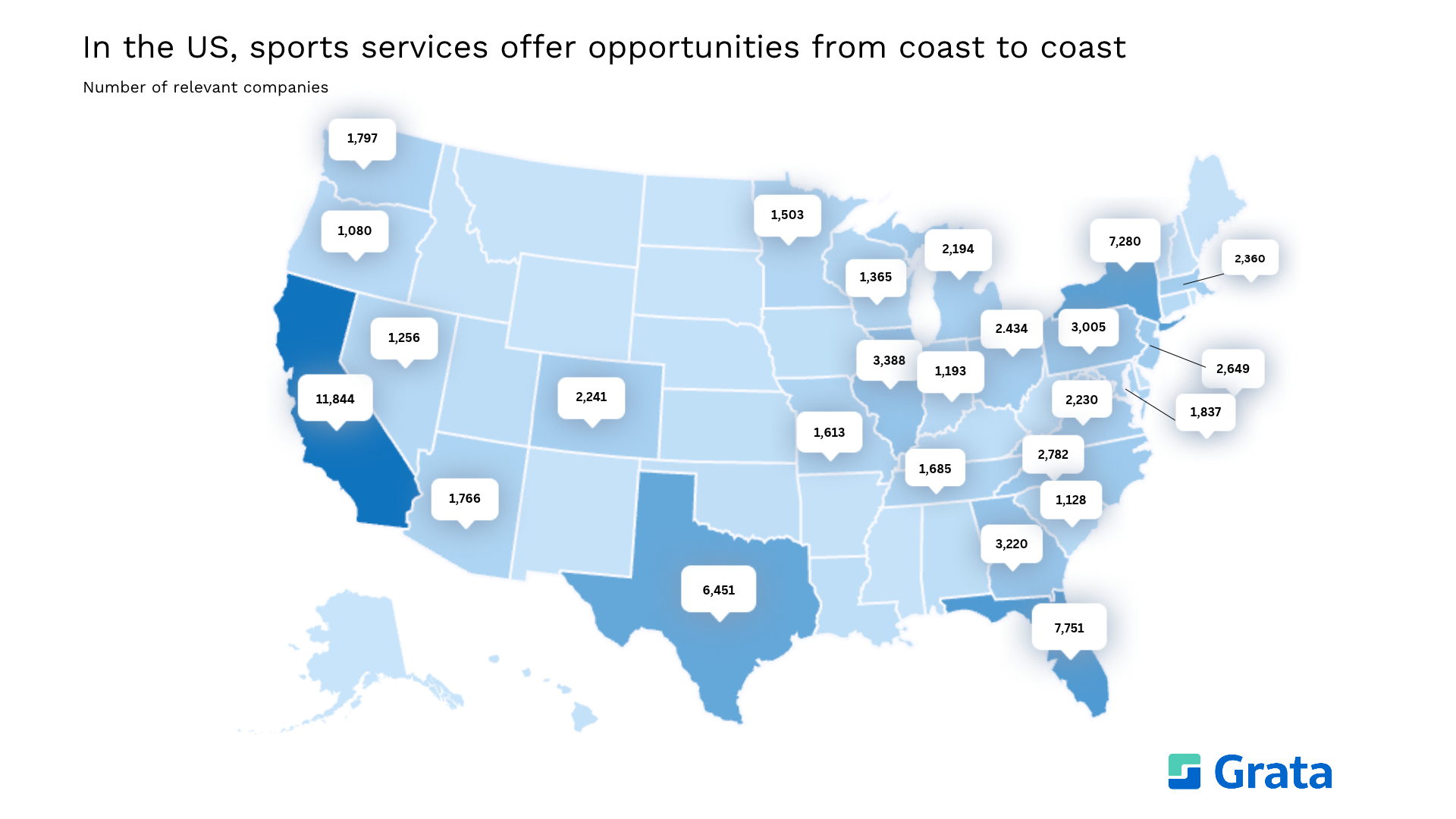
Dealmakers focused on the US can find sports services all across the country. Some key areas to pay attention to include:
Source: Grata
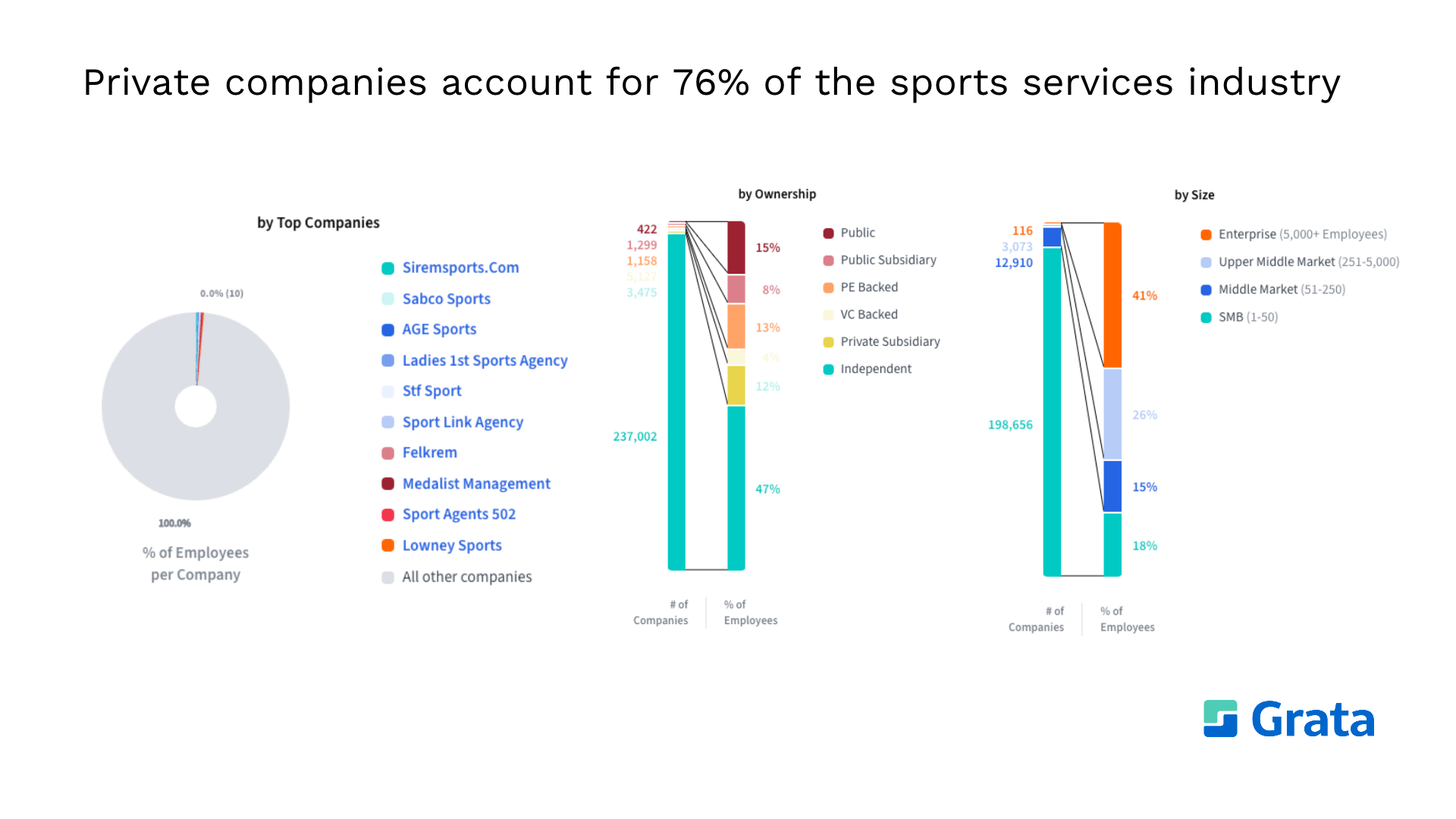
Private companies comprise 76% of the sports services industry. There are currently over 246,000 businesses in the space that are ripe for acquisition.
.png)
Source: Grata
Globally, the athlete performance and training sector is seeing explosive growth in the public markets, with an average rate of 75% year over year. One factor at play here is the evolution of wearable tech and AI coaching tools from niche gadgets into predictive training and recovery platforms. Additionally, in the US (the industry’s largest geographical market), the House settlement's revenue-sharing rules and the wider name, image, and likeness (NIL) changes have pushed college and professional programs to invest more in performance data to justify and optimize the money going to athletes.
The sponsorship and agency services sector has the standout average EV/EBITDA multiple at 58.6x. Most of the largest sponsorship and agency businesses are privately held or sit inside diversified media conglomerates, so the small set of pure-play public comparables may be trading at multiples that reflect scarcity as much as underlying growth.
Leagues and teams post the highest average EBITDA margin at 22.9%. This is a function of how media rights economics work. Once a broadcast or streaming deal is signed, an additional viewer costs a league almost nothing to serve. Margins expand directly with audience reach.
Source: Grata
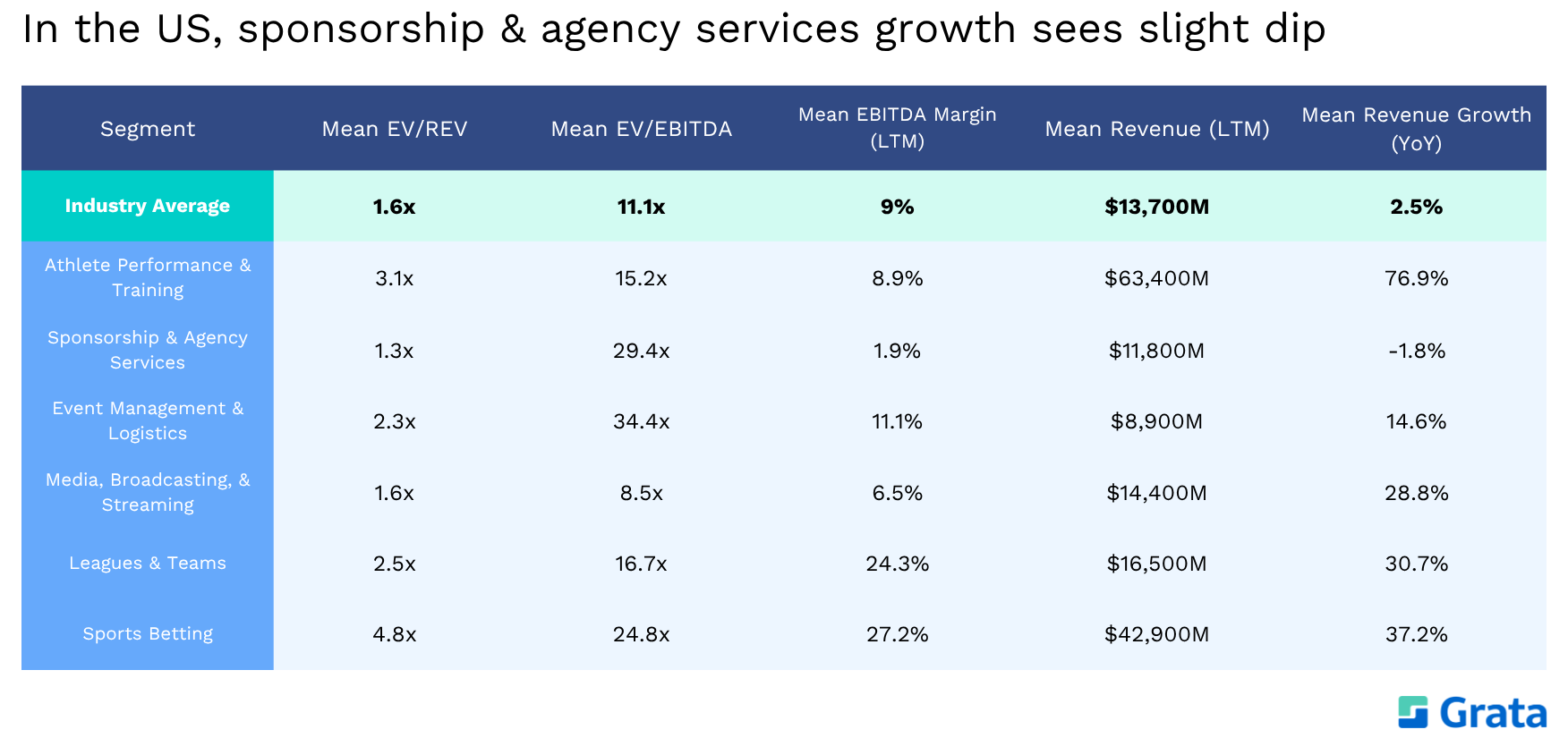
In the US, sponsorship and agency services is a soft spot in an otherwise growing sector, with average revenue slipping by 1.8% year over year. Brand sponsorship dollars may be shifting toward NIL deals with individual college athletes rather than routing through agencies built around teams, leagues, and legacy properties. More broadly, marketing budgets have shrunk even as media rights fees keep climbing.
Conversely, the athlete performance and training market sees an average growth rate of 76.9%. It also pulls in far more revenue than any other segment, bolstered by the wearables and AI training adoption trend that's sweeping across every region covered in this report.
Sports betting posts the strongest average EBITDA margin in the US at 27.2%. This is largely because sports betting platforms have little to no physical footprints. Mobile betting platforms scale with almost no incremental cost per additional user.
Source: Grata
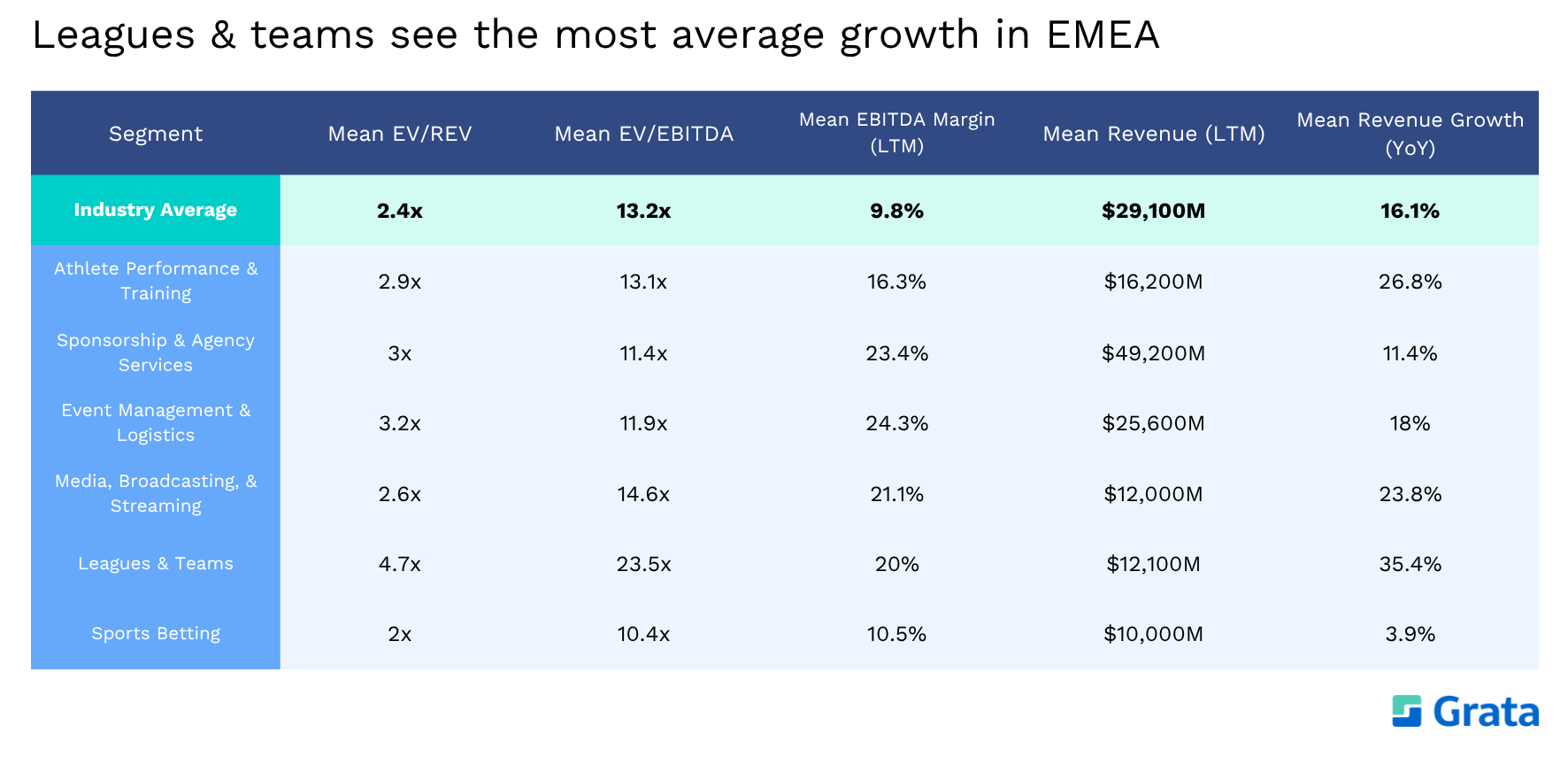
In the EMEA region, leagues and teams see the strongest average growth at 35.4% a year, nearly double industry average. The region has been at the center of a broader institutional push into football and rugby. More than one third of clubs across Europe's top five football leagues now carry PE, venture, or private debt backing. Additionally, record-breaking broadcast deals, including a Premier League rights cycle worth more than £10B, keep resetting league and club valuations.
Meanwhile, as major European sports calendars continue to fill, clubs are leaning on outside operators to run matchday operations, driving above-average growth in the event management and logistics sector.
Sponsorship and agency services pull in the most average revenue of the segments analyzed here. This may reflect how concentrated Europe's largest sponsorship and rights-management agencies have become around a handful of blue-chip football, rugby, and Olympic groups.
Source: Grata
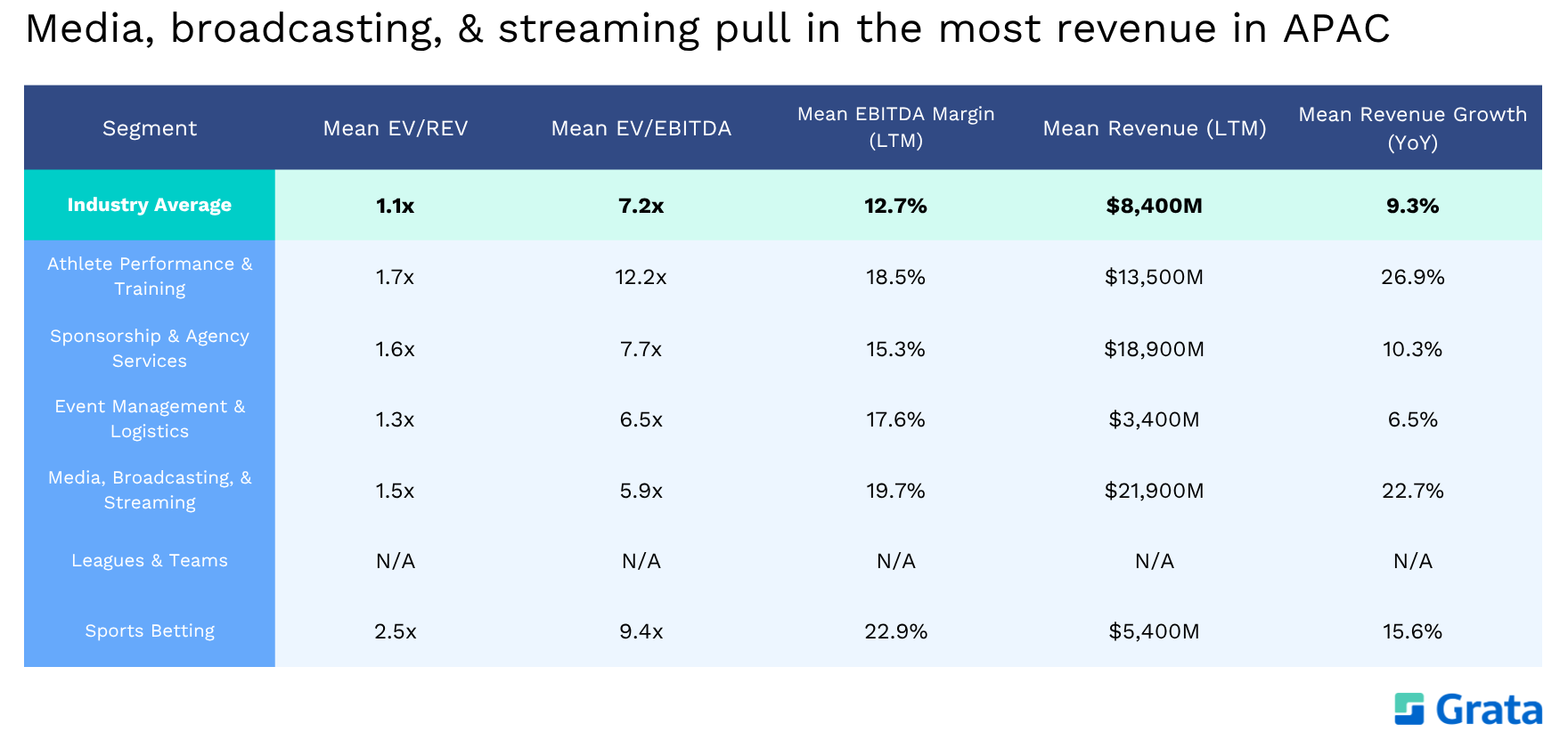
Once again, athlete performance and training leads the pack in terms of growth, thanks to the same wearables and AI-training adoption wave happening globally. Note, however, that the region's public comparables set skews smaller than the US or EMEA.
Public media, broadcasting, and streaming companies pull in the most average revenue in the APAC region and see the second-highest average growth rate. The region's media rights market is unusually fragmented: cricket, football, and multi-sport events are being split across a growing roster of streamers and broadcasters, all bidding for exclusive or overlapping windows. This pushes up rights costs, increasing revenue for the companies that hold them.
Leagues and teams shows no public comparables in APAC due to the way the region's sports franchises are structured. Even the most valuable APAC franchises tend to sit inside larger private or conglomerate ownership rather than trading as standalone public companies. For example, the IPL's Mumbai Indians are owned by Reliance Industries, a public company, but the team itself isn't separately listed. Japanese baseball and J.League clubs follow a similar pattern as subsidiaries of conglomerates like Yomiuri and SoftBank.
Source: Grata
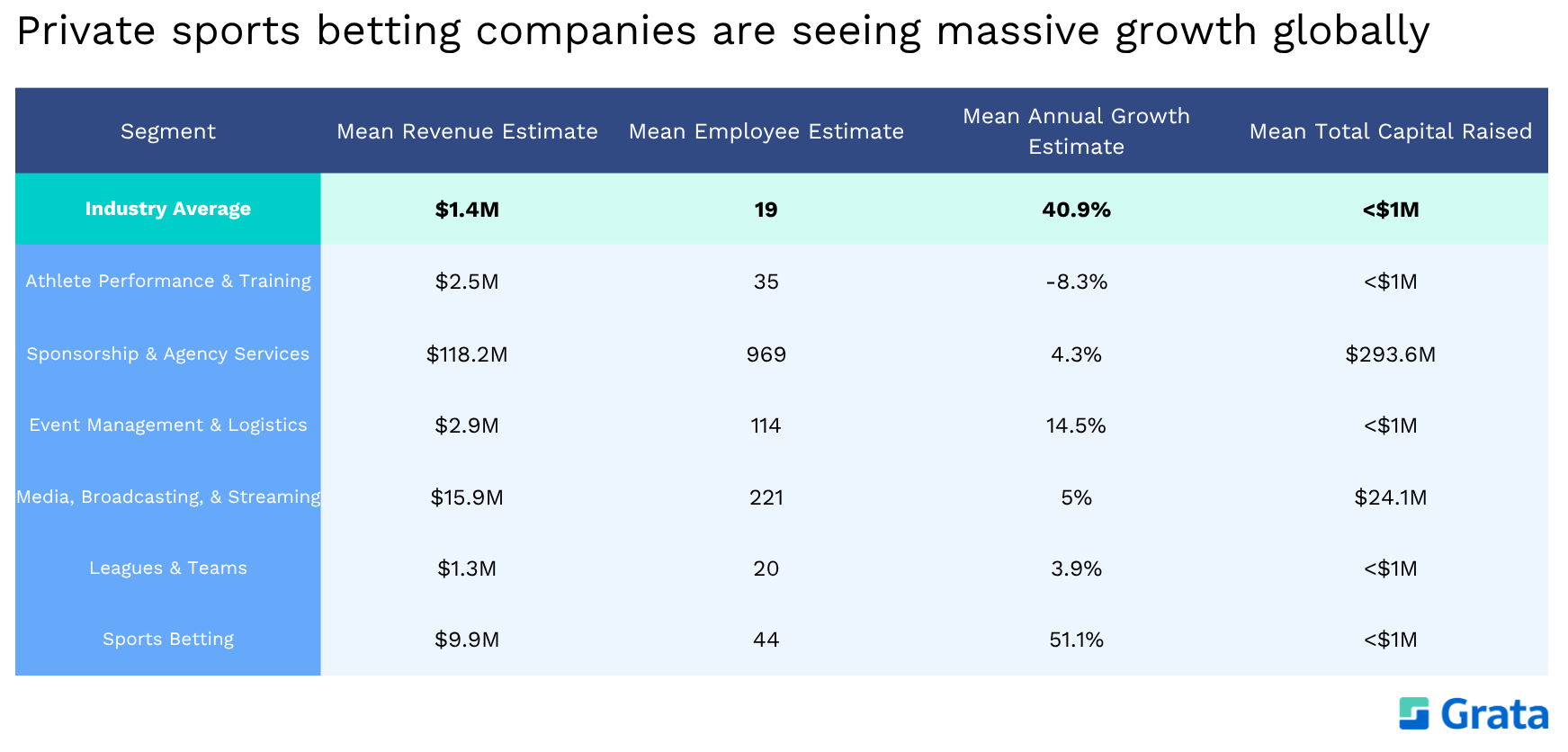
Sports betting is the standout sector in the private markets. It’s growing at an average of 51.1% YoY, despite being the smallest segment in the industry by company count, as legalization keeps expanding around the world.
Sponsorship and agency services pulls in the most average revenue of the private segments. It has also raised the most capital of the segments analyzed here, which may point to investors backing a small number of scaled agencies to consolidate a historically fragmented category.
Athlete performance and training is the only segment posting negative average growth in the private markets, even as its public counterparts surge. That divergence likely boils down to scale. The largest wearables and training data platforms are public or backed by strategics. They have the funds to out-invest smaller private challengers, leaving many earlier-stage companies to fight over a shrinking share of a crowded market.
Source: Grata
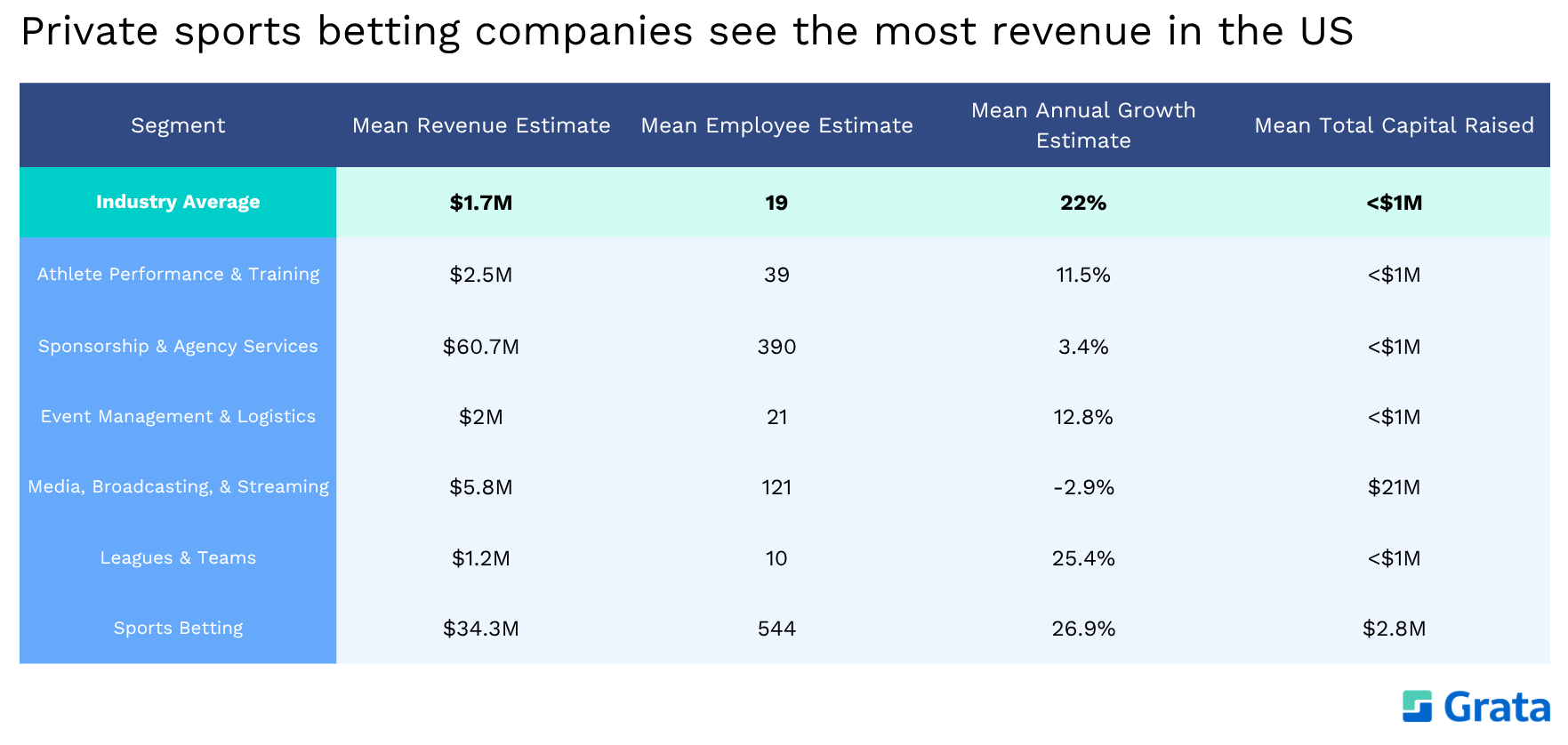
In the US, sports betting companies lead the private realm in terms of revenue, with an average of $34.3M. They also see the highest average employee count, reflecting how quickly operators have had to staff compliance, trading, and customer support functions as legalization expanded over the past decade.
While leagues and teams account for the smallest sector by revenue, they’ve posted the strongest average growth at 25.4% YoY. One likely factor at play is private capital moving into clubs and leagues below the top tier, where valuations may still have more room to grow than at the major league level.
Meanwhile, the media and broadcasting segment is contracting, with average growth falling to an average of -2.9% YoY. The pattern is consistent with the ongoing erosion of legacy paid TV subscriptions and the broader consolidation of rights around a smaller number of well-funded streamers.
Source: Grata
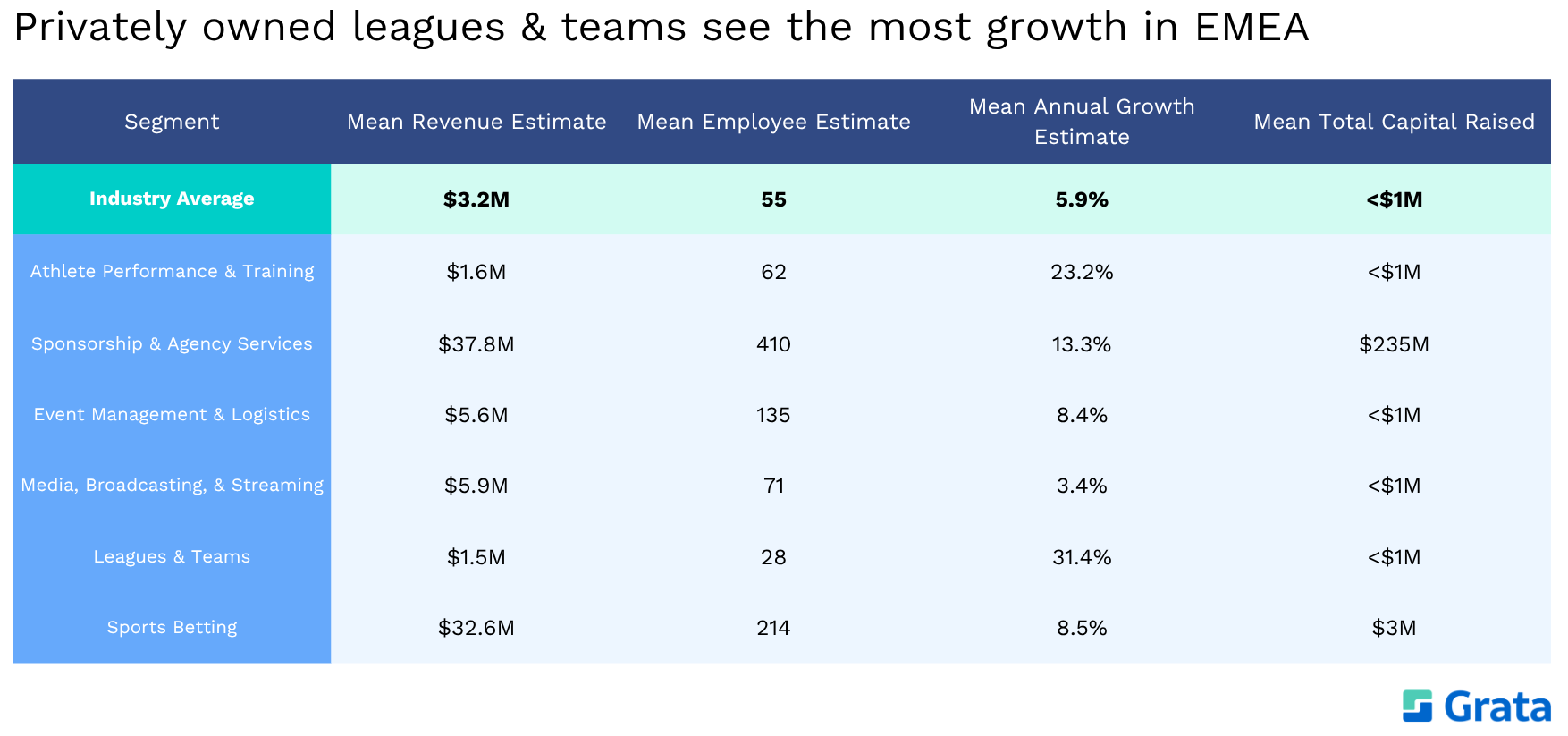
Privately owned leagues and teams in EMEA post the strongest average growth at 31.4%, though they are among the smallest companies in the region by revenue and headcount. One explanation is that the same wave of private capital moving into European football and rugby at the top of the market is starting to reach smaller, lower-division clubs. Specialized sports-focused funds may see more room to reposition undervalued assets there than at the Premier League or La Liga level.
Meanwhile, the sponsorship and agency services sector has attracted by far the most capital in the region. It also pulls in the most average revenue, at $37.8M. Athlete performance and training also shows strong momentum, growing 23.2% a year on average, driven by the same training data adoption that's transforming the segment around the world.
Source: Grata
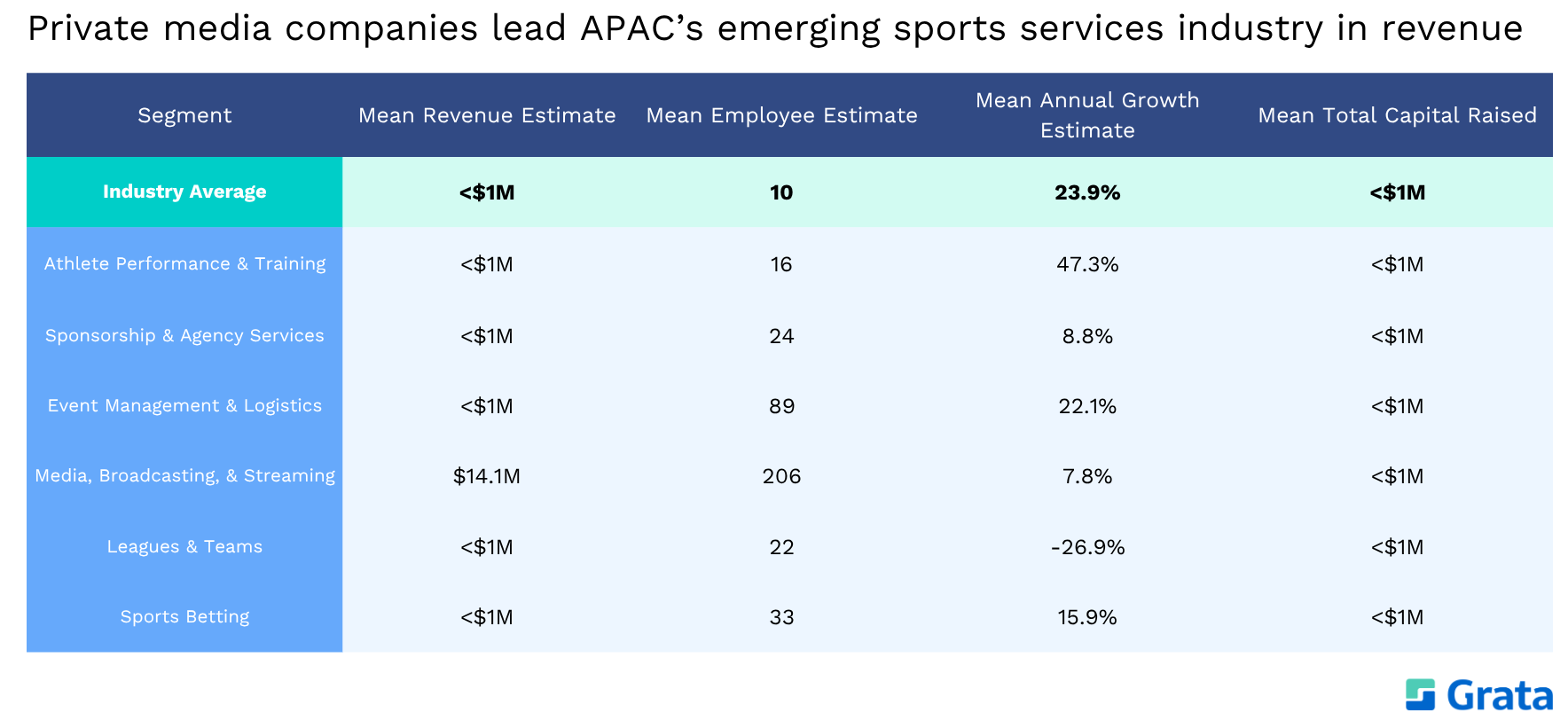
Private media, broadcasting, and streaming companies lead APAC's emerging sports services industry in revenue, at an average of $14.1M. The region's fragmented, fast-growing streaming market, where cricket and football rights are increasingly split across competing platforms rather than concentrated in one dominant broadcaster, creates room for smaller, more specialized players to find a foothold.
Athlete performance and training is growing the fastest at 47.3% a year as wearables and training tech adoption spreads across the region's expanding middle class, including in markets like India.
Leagues and teams is the one segment that’s contracting, though with so few private companies in this segment regionally, that likely reflects the fluctuations of a handful of early-stage organizations rather than a broader industry pullback.
Source: Grata
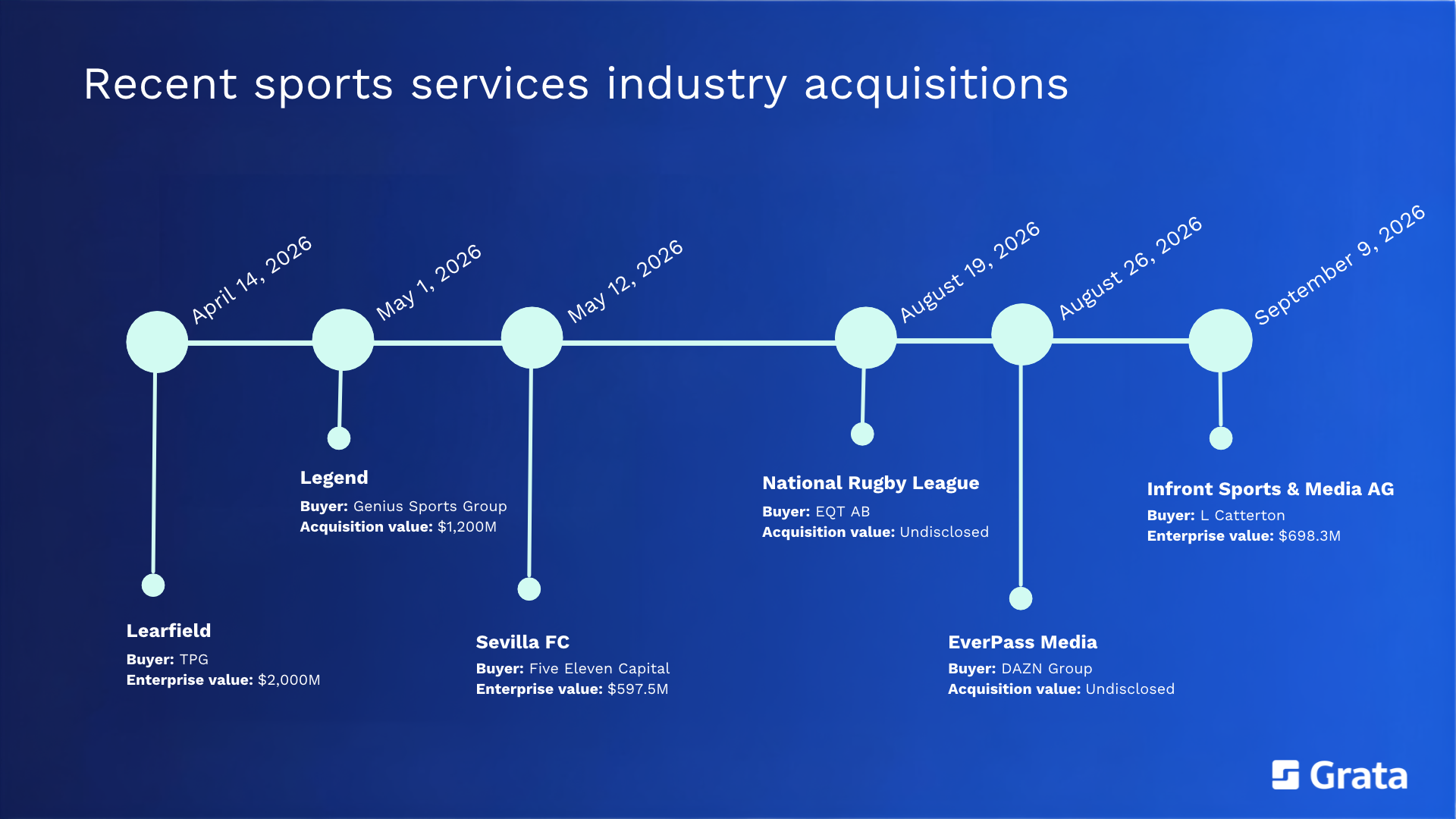
In April, TPG agreed to acquire a controlling stake in Learfield, the leading media and technology platform for college sports, in a deal valued at roughly $2B. Learfield connects more than 12,000 brands and over 1,200 institutions through sponsorship, media rights, ticketing, licensing, and NIL services, and its dataset spans more than 125M fan records.
If you’re an investor interested in companies similar to Learfield, try these:
In May, Genius Sports closed its acquisition of Legend, a digital sports and gaming media network, in a deal worth up to $1.2B. Legend owns properties including Covers.com, Casino.org, and Casino Guru. As a result of the deal, Genius Sports now operates both the official sports data feeds that power betting products and the media and advertising network that reaches users directly.
Also in May, an investment group led by former Real Madrid defender Sergio Ramos and backed by Five Eleven Capital reached an agreement to acquire a majority stake in Sevilla FC. The deal is one of a growing number of private capital transactions moving into European football club ownership.
If you’re an investor interested in companies similar to Sevilla FC, try these:
In August, EQT AB took a majority share of Melbourne Storm, one of the National Rugby League's top clubs. The deal extends EQT's existing sports portfolio, which includes IMG Academy. Terms of the transaction were not disclosed.
If you’re an investor interested in companies similar to Melbourne Storm, try these:
Also in August, DAZN acquired EverPass Media, the exclusive commercial distributor of NFL Sunday Ticket in the US. The deal gives DAZN a commercial distribution network across bars, restaurants, and hotels. EverPass will rebrand as DAZN for Business. Financial terms of the deal were not disclosed.
If you’re an investor interested in companies similar to EverPass Media, try these:
In September, a consortium led by L Catterton acquired Infront Sports & Media's majority stake in fitness competition brand Hyrox in a deal reportedly valued at $698.3M. Infront first invested in Hyrox in 2019 and became majority owner in 2022, helping the brand grow to more than 100 events and 1.4M participants in its 2025-26 season. Infront will keep its other endurance and mass-participation properties, including its stake in the Abbott World Marathon Majors.
If you’re an investor interested in companies similar to Hyrox, try these:
There are currently 21,629 companies in the sports services industry showing intent to sell. Of those, 932 are showing high intent.
There are also 128 actionable sports services companies in the Grata platform that have yet to be discovered.
Download our white paper to learn about how Grata’s Seller Intent surfaces key signals of transaction readiness months before the rest of the market.
Hundreds of active mandates are being showcased on the Grata Deal Network. If you’re interested in sourcing live deals in the sports services space, register to learn more here.
Are you a sell-side advisor interested in generating inbound leads for your data center infrastructure deal? Get started here.
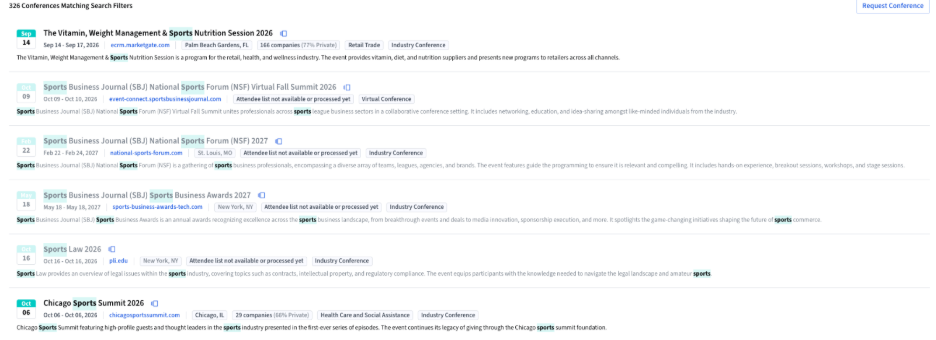
Grata makes it easy for dealmakers to find conferences, events, and trade shows in their industries. See attendee lists so you can set up meetings beforehand and make the most of your travel time. Check out which companies attended past events to find more potential targets.
Here are a few of the events related to the sports services industry that dealmakers can find and track in Grata:
If you’re an investor interested in making moves in the sports services space, Grata can help you put the insights in this report into action.
From in-depth market research to sourcing to pipeline management and relationship nurturing, Grata’s end-to-end dealmaking platform streamlines your workflows so that you can close more deals.
Schedule a demo today to get started.

Monthly tactics from Grata’s team and operators.
From market trends to career advice, Grata’s content fuels smarter decisions.

.png)
.png)

.webp)