In 2026, M&A software isn’t a “nice to have” for dealmakers — it’s an essential. Purpose-built platforms streamline workflows, power more efficient document management, and provide crucial data that supports smarter decision-making.
Below, we break down how M&A tools and AI software are changing the game for dealmakers, and identify the tools you need to know in the new year.
Why M&A Software Is a Game-Changer for Deal Teams
Private market data is notoriously difficult to find. The limited information that exists is often outdated, fragmented, or unverifiable.
Lack of visibility leads to inefficient workflows, which cost dealmakers time and money. They need a cohesive, data-driven picture of their market to build a strong pipeline and make smart decisions.
The right software can transform how dealmakers navigate each stage of the M&A process. From identifying potential targets to conducting due diligence, specialized platforms provide the tools and insights dealmakers need to make smarter decisions faster.
The Core Categories of M&A Tools
Not all M&A software tools have the same capabilities or tackle the same workflows. Here are the major types of M&A tools:
- Sourcing & Pipeline Management: These tools are designed to surface opportunities and help dealmakers track progress as they engage with targets.
- Due Diligence: These tools streamline the complex due diligence process by centralizing data, enhancing security, managing documents, and analyzing risks.
- Financial Modeling & Valuation: These tools help deal teams create detailed forecasts of a target company’s worth and financial future based on different scenarios.
- AI & Analytics: These tools provide crucial insights into markets and trends to help dealmakers assess opportunities and make decisions.
- Integration & Project Management: These tools centralize information and automate workflows to help teams navigate the integration process smoothly and efficiently. They track coordinate the many disparate elements in one place to enhance collaboration and visibility.
Top M&A Software Tools You Should Know in 2026
Grata
Grata is an end-to-end, AI-powered private markets platform tailored for dealmakers in investment banking, private equity, growth equity, and corporate development. It empowers users with investment-grade proprietary data to streamline and enhance deal sourcing workflows.
Key Features:
- Deal Sourcing: Grata’s AI-powered search capabilities allow users to search across 21M+ private companies using advanced filters and keywords. This enables dealmakers to identify hard-to-find, middle-market businesses that align with their investment criteria. Grata’s Conferences tool allows users to discover events in their industries, see attendee lists, and connect with other professionals to set up meetings ahead of time. The Autopilot feature keeps users updated on which conferences their targets are attending.
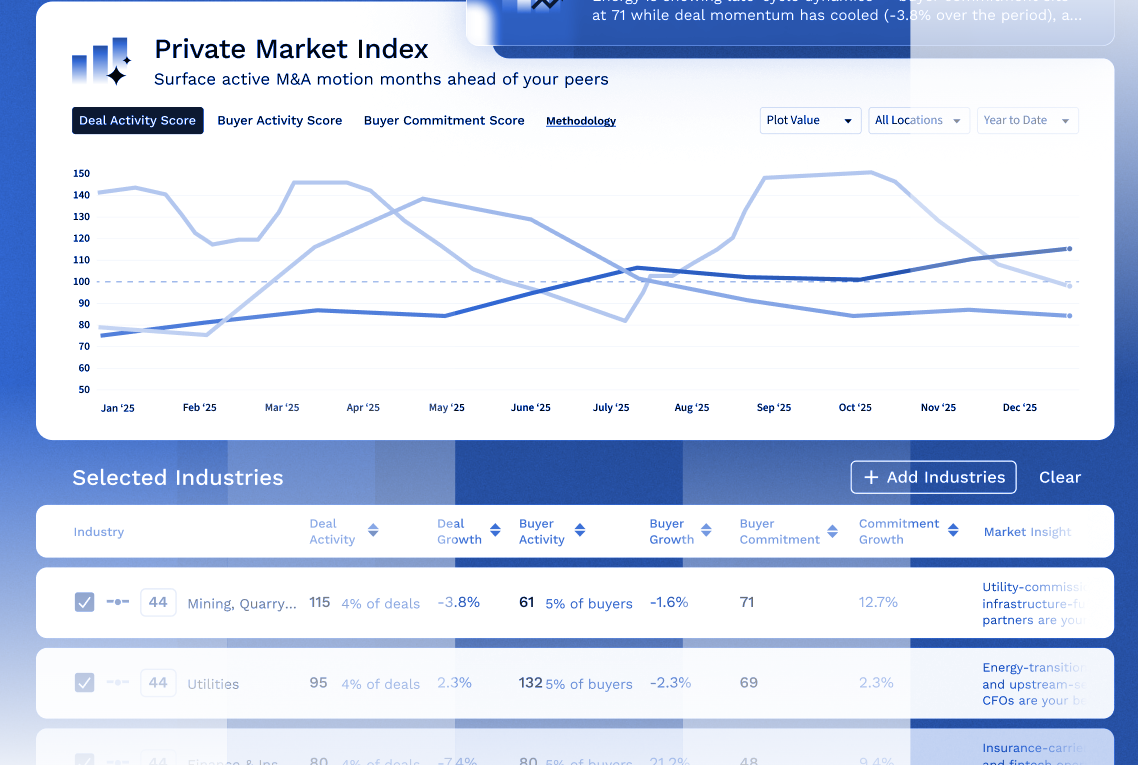
- Market Analysis: Grata’s Market Intelligence tool enables users to size markets, map out competitive landscapes, and see investment trends. With daily market updates, 70% of what the typical Grata user sees is unique.
- Agentic Search: Grata’s Agentic Search tool uses reasoning to understand the intent behind a dealmaker’s query. It uses this understanding to collaborate with the user and adapt as their needs evolve. The agent understands context and draws on Grata’s investment-grade data to quickly provide the most relevant information.
- Pipeline Management: Track your funnel, take notes, and set custom labels all while your data updates in real time.
- Collaboration, Communication, and Integrations: Grata integrates with major CRM systems like Salesforce, DealCloud, and HubSpot, allowing users to sync contact and company data, filter by CRM data, and prioritize outreach based on relationship strength and recent activity.
Datasite
Datasite is a secure M&A platform designed for managing complex transactions. It’s widely used by investment banks, corporate development teams, law firms, and private equity firms.
Key Features:
- Virtual Data Room (Datasite Diligence): Datasite’s VDR offers secure and seamless collaboration with integrated workflows and engagement tracking.
- Deal Pipeline Management (Datasite Pipeline): Establish your one source of truth with Datasite Pipeline. This feature helps teams oversee potential deals systematically and visualize pipelines with customizable dashboards. Real-time updates ensure a seamless workflow and informed collaboration.
- AI-Powered Tools: AI automates document indexing, search, and redaction to speed up review processes.
- Compliance & Security: Datasite meets the high security standards (ISO 27001, SOC 2 Type II, GDPR, CCPA) with multi-layered protection.
Blueflame AI
Blueflame AI is an agentic AI platform that unifies data, automates workflows, and accelerates decision-making across deal sourcing, diligence, market research, and fundraising.
Key Features:
- AI-Powered Tools: Blueflame functions as a real-time assistant that supports sourcing, diligence, and execution by generating executive summaries, market landscapes, and detailed company profiles from internal and external data. The platform can produce investment memos, diligence writeups, and company summaries from emails, CRM notes, pitch decks, and transcripts—cutting research and drafting time by 80–90%.
- Collaboration, Communication, and Integrations: Blueflame connects with systems like DealCloud, Affinity, Salesforce, and HubSpot to surface insights based on existing relationships, pipeline stage, or past touchpoints.
- Compliance & Security: Blueflame AI meets leading security and privacy standards — including SOC 2 Type II, GDPR, CPRA, and GLBA — to help your firm stay compliant and protected. The company was founded by cybersecurity experts who are equipped with decades of experience in protecting sensitive financial data and systems.
DealRoom
DealRoom is an M&A deal project management platform designed to simplify and accelerate complex transactions. It offers a centralized solution for managing due diligence, project management, and post-merger integration.
Key Features:
- Due Diligence Management: DealRoom’s dynamic virtual data room (VDR) enables secure document sharing, version control, and real-time collaboration. Built-in due diligence templates and request lists help streamline the process and ensure key tasks are completed efficiently.
- Pipeline and Project Management: DealRoom allows users to manage multiple deals simultaneously with pipeline tracking tools and customizable project dashboards. Task tracking, timeline management, and real-time notifications ensure deal progress stays on schedule.
- Post-Merger Integration Tools: The platform offers specialized features to manage integration workflows, including cross-functional task management, milestone tracking, and collaboration spaces for various teams involved in the integration process.
- Advanced Reporting & Analytics: DealRoom provides powerful analytics dashboards to track team activity, task completion rates, document engagement, and user activity. It offers dealmakers actionable insights at every stage.
- Security & Compliance: DealRoom is compliant with GDPR, HIPAA, SOC 2 Type II, and other global data protection standards. Role-based access permissions and encryption safeguard information throughout the transaction lifecycle.
Ansarada
Ansarada is an AI virtual data room and dealmaking platform built for the full transaction lifecycle. Trusted by dealmakers across M&A, capital raising, divestiture, and procurement, Ansarada combines secure document management with intelligent workflows that guide deal teams from preparation through to close.
Key Features:
- Virtual data room: Ansarada's VDR provides enterprise-grade security with granular permission controls, dynamic watermarking, and real-time activity tracking.
- AI assistant (Ask Aida): Ask Aida is Ansarada's built-in AI that helps deal teams extract insights from documents, answer due diligence questions, and surface risks faster.
- Bidder engagement and deal intelligence: Real-time bidder engagement data shows which documents are being accessed and by whom, giving sell-side advisors a sharper view of buyer interest and intent throughout the process.
- Compliance and security: Ansarada meets leading international security standards including ISO 27001 and GDPR, with infrastructure designed for the security requirements of global financial transactions.
Affinity
Affinity focuses on relationship intelligence and CRM-like tracking for dealmakers. Its key features include automated data capture, AI-powered network expansion, engagement history, and email and calendar syncing to create people and company profiles with fully integrated data.
Key Features:
- CRM: Affinity offers a CRM that is purpose-built for private capital. The tool offers relationship intelligence, automatic data capture, and purpose-built workflows.
- Data Enrichment: Affinity’s CRM integrates network, deal, and portfolio data across systems to empower deal teams to make decisions faster. Additionally, the Affinity API allows dealmakers to bring other data sources into the platform to drive consistency and efficiency across the dealmaking process.
- Pipeline Management: Deal teams can automatically add and organize deal information, interactions, and documents in a single place. Affinity allows users to track deal progress with automated status updates, custom priority fields, and a clear view of next steps.
AI Tools Are Changing the Game in M&A
AI in M&A workflows is no longer a foreign concept to dealmakers. Almost half of dealmakers (49%) use AI tools nearly every day, according to a recent survey conducted by Sourcescrub.
From the initial deal sourcing to post-transaction operations, AI tools are changing the entire M&A lifecycle:
Deal sourcing: AI-powered platforms can analyze millions of businesses and help dealmakers identify potential targets that traditional databases might miss.
Due diligence: Machine learning algorithms process vast amounts of data quickly, uncovering patterns or risks that might otherwise go unnoticed.
Valuation: AI models analyze multiple factors to provide more accurate and nuanced valuations, informing pricing and deal structure decisions.
Post-transaction integration: AI-driven analytics can track employee performance, customer satisfaction, and operational efficiency to provide real-time insights to management teams.
AI tools for M&A are evolving rapidly. Generative and agentic models will have a massive impact on dealmaking processes and the M&A world at large in the coming years. Firms that foster a culture of AI adoption and fluency stand to gain a huge competitive advantage over their less tech-savvy peers.
What to Look for When Choosing an M&A Tool
Choosing the right M&A software solution requires a clear understanding of your organization's specific needs and goals. Use these steps to help guide you through the evaluation process:
- Assess organizational needs.
- Determine the volume and complexity of deals your team handles.
- Consider team size and collaboration requirements.
- Identify critical areas where software support is essential — such as deal sourcing, due diligence, or integration management.
- Compare key criteria.
- Ease of use: Look for intuitive platforms that require minimal training.
- Security: Ensure the platform meets industry standards for data protection, including encryption and compliance certifications.
- Customization: Evaluate whether workflows, dashboards, and models can be tailored to fit your processes.
- Conduct vendor assessments
- Request demos to explore platform functionalities.
- Review case studies or testimonials to gauge vendor reliability and customer satisfaction.
- Check the level of customer support and availability of onboarding resources.
- Review features and pricing.
- Compare feature lists side by side to ensure the platform covers all your priorities.
- Understand the pricing structure — whether it's based on user count, storage, or deal volume — and request a detailed quote.
- Factor in scalability to accommodate future growth.
Embrace the Tech Stack of the Future with Grata
Grata's AI-powered private markets platform empowers dealmakers with investment-grade data and game-changing workflows. By combining forces with Datasite and Blueflame AI, we’re building the complete M&A tech stack of the future.
Ready to see how proprietary AI can supercharge your dealmaking processes? Schedule a demo to get started.

.png)

.webp)



.png)
.png)

.png)