Direct outbound sourcing means sending a lot of cold emails.
How do you, as an entry-level Business Development (BD) analyst, write emails to executives that not only get opened, but get responses?
Effective outbound emails are essential for sourcing deals and making a strong impression. So, let's take a look at the components that make up a great sourcing email, as well as some examples of real emails in action.
Here’s what you need to know about sourcing email templates.
The Email Components
Subject Lines: Grab Attention
Subject lines play a crucial role. It's simple: capturing the recipient's attention increases open rates.
There are generic best practices to follow regardless of the email's content, like keeping the subject line length to 9 words and 60 characters and avoiding spam words (Free," "$$," and "billion" just to name a few). But there are some M&A-specific guidelines to ensure a busy CEO clicks on your email.
Keep your subject line focused on the value your email is providing or the call to action. Are you able to introduce them to the CEO of one of your port cos? Lead with that. Are you looking for a meeting? Lead with that. Don't make the CEO guess the intention of your email.
Sample Subject Lines:
"Investor Intro"
"Meeting with [firm name]?"
"Series X interest?"
"Meeting at [event]?"
Openers: Engage and Connect
To capture the executive's attention, your opener should be direct, engaging, and purposeful. Avoid meaningless phrases and focus on these approaches:
Trigger-based Opener: Connect a recent development in the company to the potential for M&A opportunities. For example, acknowledge their recent funding round and express interest in their future rounds.
Commonality Opener: Do some digging to find shared experiences or connections that can create an immediate bond.
Credibility Opener: Showcase your firm's authority and expertise in the industry. Highlight past transactions and market research.
The Ask: Be Clear and Concise
Keep your ask short and make it easy for the CEO to respond. Avoid making them search for the call to action (CTA). Here are some examples:
"Let’s meet virtually for 30 minutes to discuss if this is a good fit."
"Let’s hop on a 15-minute call to discuss a partnership."
"Can we talk next week more about ways that [Firm Name] and [Company Name] could work together?"
Real Emails from Real Dealmakers
A great M&A email knows its value proposition and its audience.
Your value proposition should anticipate and answer objections while highlighting your unique selling points. Consider these key areas:
High Evaluations: If you can confidently offer more than anyone else, highlight your fund size or explain what you find valuable about the company.
Market Expertise: Demonstrate your knowledge with proprietary market insights and trends that inform your firm's investment thesis. Mention key features you're looking for in an investment that align with your target's profile.
M&A Experience: While your personal reputation is still growing as an entry-level analyst, leverage your firm's distinction and showcase a snapshot of your firm's M&A process. Include a quote from a CEO about your process to reinforce credibility.
Cold Outbound Email to Founders
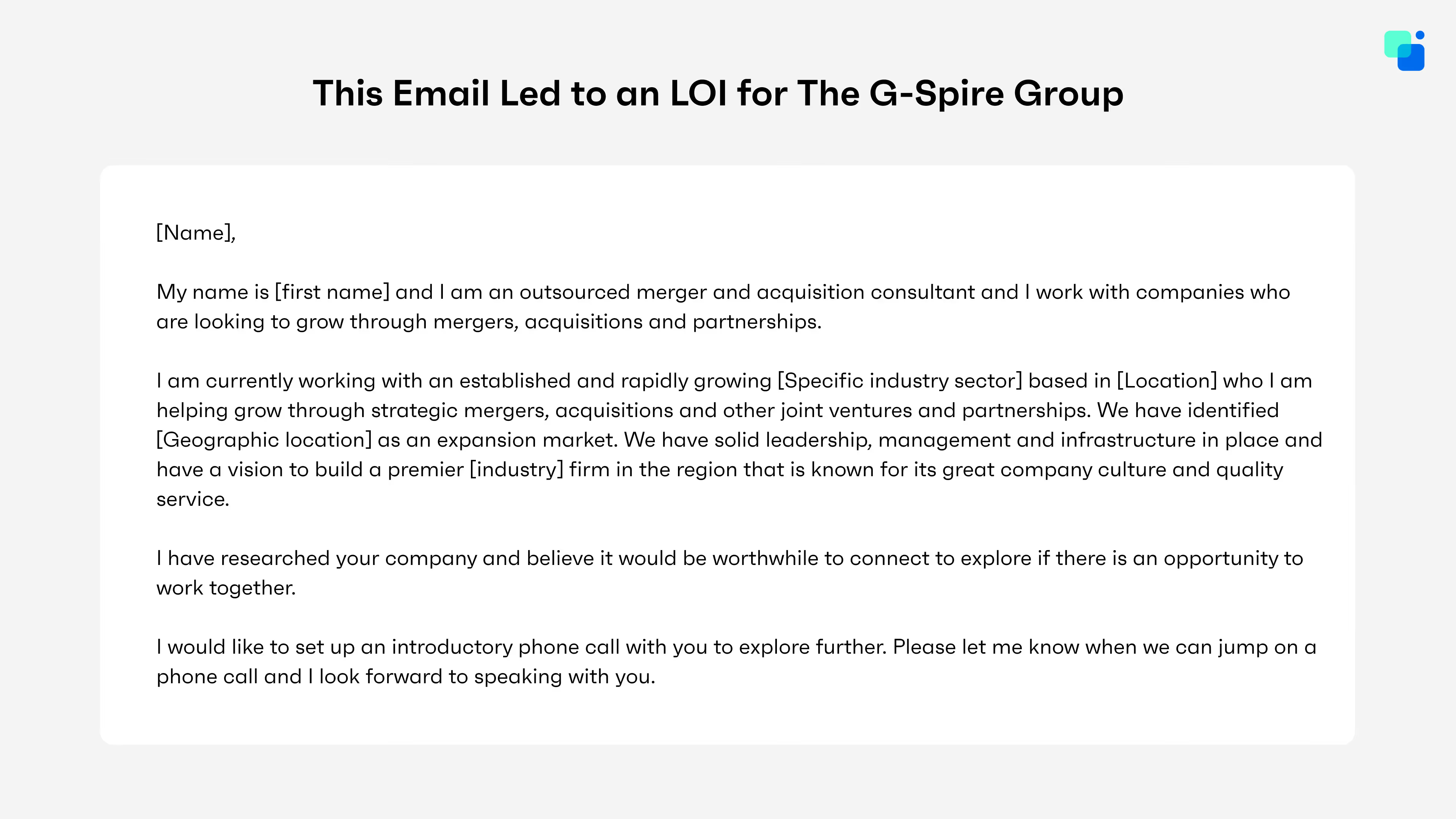
According to Ryan Goral, founder of G-Spire Group, “This email was based off a template. I did the research and reached out. Every word you send doesn’t have to be perfect, it just has to come across as personal and genuine.”
Here is his acquisition email example.
[cg_copy_to_clipboard_start="email-1"]
My name is [first name] and I am an outsourced merger and acquisition consultant and I work with companies who are looking to grow through mergers, acquisitions, and partnerships.
I am currently working with an established and rapidly growing [Specific industry sector] based in [Location] who I am helping grow through strategic mergers, acquisitions, and other joint ventures and partnerships. We have identified [Geographic location] as an expansion market. We have solid leadership, management and infrastructure in place and have a vision to build a premier [industry] firm in the region that is known for its great company culture and quality service.
I have researched your company and believe it would be worthwhile to connect to explore if there is an opportunity to work together. I would like to set up an introductory phone call with you to explore further. Please let me know when we can jump on a phone call and I look forward to speaking with you.
Depending on your firm and timeline, you may want to wait for a reply anywhere from 2-3 days to 1-2 weeks before reaching out again.
Here are two follow-up email examples to use in your next cold outreach.
Follow-Up Email Template #1
[cg_copy_to_clipboard_start="email-3"]
Dear [Co-founder 1] and [Co-founder 2],
I wanted to follow up on my note from last week regarding a potential collaboration between [Company] and our client — one of the world’s leading [industry] firms.
Given your leadership in [industry] and the impressive work you’ve done around [Industry hot topic A/B], we’re very interested in exploring whether there might be strategic alignment.
Are you open to a short introductory call to discuss further?
Looking forward to your thoughts.
[cg_copy_to_clipboard_end="email-3"]
Follow-Up Email Template #2
[cg_copy_to_clipboard_start="email-4"]
Dear [Name],
I hope you’re doing well. I’m following up on my earlier email about our client — a rapidly growing [industry] company expanding into [Geographic location].
Given [Company]’s reputation for [specific strength or niche if you know it], I’d love the opportunity to introduce our client and explore whether there’s scope for partnership, acquisition, or another way to work together.
Would you be open to a quick call in the next week or so?
[cg_copy_to_clipboard_end="email-4"]
Sending 2-3 follow-up emails is the most optimal strategy. The first follow-up email tends to be the most effective, boasting 40% higher reply rates than the initial email.
The Necessary Ingredients for a Great Outbound Email
How do you recreate their success? Here are the components you'll need.
Credibility or Commonality Opener - How do you grab their attention?
Value Add - What value can you offer them?
Personal/Firm Introduction - Who are you?
Ask - How do you want them to respond?
Demonstrating credibility or offering valuable connections is much harder for a junior BD early in their career.
What does a "Credibility Opener" or a "Value Add" look like for entry level BD analysts who are still building their M&A credibility?
"I've had the experience of having someone reasonably young who was extremely effective. It was a mixture of knowing a handful of the buzzwords, but it was courtesy and humility that really worked. You know, if you're a founder and you're receiving stuff, you'll see who it is that’s writing to you, and you'll see that they're young. You won't be thinking that this person's gonna write the check -- [CEOs] understand how it works. But, there are points at which it's appreciated, the courtesy and understanding, and having taken the effort to really get to know them. And I've seen it work many, many times." - Paul Dondos, CEO and founder of Artemis Origination.
See More Email Examples
Crafting strong outbound emails is a vital skill for entry-level BD analysts.
By focusing on attention-grabbing subject lines, engaging openers, clear asks, and compelling value propositions, you can increase your chances of sourcing deals and building meaningful connections.
From market trends to career advice, Grata’s content fuels smarter decisions.
AI & Automation
How Dealmakers Win Now That AI Is Table Stakes
Research from Financial Times Longitude and Datasite shows AI is becoming standard across M&A workflows. Learn why the next competitive advantage won't be the technology itself — but the quality and accessibility of the private market intelligence powering it.
The PE Playbook: Landscaping & Property Maintenance
Discover the need-to-know investment trends for private middle market dealmakers looking to make moves in the landscaping and property maintenance industry.
What's New in Grata Intelligence: Richer EU Data, Sharper Search & 50,000+ Dealmaker Profiles
Explore what's new in Grata Intelligence: richer European company data, faster semantic search, similar company discovery, and 50,000+ banker profiles.
How AI Agents Can Turn Institutional Knowledge into Deal Intelligence
Learn how AI agents pull an M&A firm’s internal data, memos, and diligence findings into one view and apply them to new deals, from sourcing through evaluation.